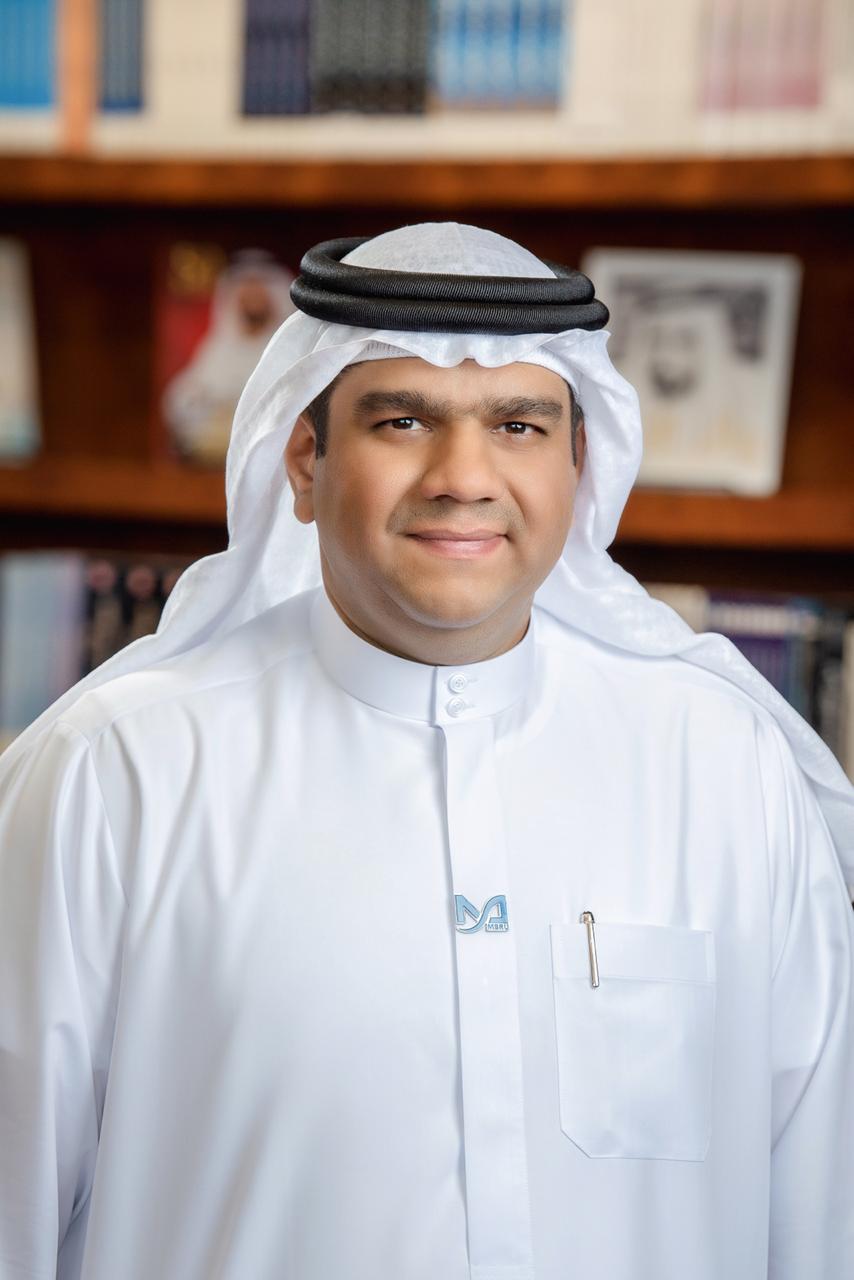
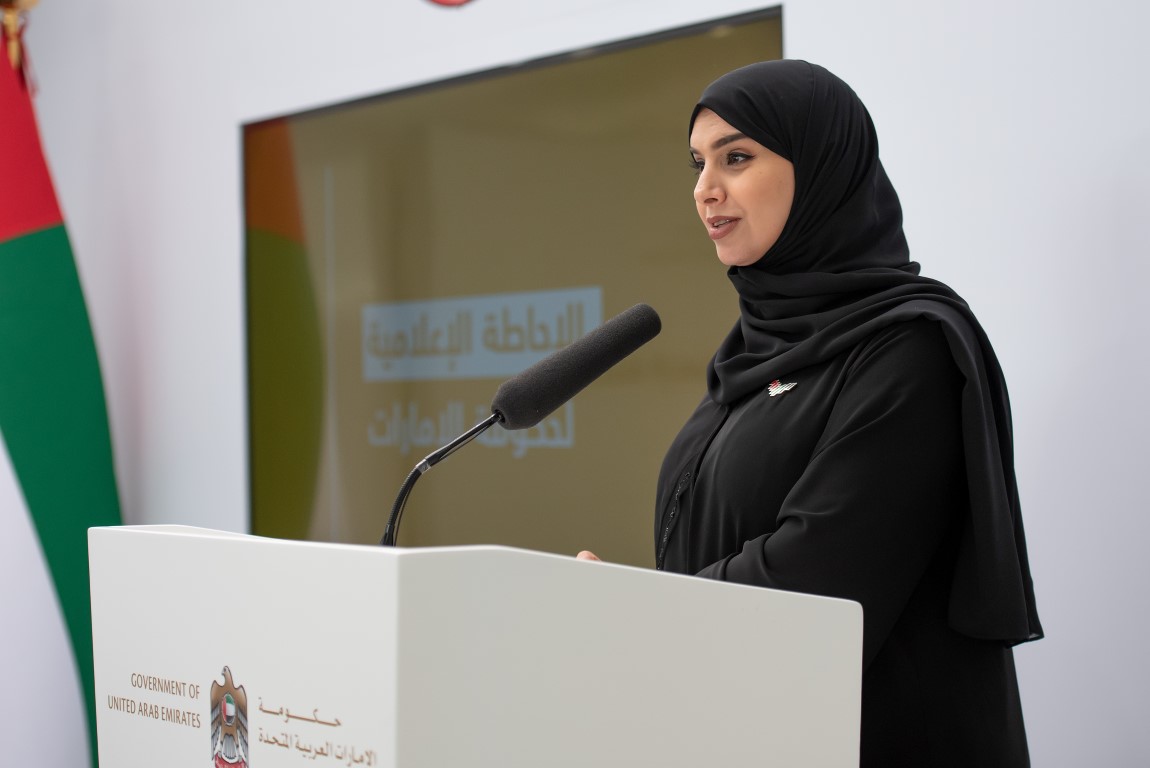
DUBAI, United Arab Emirates: Dubai appears to finally be on the road to overcoming the COVID-19 pandemic, according to the head of the city’s COVID-19 Command and Control Centre.
Dr. Amer Ahmad Sharif, command center’s chief noted that infection rate in the last three weeks has considerably fallen while hospital capacity is not anymore overwhelmed by a huge number of COVID-19 patients.
The announcement came more than a month after the UAE moved to ease COVID-19 restrictions and slowly started re-activating the economy with malls and restaurants coming back to life and hotel guidelines issued as preparations for re-opening.
Officials said there are approximately 500,000 Filipinos in Dubai, of which, the Philippine Consulate said, 50 Filipinos have died in the past months due to COVID-19
Meantime, in a media advisory issued this week, the government’s official information arm, Emirates News Agency (ENA), said these promising COVID results came on the heels of sustained precautionary measures and cooperation of both the public and private sectors, which helped Dubai achieve marked progress in curbing the spread of the virus.
The command center noted a decline in the number of identified cases and people with COVID-19 symptoms visiting hospitals in the last few weeks.
Dr. Sharif said there are a number of hospitals in Dubai that now do not have any COVID-19 cases while most government and private hospitals in the city have resumed diagnostic and treatment services, with their capacity not anymore under pressure due to COVID-19 cases.
Dr. Sharif said the results indicate Dubai is moving steadily towards overcoming the pandemic.
The command center’s head also said an analysis of indicators in the last three months showed a significant decline in COVID-19 cases. The rate of infections in the last three weeks, he said, has fallen considerably while the rate of recoveries has increased, according to ENA, which added that the number of cases requiring hospitalization likewise saw a decline.
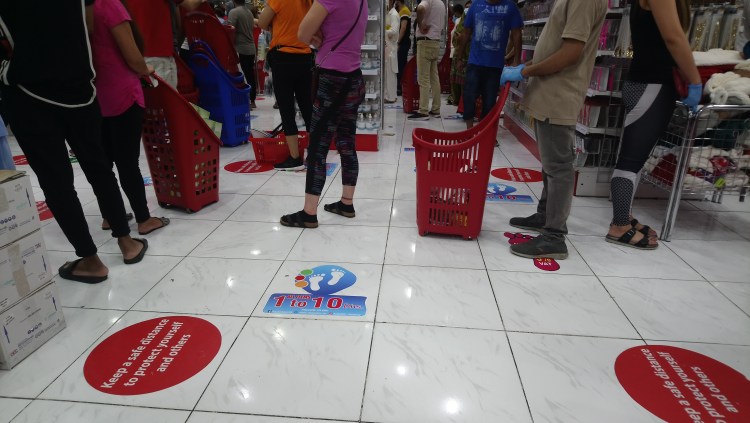
With all these promising developments, Dr. Sharif nonetheless stressed on the need for the public to continue following guidelines issued by local and federal authorities and adherance to preventive measures such as physical distancing and use of sanitizers.
According to latest updates by the Ministry of Health and Prevention (MoHAP), there were 43,752 COVID-19 cases across the UAE as of today, Friday June 19, following the detection of 388 new coronavirus infections.
MoHAP also noted that an additional 704 individuals have fully recovered from Covid19, bringing the total number of recoveries to 30,241, while three new deaths were reported, bringing the number of fatalities at 298.
Noticeably, the number of new COVID-19 infections has declined to the range of some 300 in the pasts days from the usual daily average of 500 detections.
There were 346 new cases on June 16, 2020; 342 on June 15 and 304 on June 14, MoHAP said.
Just last week on June 7, there were 540 new cases detected; 568 on June 8; 528 on June 9; and 603 on June 10. There were 513 on June 12; and 491 on June 13, still according to MoHAP as reported by the Emirates News Agency (WAM).
The UAE relatively also has the lowest COVID-19 fatalities with 298 of the 43,752 total cases.
(Main picture is that of Dr. Amer Ahmad Sharif, head of COVID-19 Command and ControlCentre. Photo courtesy of WAM)
DUBAI, United Arab Emirates: The number of new COVID-19 infections in the UAE has declined to some 300 in the past two days from the usual average of 500 detections, records from the Ministry of Health and Protection (MoHAP) showed.
There were 346 new cases today, June 16, 2020; 342 yesterday and 304 on June 14, according to the Ministry of Health and Prevention (MoHAP).
Just last week on June 7, there were 540 new cases detected; 568 on June 8; 528 on June 9; and 603 on June 10. There were 513 on June 12; and 491 on June 13, still according to MoHAP as reported by the Emirates News Agency (WAM).
The UAE relatively also has the lowest COVID-19 fatalities with 293 of the 42,982 total cases also as of today, June 16.
With these numbers, officials urged the public to remain vigilant against the virus, not be complacent and strictly observe social distancing.
(Main picture is that of Dr. Amna Al Dahak Al Shamsi, official spokesperson of the UAE government. Photo courtesy of Emirates News Agency)
The Department of Foreign Affairs (DFA) has repatriated 370 overseas Filipino workers (OFWs) who have either been stranded in UAE while on visit visas or terminated by their employers in the face of the coronavirus pandemic.
Consul General Paul Raymund Cortes
Consul General Paul Raymund Cortes, head of the Philippine mission in Dubai and its neighboring northern emirates, told reporters that the OFWs were on board Cebu Pacific flight 5J 19 which left Dubai International Airport at around midnight of June 15 and arrived in Manila around 1:30pm on the same day.
“For your information, the Philippines has chartered its first government-sponsored repatriation flight from the UAE. Some 370 passengers are booked for a flight from Dubai to Manila tonight June 15 at 0010H.
“The 370 is composed of passengers from Dubai and Abu Dhabi with about 80% from Dubai,” Cortes said.
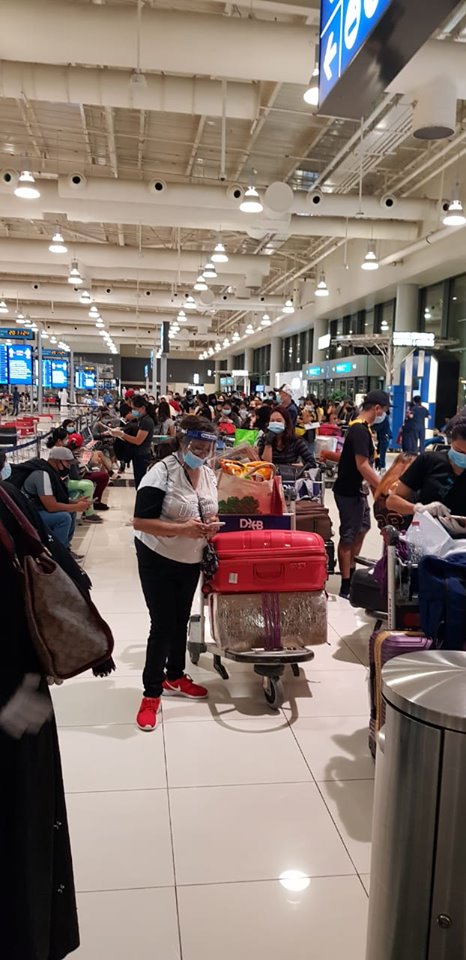
Part of the 370 repatriated OFWs at Dubai International Airport last night (Photo courtesy of the Philippine Consulate in Dubai)
He said around a third of the OFWs were on visit visa while another third were those whose employment visa has been cancelled by their respective employers.
UAE immigration policies require those with expired visit visas to have them renewed if they want to extend their stay; on the other hand, those whose employment/resident visas have been cancelled have 30 days to either look for a new job leave.
ABU DHABI, United Arab Emirates – Valid UAE resident visa holders who have been stranded elsewhere after the government suspended all flights back in March may now return to the country.
This is great news for thousands of overseas Filipino workers (OFWs) who were in the Philippines on vacation or business trips when the flight suspensions were imposed on March 24, 2020. The new policy directive aims to bring nearly 200,000 people back to the country, according to the Emirates News Agency (WAM).
“The return of foreign nationals to the country is part of the UAE’s humanitarian efforts in light of the current crisis. The focus will be on residents – representing 50% of the total of the current phase – to be reunited with their families,” WAM quoted Khalid Abdullah Humaid Belhoul, Undersecretary of the Ministry of Foreign Affairs and International Cooperation (MoFAIC) as saying in a media advisory issued today, June 13, 2020.
It also quoted Major General Mansour Ahmed Al Dhaheri, Director General of Identity at the Federal Authority for Identity and Citizenship (FAIC), as saying that: “This initiative came in implementation of the wise leadership’s directives to enable residents abroad to return to the UAE as part of a gradual return to normalcy.”
The application process
Returning UAE resident visa holders should register with the “Residents’ Entry Permit” service on the FAIC website (smartservices.ica.gov.ae.), and all requests will be answered within 48 hours, said the WAM advisory.
Upon receiving approval by e-mail from FAIC, the next step is for them to book a return ticket on the UAE national carriers or other airlines operating flights to the country.
Safety measures
Following arrival, returning resident visa holders will undergo a COVID-19 test and must self-isolate at home or undergo an institutional quarantine for a period of 14 days. Also, an approved app to track their health status will be used for public safety.
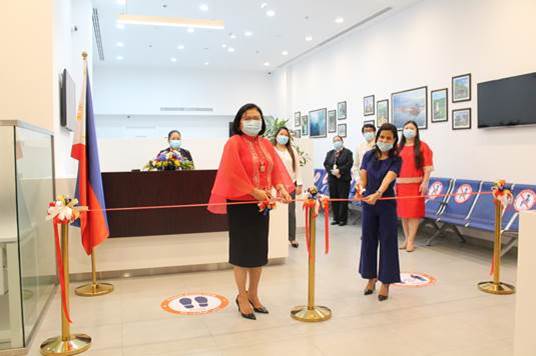
Philippine Ambassador to the United Arab Emirates, Hjayceelyn M. Quintana led the inauguration of the Passport Renewal Center (PaRC) at VFS Global in the World Trade Center in Abu Dhabi city. The inauguration coincided with the commemoration of Philippine Independence Day, which falls every 12th of June.
This is the second PaRC facility for Philippine passport renewal that is now operational in the United Arab Emirates. The first PaRC facility was opened in the Wafi Mall in Dubai on November 21st 2019 with the Philippine Secretary of Foreign Affairs, Teodoro L. Locsin, Jr. leading the inauguration.
The two PaRC facilities are operated by VFS Global. VFS Global is the world’s largest visa outsourcing and technology services specialist for governments and diplomatic missions worldwide. The establishment of the PaRC facilities in Abu Dhabi and Dubai are based on a Memorandum of Understanding between the Department of Foreign Affairs and VFS Global.
Philippine Ambassador to the United Arab Emirates, Hjayceelyn M. Quintana
“A befitting gift to Filipinos in the UAE on the occasion of Philippine Independence Day is the opening of the PaRC facility in Abu Dhabi. It is also very timely, given the need to reduce travel and observe strict physical distancing and other health protocols during the pandemic,” said Hjayceelyn M. Quintana, Philippine Ambassador to the UAE.
Filipinos now have an alternative location to go for passport renewal aside from the Philippine Embassy in Abu Dhabi. The VFS Global PaRC facility offers the convenience of weekend processing of passport renewal application because it operates on Friday and Saturday in addition to the regular working days from Sunday to Thursday. The facility is open daily from 10am to 6pm.
The new facility will start accepting Philippine passport renewal applications from 14 June 2020 and is located at Level B2, The Mall, World Trade Center, Khalifa Bin Zayed the 1st Street (Airport Road), Abu Dhabi. In line with the precautionary measures taken to curb the spread of Covid-19, appointment scheduling at the VFS Global PaRC facility has been made mandatory temporarily. Prior to personally submitting passport renewal application, applicants need to secure an appointment from VFS Global by visiting www.vfsglobal.com/philippines/uae/passport-services/index.html
DUBAI, United Arab Emirates: An 11-month-old boy ended up COVID-positive after adults at a flat, two of whom were unknowingly infected with the coronavirus, took turns cuddling him.
The baby was brought by his parents along as they visited friends at a shared accommodation in Karama. The parents, too, including two other occupants of the flat, eventually tested positive.
Eufracio Romero, Jr., father of the infant, Burj Hannter, said their baby, was once a regular at the flat, a three-bedroom unit with a common kitchen and bathrooms shared by nine people including their child’s babysitter.
“Si Burj kasi ay malapit sa kanilang lahat kaya love na love nila si baby,” said Romero.
“Sa kanila na kasi lumaki si Burj, kaya sumigla ang bahay nang dumating siya sa kanila. Minsan nga ayaw pa ibigay sa amin kung susunduin na namin. Kaya happy din kami, kasi alam naming mag-asawa na mahal nila ang baby namin,” said Romero, a formwork engineer. His wife, Zeny, works as office administrative officer at a real estate company.
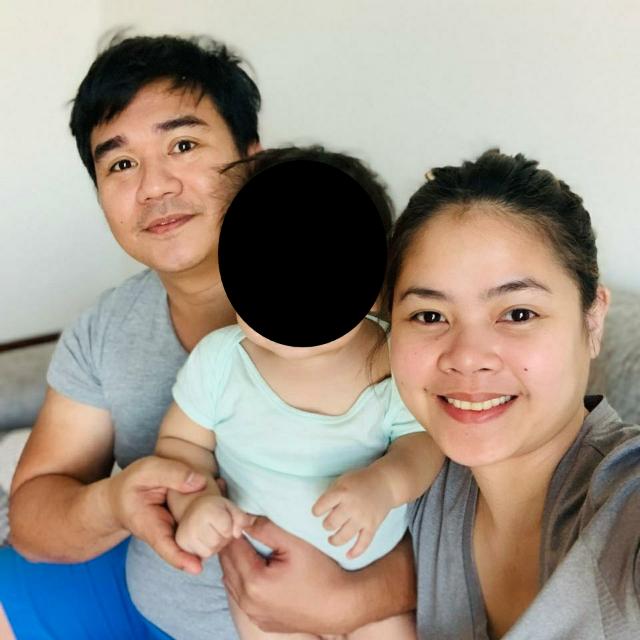
Eufracio Romero, Jr., father of the infant, Burj Hannter, and wife, Zeny. (Contributed photo)
“Worried po talaga kami para sa baby, lalo na’t 11-months old lang siya. Hindi namin alam kung may nararamdaman siyang kakaiba or may masakit ba sa kanya,” said Romero, recalling the days when he and his wife started experiencing symptoms following the series of visits to the flat.
“Kahit pareho kaming may mga sintomas, si baby pa rin nasa isip namin,” he said.
The couple took a swab test after being asked by a close friend, Jolly Milette Santo Zulueta, who also stays in the same shared accommodation they were visiting at, to do it after she herself, and another flat mate, tested positive.
Zulueta, 43, a flower shop operations manager traced her coronavirus infection to two of their flat mates staying in one of the rooms. Zulueta lives with her husband, Richard, a communications director at a skills training company.
The two flat mates, who were among those playing with baby Burj during the Romeros’ visits, tested positive after they started reporting back for work in the last week of April. They have not undergone tests at the time of the Romeros’ visitations, and were among those who cuddled and passed baby Burj around, according to Jolly Milette.
“We had one major concern,” Jolly Milette said. “During those days (in April and May) our friends (the Romeros) frequently visited us with their baby (Burj Hannter). We called them up and convinced them to do swab test as well, and on May 20, they got their results na lahat sila positive,” she said.
“Naging bola kasi namin lahat si baby; pasa pasa then lahat kami kumakarga,” she said.
In all, four of the flat’s nine occupants got the COVID: the first two, who were living together in one of the rooms, and were admitted to the hospital on May 12 and May 15 respectively; Jolly Milette; and another flat mate.
The remaining five occupants, including Jolly Milette’s husband and the babysitter, tested negative.
The first two positive cases were discharged on May 26 and May 28.
Jolly Milette and the Romeros were taken by a medical team from the Dubai Health Authority (DHA) to an isolation center in a hotel near the Al Maktoum airport on May 23.
The Romeros were discharged on May 31; Jolly Milette, on June 2.
“Mas kinakabahan kami para sa baby nung nandito pa kami sa bahay,” said Romero. They were staying a floor below Zuluetas in the same building in Karama.
“Pero nang nakuha na kami at nadala na kami sa isolation, nakita naman namin kung paano ang care sa amin ng mga nurses at doctors duon, kaya naging panatag ang loob namin,” he said.
The Romeros were from Sibuyan, Romblon.
In Dubai, most married overseas Filipino workers (OFWs) leave their infants to friends doubling as babysitters during the day to save on cost incurred should they leave them at care centers instead.
DUBAI, United Arab Emirates: Whenever calamities hit home, overseas Filipino workers (OFWs) in the UAE are quick to pass the hat.
But what happens when they themselves are faced with a whammy like the current COVID-19 pandemic?
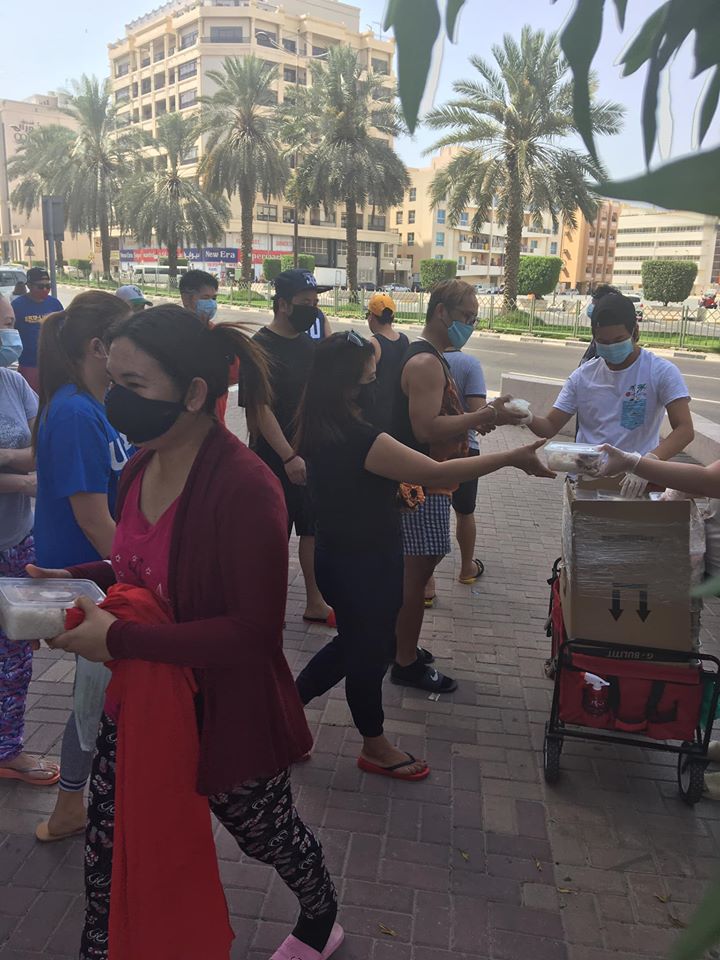
Feby Cachero Baguisa Dela Peña and his team handing out free meals. (Facebook grab with permission)
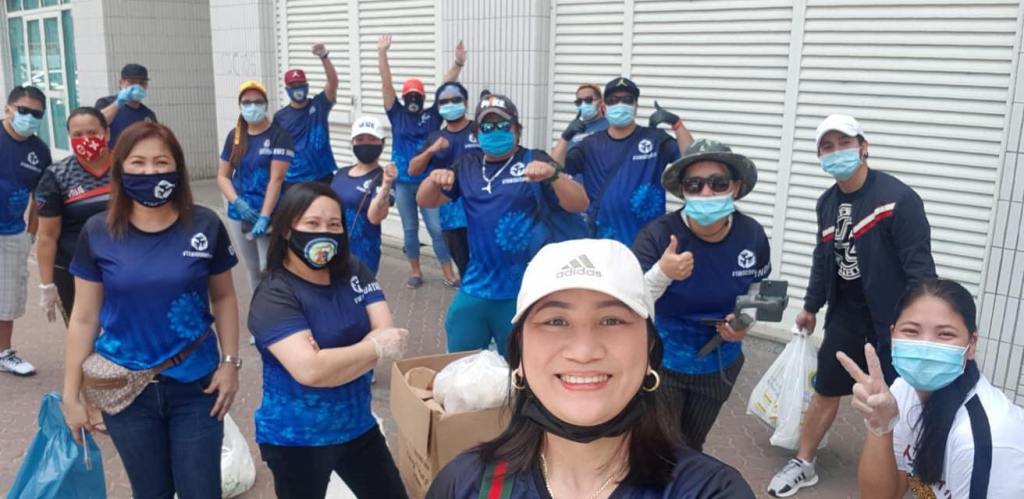
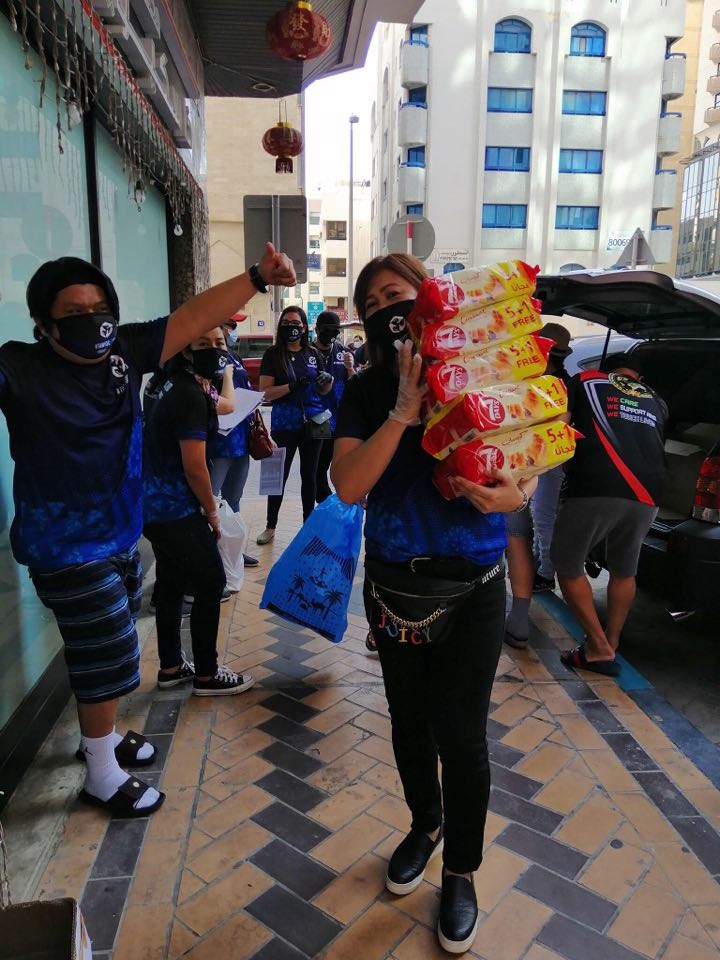
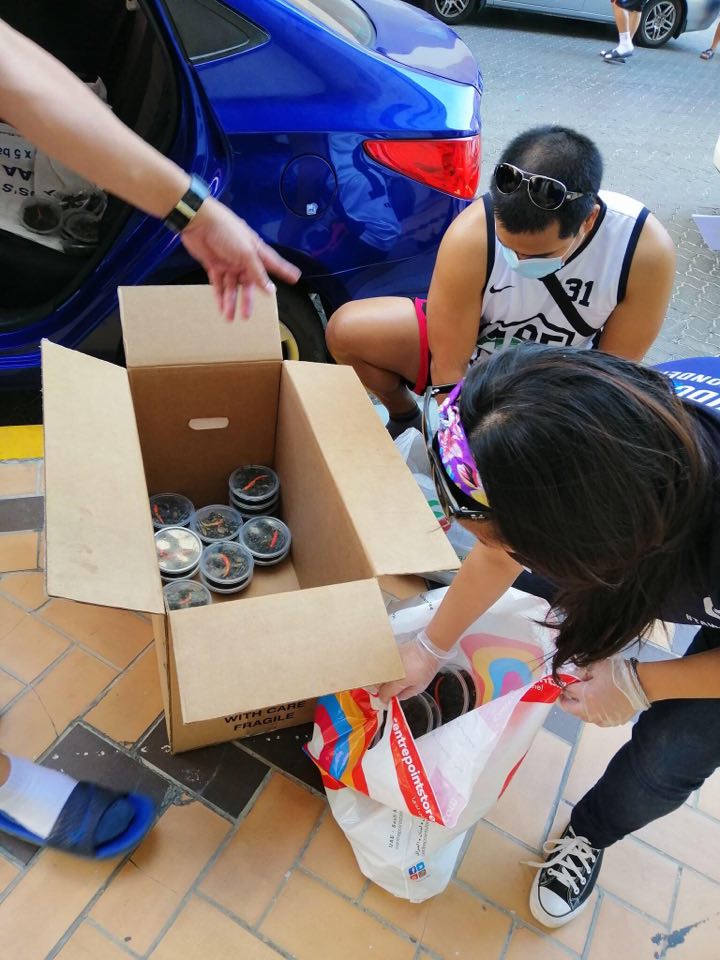
They stick together – preparing hot meals they give for free and bartering pre-loved items for groceries to donate to those who lost jobs, were on no-work-no-pay arrangements, or have their salaries reduced.
The bright side is that there seems to be no shortage, so far, of Good Samaritans as more and more Filipinos, including some of the jobless, themselves, step up to the plate and help fellows who have hit rock bottom.
Among them is 47-year-old Arnel Fernandez, a sales support executive who has been in Dubai for the past 21 years and who said the current situation is unprecedented.
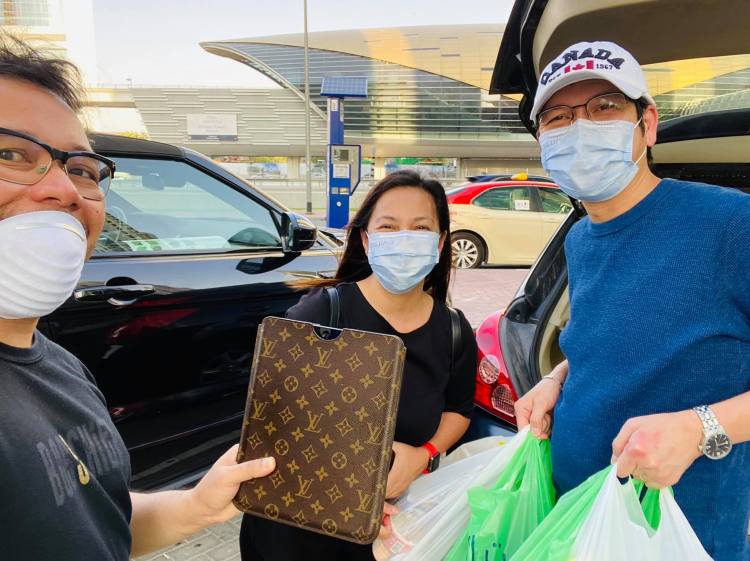
Arnel Fernandez with his car load of free groceries (Photo grabbed from his FB with consent)
“Ito ang worst,” he says. “Mayroon nang tulungan dati pa, pero di ganito,” he added.
Indeed, as the UAE economy begins opening up, individual humanitarian efforts have correspondingly started multiplying among OFWs, who note it might still take a while before businesses regain steam and normalization sets in. This because a vaccine against the coronavirus has remained elusive.
Mobile food station
Fernandez regularly drives around Dubai, his car loaded with grocery or packed hot meals. He’d pick a spot and then announce on his Facebook account where he is, so that people in the area could rendezvous with him for the deliveries.
It’s a risky undertaking, considering his age and that he could be exposing himself to COVID asymptomatic people.
Weeks ago, he spent the entire month’s rent payment for a partitioned room he has on relief groceries and gave them for free.
Arnel Fernandez and wife, Japrille.
“Never ako nag-stop kakaikot, maglala-live (on Facebook) para alam nila na mamimigay ako. Di ko po alam bakit ko ginagawa ito. Alam ko lang po makatulong kahit papaano para walang magutom at bawas-isipin na rin sa mga kababayan natin ang pagkain nila. Masaya po ako sa ginagawa ko,” Fernandez said.
He added that fellow Filipinos, including his peers, have also been donating for his cause. “Kaya nangyari ‘pag pawala na, may papabili at idagdag nila. Ayun, tuloy ulit. Till now, walang araw na huminto ako,” Fernandez said.
“Ulam po minsan nagpaluto ako. Sinaing at tulingan sinasama ko na sa relief. May bigay ang ibang kaibigan na sinasabay na din namin like tocino, puto, kutsinta and ensaymada.
“Hanggat kaya ko po at may nagpapasabay na isama sa tulong ang bigay nilang bigas at de-lata siguro di kami titigil,” Fernandez added. He said his wife, Japrille, has been supporting him financially.
He said he will continue with his support drive so long as he is healthy.
Jobless mom cooks hot meal for the jobless
Feby Cachero Baguisa Dela Peña and friend at their post in Muraqqabat. (Facebook grab with permission)
Feby Cachero Baguisa Dela Peña, 34, who used to be office coordinator and hygiene manager at a gelato company, has been jobless since 2017.
These days, she can be seen in Muraqqabat, Deira which is north of Dubai, handing out hot meals – usually adodo, a homegrown Pinoy comfort food.
She started giving free food during the recent Eid Al Fitr, which marked the conclusion of the month-long Ramadan. “Nakita ko po kasi mga Pinoy, nakapila sa free food, kaya naisip ko na bakit di na lang kaya ako magluto at mamigay? Filipino food pa ang makakain nila,” Dela Peña said.
Free food for all. (Photo grab from Feby Cachero Baguisa Dela Peña’s Facebook with permission)
She routinely goes to bed at around 3am after being done preparing the next day’s meal’s food ingredients; she gets up at 8am to cook, would be done at around 2:30pm and is usually at her spot along Muraqqabat just outside her place by 3pm. By 4:30 pm, she and her team are done giving away the day’s hot meal. She goes home, gets some rest and repeat the cycle.
Photo grab from Feby Cachero Baguisa Dela Peña’s Facebook with permission
It’d usually be some 30 kilos of chicken, 150 eggs boiled or fried and 25 kilos of rice mostly donated by fellow Filipinos who have gotten word of her good deeds.
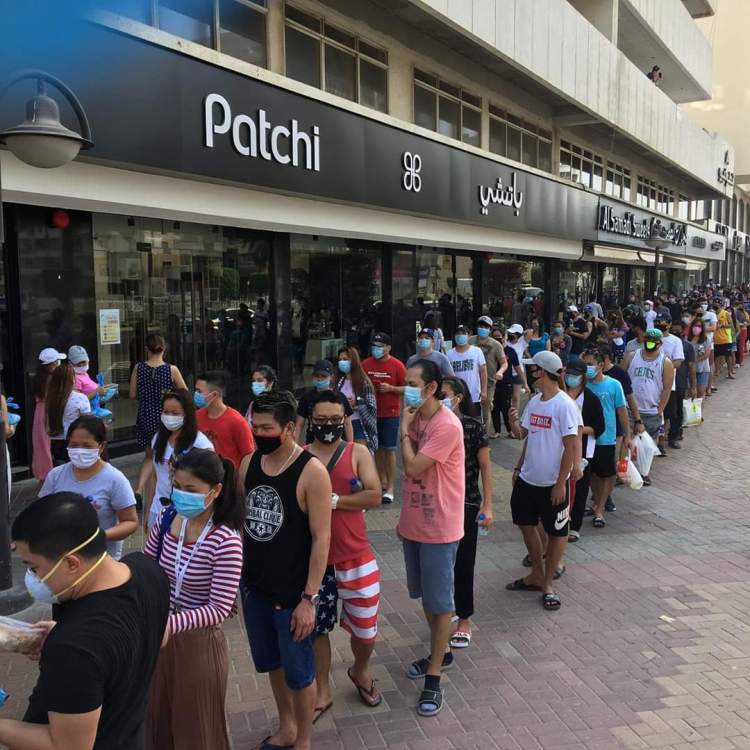
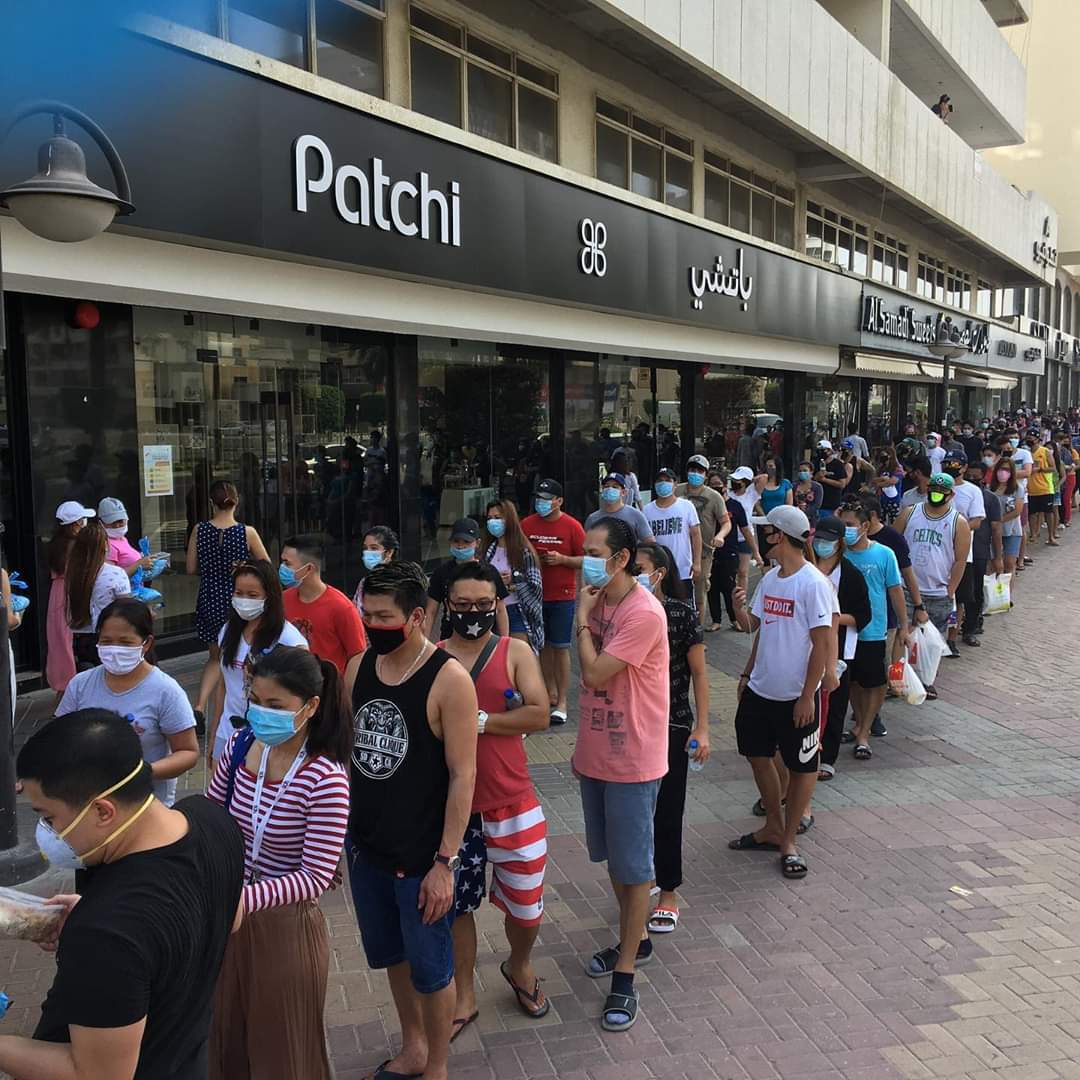
Around 170 OFWs queue in for the food every day, Dela Peña said.
Free food for all. (Photo grab from Feby Cachero Baguisa Dela Peña’s Facebook with permission)
“Regular na po silang pumupunta. Lahat yang 170 na yan,” she said.
“Paano tayo titigil sa pagtulong. Sa panahon ngayon, ito ang inaasahan nila para makakain. Kanina si ate napa-iyak sa harap ko habang kausap ko siya. Alam niyo po mga kabayan, wala po akong ibang hangad kundi maibsan ang bigat na inyong nararamdaman. Kahit sa simpleng pagkain sanay mapasaya namin kayo. Laban lang po tayo,” Dela Peña once said in her Facebook post.
‘New normal’
Dr. Rex Venard Bacarra, Dean of General Education at the American College of Dubai, is also among a growing number of OFWs engaged in humanitarian missions for their fellow OFWs like it’s the “new normal.”
“Ang daming nangangailangan,” he said.
Like Fernandez, Bacarra would usually announce a rendezvous on his Facebook.
“What I usually do is look at the comments section of different Filipino pages. Then if I see someone who really is in need, I message and offer assistance,” said Bacarra, who onced bartered his Louis Vuitton monogram iPad cover for two small grocery bags of Filipino food for donation.
“It has to be done. Especially here in the UAE. Generally, Pinoys come here to provide for their families, kaya mas mataas ang chance to be depressed. Wala na na ngang maipadala, wala pang work,” the university professor said.
Dr. Rex Venard Bacarra, Dean of General Education at the American College of Dubai handing out his LV for groceries to be donated. (Photo from his Facebook taken with permission)
The LV monogram IPad deal was consummated through a Facebook barter page – the Amicable Barter Community in Dubai (ABCD), recently opened by Lou Olvido Parroco, herself an OFW who now works as a life coach, along with husband, Cesar, a digital marketing & training manager.
Photo screen-grabbed from ABCD Facebook
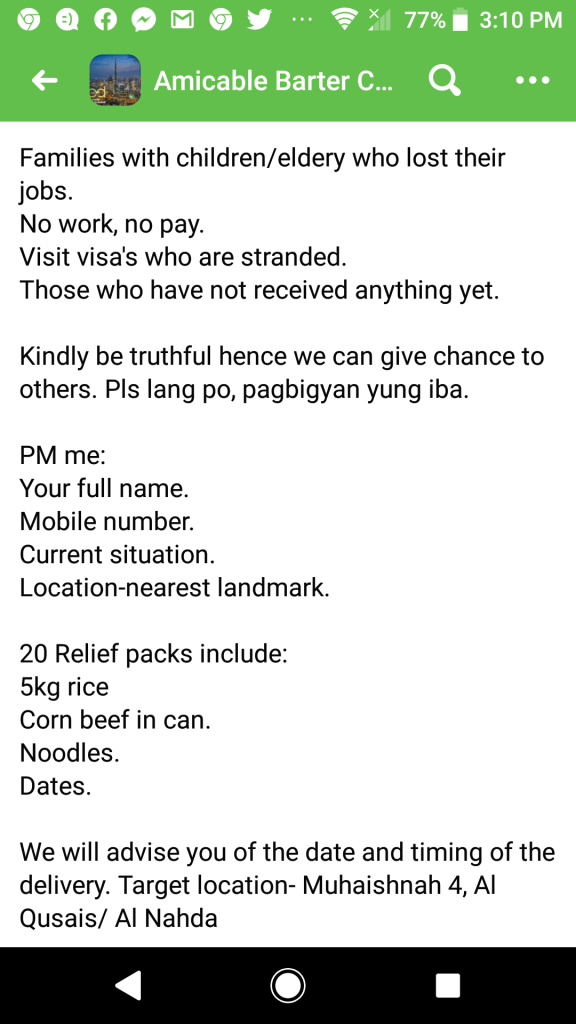
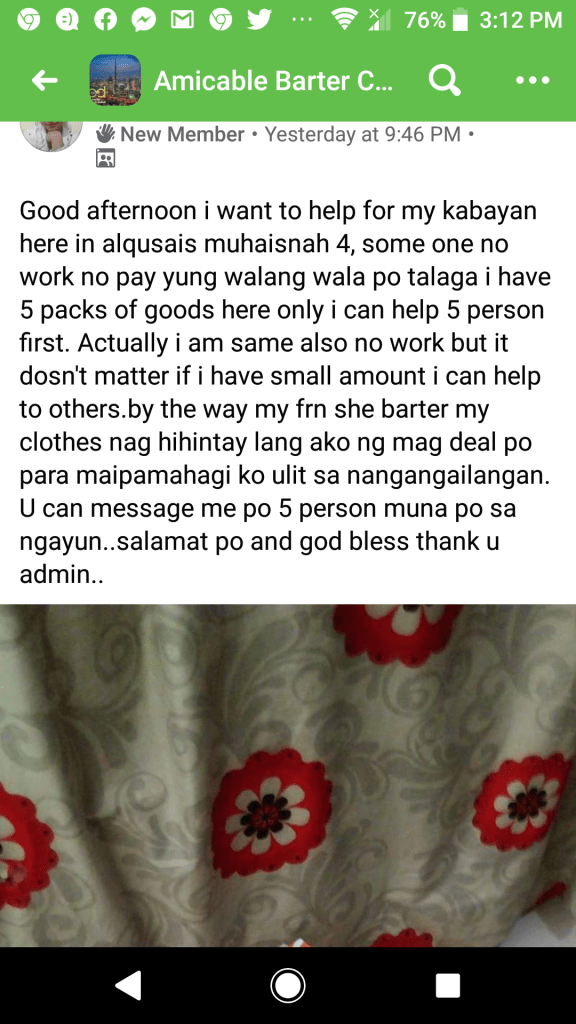
The concept was simple: Post a picture of an item and indicate what you want to barter them for. But a lot of OFWs have gone a notch higher and used it as a platform for their humanitarian cause. And so, one would regularly see posts about pre-loved items being bartered for groceries for the jobless.
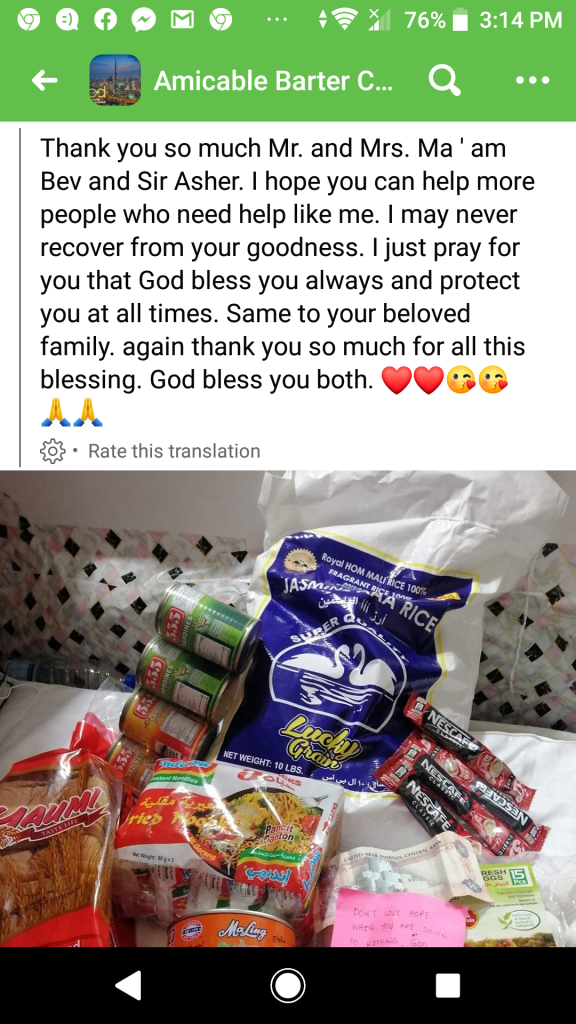
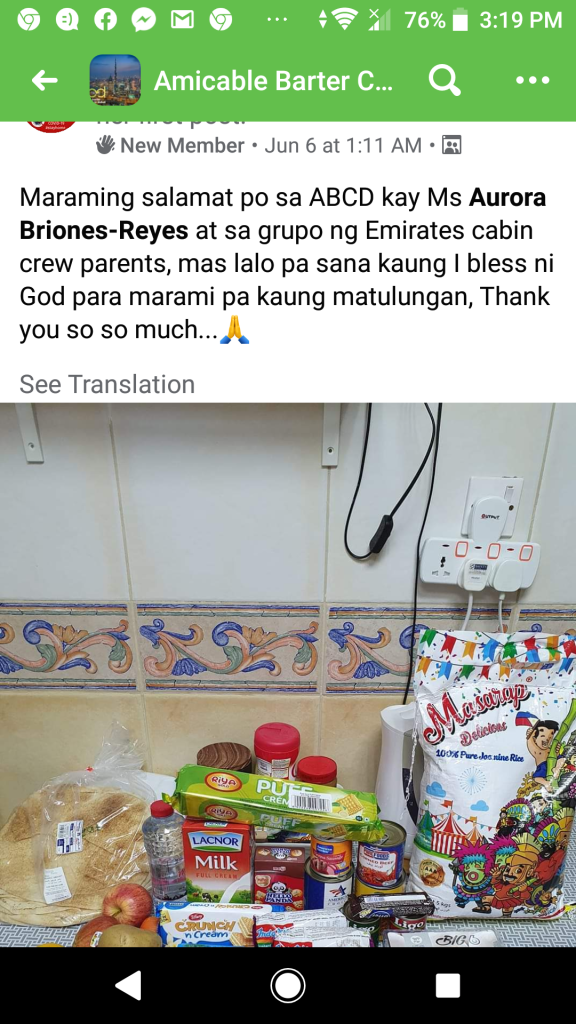
Bacarra, who has also been receiving grocery items for donation, has been posting pictures of beneficiaries receiving them. “I just felt that I needed to start posting for the sake of transparency. Two-fold, actually. For people to be aware and be inspired to do the same,” he said.
Photo screen-grabbed from ABCD Facebook
“There are a actually many who are giving food items to me. I wasn’t just posting since people might misinterpret, but then habang dumadami, I needed to be transparent. And also, the good works of others, those who give, should be known. As I always say- light shouldn’t be hidden,” Bacarra added.
Among the hundreds of OFWs who have gotten grocery supplies through the ABCD barter club is Marie Bernadette Jacobo Ortiguerra, a hotel marketing manager who live with her husband, also a hotelier, and their children in Dubai.
Marie Bernadette Jacobo Ortiguerra (Contributed photo)
“I work from home at 30% lang from the basic salary ang natatanggap ko; 70% ang kaltas. Nakaka-iyak po,” she said, adding that she was overjoyed when ABCD approved her barter proposal from which she got essentials for her young ones.
“Malaking tulong nagagawa sa amin ng ABCD talaga, napapa-barter ko yung mga gamit namin na bibihira nagagamit, then kapalit po any milk and diaper ng bunso ko,” she said, even posting what she received on the ABCD Facebook page and thanking everyone. Her “bunso” is four-and-a-half years old.
Her husband, she said, has been getting a mere half of his basic salary every month. “Every month, kalahati lang nung basic salary nya though meron pong housing allowance. Hindi pa alam kung hanggang kelan po ito,” Ortiguerra said.
Photo screen-grabbed from ABCD Facebook
Team #ayudanatics
Another offshoot of ABCD is the newly formed Team #ayudanatics, a group of tenpin bowlers, among them Albert Alba, a public relations professional, with Mario Rivera, Liza Castro and Uella Marcial, who have all agreed to collectively seek donations and distribute them, first to their bowler friends and staff at the bowling center and on to other distressed OFWs.
Albert Alba, second from left, and the #ayudanatics (Contributed photo)
It all started with Alba bartering his aquarium for eight bags of 5-kilo rice, eight trays of egg and eight frozen chicken thighs at ABCD because he, at the time, had eight distressed OFWs on his list.
“From the proceeds ng barter, marami ding nag-message, so nagdagdag na rin ako from my own pocket. Hangga’t may nangangailangan at may sources pa rin naman ng maitutulong, tuloy lang. When I say sources, I mean either from future barters, donations from friends or, kung kaya, kaunting sariling purchase din,” Alba said.
He expressed hope that Dubai’s opening is not hampered “kasi unless magkaroon na ulit ng income yung iba or magka-work na yung mga nawalan ng work, then kailangan pa din nila ng tulong.”
The Philippine government has launched a repatriation program for OFWs. In the UAE, priority is given to those who are on visit visa; those terminated by companies or are on a no-work-no-pay set-up have their employers to run to for help as mandated by law.
Still there are a lot too, like Ortiguerra, whose salaries have been slashed as per provisions of the UAE Minister of Human Resources and Emiratisation’s (MOHRE) Ministerial Resolution No. (279) of 2020.
The resolution pertains to the “stability of employment in private sector companies during the period of…precautionary measures to contain the spread of the novel coronavirus” in the UAE.
The resolution, issued on March 26, 2020, allows for some measure of flexibility in employment and hiring practices.
Nurse on food relief drive
In Abu Dhabi meantime is a school nurse, Mary Margarete “Em” Serrano, who has been on leave since the first week of March as schools have then closed and will re-open by August.
Mary Margarete “Em” Serrano (Contributed photo)
And so on her free time, Serrano has embarked on her own little way of helping displaced OFWs by being a middle person doing the leg work between donors and beneficiaries.
This, in the meantime, as she awaits a call from the government-run, Abu Dhabi Health Services Company, or SEHA, the English phonetic pronunciation and translation of the Arabic word for “health,” for her to do hospital duty.
“Ina-absorb po ako ng SEHA to work for COVID patients. Naghihintay ako ng call for hospital assignment,” Serrano said. SEHA manages eight hospital systems.
A vlogger, Serrano started her advocacy work also in March. “Tapos nang nilabas ko sa vlog ko about free meals, lalong dumami ang humihingi ng tulong sakin sa page ko at personal account. Kaya araw-araw naghahanap ako ng sponsor para may mai-tulong po sa mga kabayan. Lalo na Yung mga may baby,” Serrano said.
Mary Margarete “Em” Serrano (Contributed photo)
She doesn’t run out of donors, which enables her to branch out to distressed OFWs to neighboring Dubai and even as far as Sharjah, which is about three hours’ drive from Abu Dhabi. “Filipinos lahat ang sponsors ko,” Serrano said.
Buying groceries and taking them from sponsors to be repacked then distributing them at a drop point every day can be exhausting, not to mention the risk of getting the virus, but Serrano said it keeps her running to know that she has been of help.
“Hindi po ako makakatulog sa gabi knowing na may baby na walang gatas o may kabayan na ilang araw nang hindi kumakain. Ginagawa ko po ito to help our kabayan kase alam ko po pakiramdam ng walang-wala. At sake sa panahon ngayon, dapat talaga magtulungan,” Serrano said.
Tawid-COVID food drive
Also in Abu Dhabi is Laliebeth Petancio, an OFW spearheading Tawid-COVID Correspondents (TCC), composed of a group of volunteers helping each other in coming up with a bulk distribution of care packs from donations of friends, aside from rolling out a “Weekend’s 300” packed foods that TCC members themselves cooked and prepared.
TCC volunteers converge for instructions before heading to their assigned areas. (Contributed photo)
“It is a collaborative effort of the volunteers. Some have their connections of sponsors and we come up with a unified listing for distribution,” said Petancio, finance administrator at an oil and gas company, who regularly takes official leave of absence on Thursdays for her community service.
Since March, relief efforts have been continuous with both dry goods and food packs being handed out on a weekly basis. Some group-members of TCC do relief operations on weekdays when it is necessary to send packs to those OFWs who need urgent help.
TCC members prepare their relief assignments prior to unified distribution (Contributed photo)
“Aside from cooked food weekly, meron batches din ng groceries from a group of sponsors tapping with the Tawid-COVID correspondents,” she said.
Petancio said over 3,500 distressed OFWs in Abu Dhabi have benefitted from their food and grocery drive.
Contributed photo
“I am just amazed that a lot out there can really respond even if you don’t ask them for help, and most of all, for the trust that I have gained from them (donors) nakakamangha naman,” Petancio said.
‘Don’t give up’
Meantime, One Carlo Diaz, who works at Dubai Media City, says reaching out to those in need is a way of telling them not to give up.
One Carlo Diaz (Facebook photo taken with permission)
“I saw that many Filipinos have been asking for help because they have lost their jobs due the pandemic, and has since haven’t gotten any source of stable income to sustain themselves,” said Diaz, who at 23, has also been doing his share of distributing free food.
“I believe that the immediate relief food packs give can really go a long way. It’s a simple gesture that I hope would remind people to never give up, especially as we all struggle to overcome the pandemic away from our families,” he added.
Spending out of his own pocket, Diaz said friends have been considering pooling their resources with him and looking for donors so that more could benefit.
Ajman drive
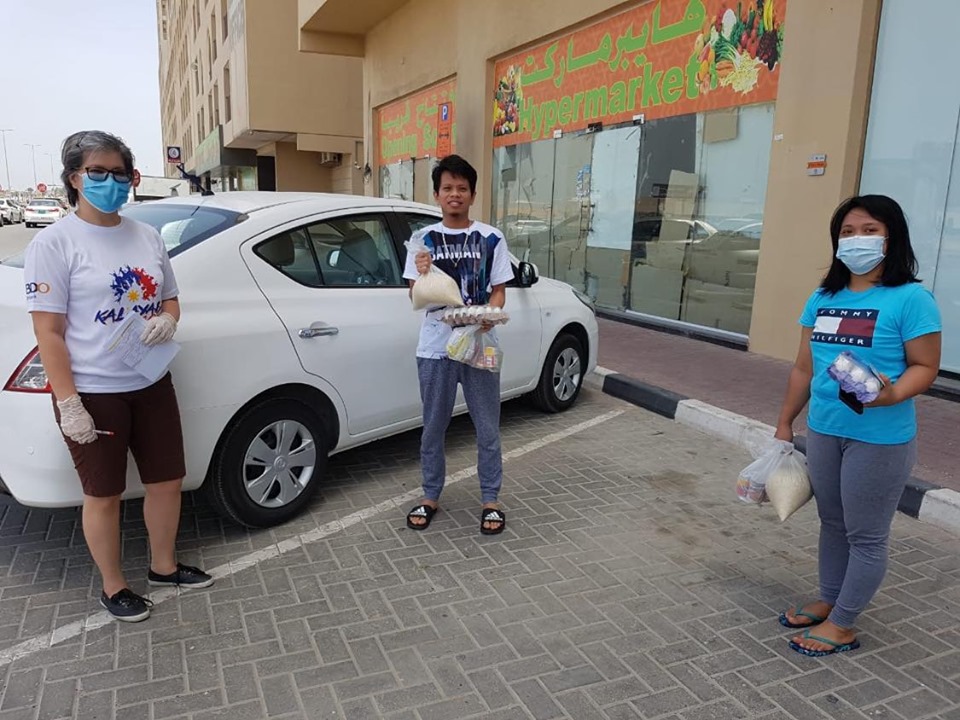
In Ajman, a neighboring emirate of Dubai’s in the north, still another group of OFWs, banding together under the Kalayaan 2020 umbrella group has also been doing the rounds of free food distribution among distressed OFWs.
Supplied photo
Zoren Yutuc Ico said their group has around 400 members and have given out food and groceries to some 750 beneficiaries, including people of other nationalities.
Kalayaan 2020 is organizing this year’s Philippine Independence Day celebrations and is based in Dubai where members have also been engaged in food relief efforts for distressed OFWs, over 3,000 of which have signed up as recipients.
According to Labor Secretary Silvestre Bello III, there are 400,000 documented OFWs in Dubai. Across the UAE, officials estimate that there are approximately 750,000. The first batch of OFWs arrived in the UAE in the 1980s.
MAIN PICTURE CAPTION:OFWs queuing in for free food in Muraqqabat. (Photo grabbed from Feby Dela Pena’s FB with consent)
DUBAI, United Arab Emirates: Getting infected with coronavirus in shared accommodations is like a bowling match: pins fall one after another while others are shaken and the rest remain standing.
Jolly Milette Santo Zulueta (Contributed photo)
This, according to 43-year-old Jolly Milette Santo Zulueta, flower shop operations manager, who live with her husband, Richard, a communications director at a skills training company, in a three-bedroom flat, with common kitchen and bathrooms, shared by seven other occupants in Karama, a mostly-residential enclave north of the city.
“What happened to us was like bowling: When the virus (bowling ball) strikes, some pins (people) fall, some remains standing,” Zulueta said.
Zulueta’s COVID scare started when two of their flat mates, who were staying in one of the rooms, tested positive for coronavirus after going back to work at a time when restrictions in the movement of people started to be eased in the last week of April.
“During those days, nilagnat si patient #1 and may cough naman si patient # 2. Both of them went to a clinic for check-up,” recalls Zulueta, who was staying in another room with her husband.
Initial findings did not indicate COVID, but following swab tests, Zulueta said, the two turned out positive for coronavirus.
“Good thing si patient #1 ni-require ng company nya to do swab test. Sya po yung unang nag-positive sa amin. Then, we asked patient #2 to do her swab test as well. Sila po kasi ang magkasama sa room. Her swab test turned out positive din,” said Zulueta.
As this developed, Zulueta herself started feeling ill.
“While we are all waiting for their swab test results during that week, may mga naramdaman na ako, pero I never thought na infected na din ako,” she said, recalling that she experienced four days of dizziness, which, according to doctors is a sign of COVID infection as it means the body’s oxygen level was going down.
Zulueta said the dizziness went with headaches and she took it as vertigo. “So, I took my medicine and I also took paracetamol, then I was fine,” she said.
Zulueta then started having chills with no fever, which happened for six nights, followed by shortness of breath that came on a midnight. “I adjusted the AC temperature, drunk water and adjusted my pillow, then I was fine again,” she said.
But the tell-tale signs just would not go away as Zulueta started having a dry, itchy throat to which a doctor prescribed medication. The following day, she lost her sense of taste and smell – another sign of COVID-19 infection – and it stayed for two weeks, Zulueta said.
Zulueta said they sought the doctor’s advice, who told them to observe the proper protocols about having COVID-positive flat mates, and that they all need to a swab test which they did on May 16 at Al Badaa Health Center, a government primary health care clinic along Jumeirah Street near Satwa. The results showed that she and another flat mate were COVID positive.
“Dalawa pa po kaming nag-positive sa bahay and five were negatives, including my husband,” said Zulueta.
“But we had one major concern pa, kasi during those days (in April and May) our friends frequently visited us with their baby. We called them up and convinced them to do swab test as well, and on May 20, they got their results na lahat sila positive,” she added.
The visitors were a couple and their infant. “Naging bola kasi naming lahat si baby – pasa-pasa, then lahat kami kinakarga sya,” said Zulueta. The baby is now okay, she said.
Soon, a medical team from the Dubai Health Authority (DHA) took Zulueta and the rest, including their visitors at flat and their 11-month-old baby, to an isolation center in a hotel near the Al Maktoum airport where they got world-class treatment.
Jolly Milette Santo Zulueta (Contributed photo)
“We are well treated well. Sobrang maalaga ang mga doctors and nurses. We had our swab tests and we are all negative. Despite this, the doctors kept monitoring our vitals and health as per daily check-up,” Zulueta said.
After 11 days, Zulueta was discharged on June 2, 2020, her medical certificate in hand.
As of press time, she was on a 14-day home quarantine to ensure that she’s all good before going back to work.
“With our case, it’s ‘hawa-hawa.’ Pero di talaga namin alam kung sino ang (original) carrier. Kahit gaano tayo ka-ingat, sometimes it happens. Sabi ko nga it’s an invisible enemy. Kaya dapat talaga doble ingat tayong lahat,” Zulueta said.
Her piece of advice: “Be responsible. If you feel something wrong with your body, consult a doctor. If you suspect that you have COVID-19, ‘wag po kayong matakot. Mas mabuti po na malaman ng maaga bago pa maging malala.
“Sa mga kagaya ko pong Covid-19 patient: Be strong. Don’t let depression, anxiety and stress let you down. Kaya po natin ito. Wala pong ibang makakatulong sa atin kundi sarili din natin, and prayers.”
What is the protocol when someone in the flat has COVID-19?
Zulueta said they were concerned and did not know what to do when they found out that two of their flat mates were COVID-positive.
“Nag-worry kami. I called my employer to help us because her husband is Infectious Disease head doctor (at a Dubai hospital). Mainly po Covid-19 cases ang hinahawakan nya,” she said.
The doctor called her right away and advised what they needed to do:
(Here’s a checklist that note down a post on your wall, as well share with friends)
Calm down, don’t panic
Wear mask and gloves
Isolate the COVID-positive flat mates.
All the test should do 14-day quarantine.
Take a swab test
Disinfect the while flat unit once the COVID-positive flat mates have been taken by a medical team. Soak and wash their things.
Report the incident to your building management and security to secure your premises
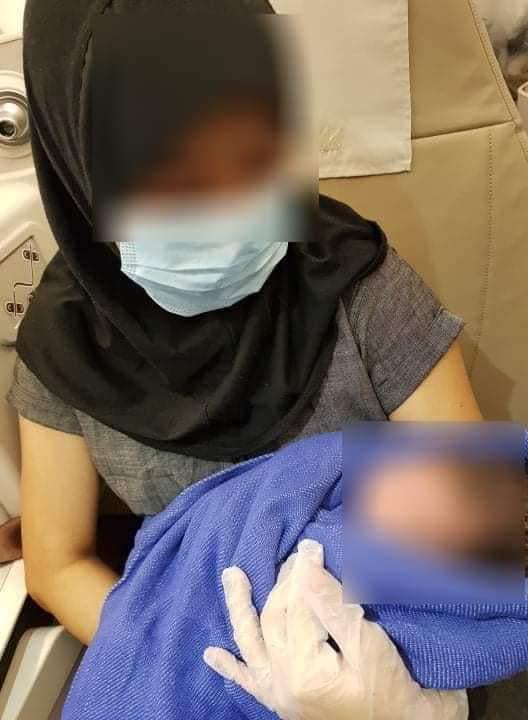
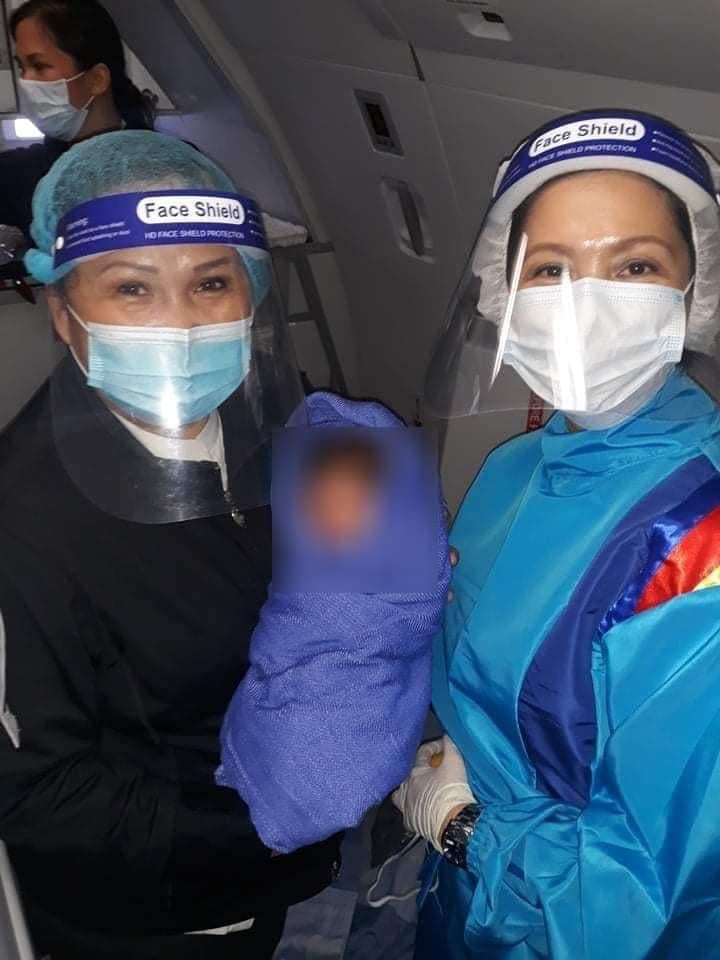
DUBAI, United Arab Emirates: A Filipina successfully gave birth to a healthy baby boy at 38,000 feet on board a Philippine Airlines (PAL) flight from Dubai to Manila as cabin attendants assisted her with help by one of the pilots, who was receiving step-by-step procedures from a doctor through a satellite phone.
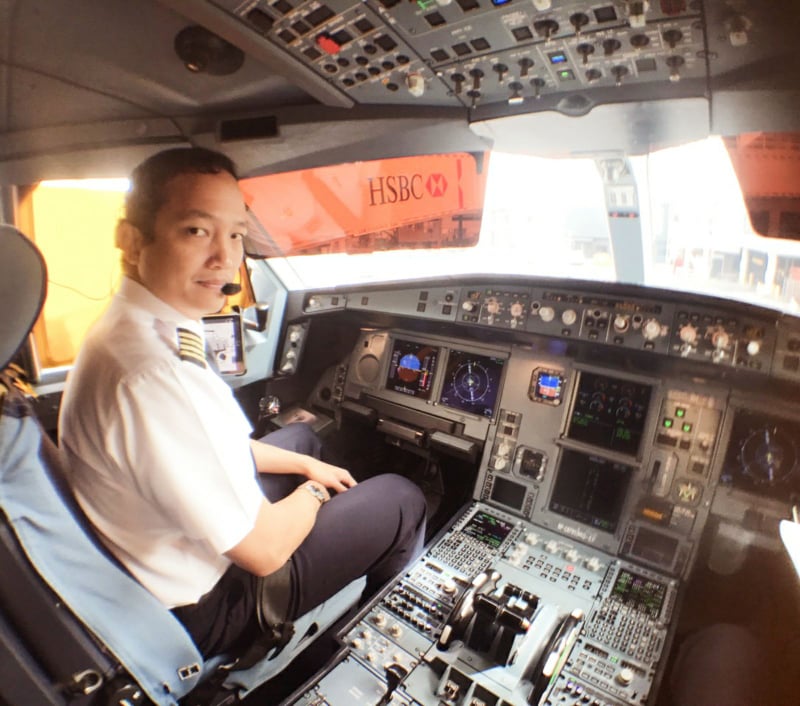
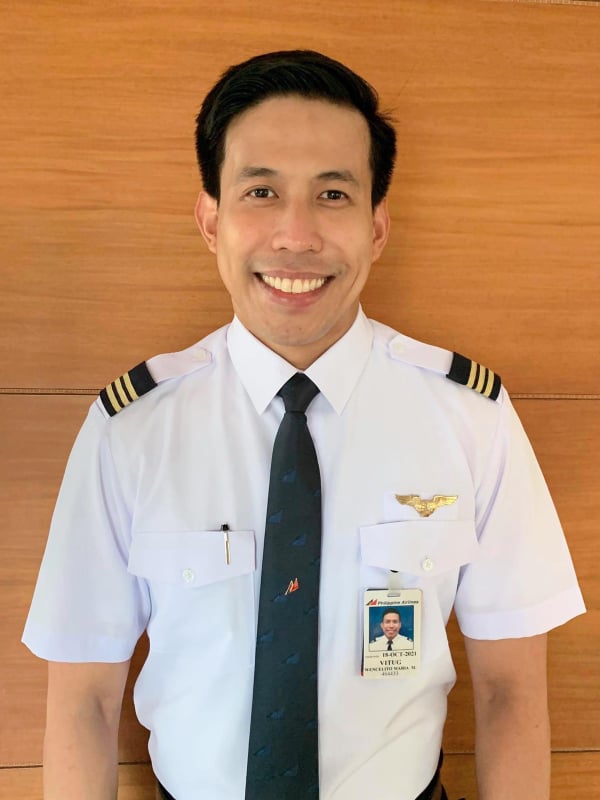
“It was a fateful day,” Second Officer Fidel Guzman Ala told The Daily Bread.
Second Officer Fidel Guzman Ala’s Facebook. Sent to Daily Bread
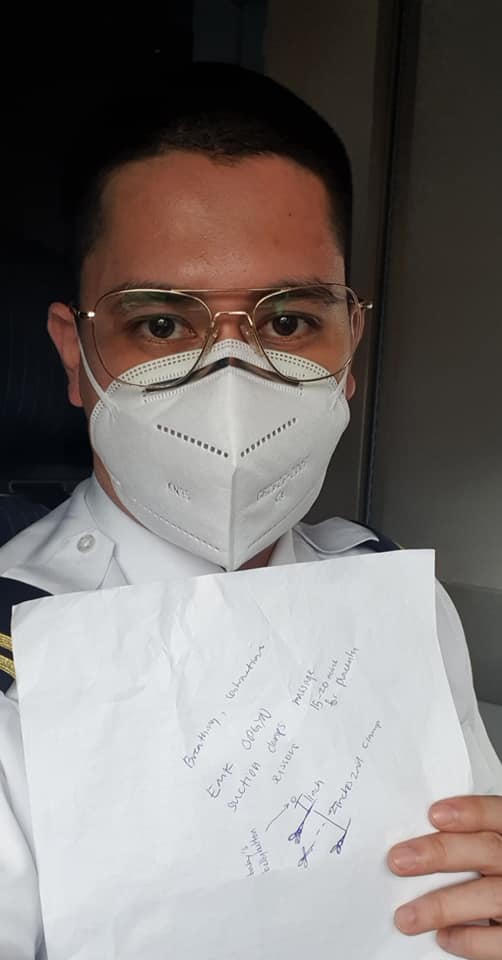
“It was one of, if not the most, stressful and yet fulfilling experiences in my life. As there were no doctors on board, I had to call one through radio satphone and very carefully relay all those medical terms to the cabin attendants delivering the baby,” he said on Facebook.
He said the experience “felt a tad terrifying.”
“One misinterpretation of the doctor’s instructions would spell out a person’s doom or destiny. I had to ask and re-ask the doctor on the line if I understood him correctly.
Second Officer Fidel Guzman Ala showing his notes on how to cut the umbilical cord as advised by a doctor on the radio satphone.
“I now recognize the efforts of those who went through medical school. Who would have thought that in my lifetime, I would have to relay the step-by-step procedure and instructions for cutting an umbilical cord? I had to draw a diagram and re-ask the doctor again and again just to be sure,” Ala further shared.
Agnes Pagaduan, PAL country manager for the UAE, said the Filipina, whose name she did not disclose for privacy reasons and was 34 weeks pregnant, was given the all-clear, fit to travel approval by authorities when she boarded the chartered PR 659 flight that left Dubai at around 9pm on Friday, June 5 (UAE time), with expected time of arrival (ETA) in Manila at 10am Philippine time.
“May clearance naman sya… fit to travel. Okay naman sya nang mag-check-in. Baka na-excite lang. I got information na nanganak sya on board. Lalaki ang anak,” Pagaduan also told Rappler.
Ala said the boy was named Ali, which in Arabic meant “elevated,” “most high” or “exalted.”
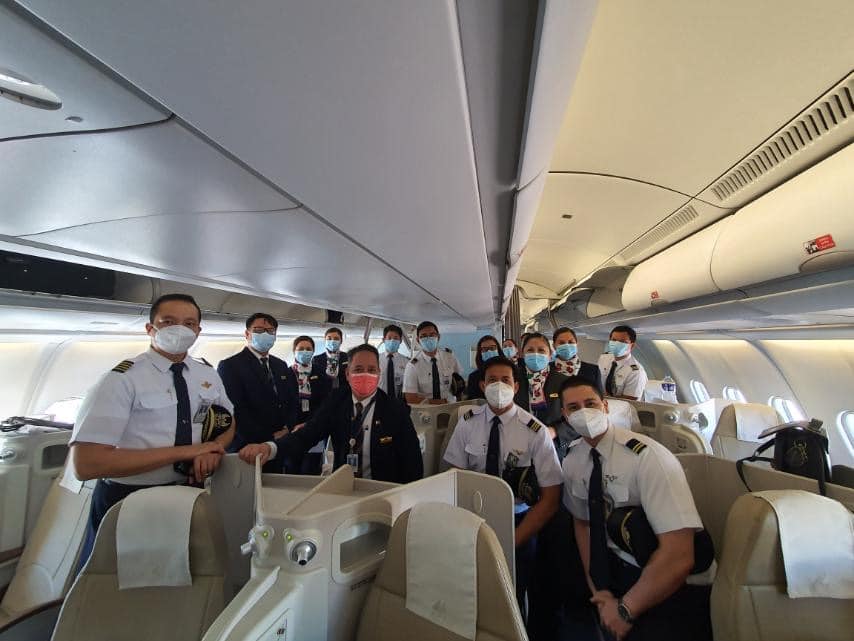
The PAL pilots and cabin staff
“Such a wonderful name for one who is born flight levels above ground. Ali, I hope to meet you one day. God bless you. You are a miracle amid this world’s current misery. Fi Amanillah (I leave you in the custody of Allah)! All the best!” Ala said.
Pagaduan also said the flight’s crew attended to the Filipina. “Ang crew namin ang nagpa-anak. Well-trained naman sila,” Pagaduan said, adding that the airline has had several such incidents of expectant mothers giving birth while in flight.
Pagaduan said PAL flight PR 659 had 294 passengers of which 25 were pregnant ones. It would have been approximately an eight-hour Dubai-Manila flight but the plane had to be diverted to Bangkok’s Suvarnabhumi Airport because of the medical emergency.
“Dinala sya sa pinakamalapit na ospital,” Pagaduan said.
The flight reportedly left Bangkok shortly after the woman and her child were disembarked, and arrived in Manila around midday.
She said PR 659’s passengers were mostly those returning to the Philippines for good in light of the employment situation in the UAE caused by the COVID-19 global pandemic.
“Karamihan sa mga sumakay ay talagang mga ‘for-good’ na… mga nawalan ng trabaho,” Pagaduan said.
She also disclosed that PAL has another chartered flight, Sunday July 7, with 355 passengers on board of which over 20 were expectant moms.
Thirty-four weeks of pregnancy is around two weeks short of nine months – the pregnancy period.
(Main picture was from Second Officer Fidel Guzman Ala’s Facebook as sent to Daily Bread)
DUBAI, United Arab Emirates: A Philippine Airlines (PAL) flight with 25 pregnant Filipinas on board had a very interesting story to it after one of the expectant moms gave birth to a healthy baby boy while the plane was flying at over 30,000 feet.
Agnes Pagaduan, PAL country manager for the UAE (Facebook grab with permission)
Agnes Pagaduan, PAL country manager for the UAE told Daily Bread the chartered PR 659 flight that left Dubai at around 9pm on Friday, June 5 (UAE time), had 294 passengers and had an expected time of arrival (ETA) in Manila at 10am Philippine time.
The Filipina, who was 34 weeks pregnant and whose name Pagaduan did not disclose for privacy reasons, was given the all-clear, fit to travel approval by authorities, the PAL official said.
“May clearance naman sya… fit to travel. Okay naman sya nang mag-check-in. Baka na-excite lang. I got information na nanganak sya on board. Lalaki ang anak,” Pagaduan told Rappler.
“Ang crew namin ang nagpa-anak. Well-trained naman sila,” Pagaduan said.
She the airline has had several such incidents of expectant mothers giving birth while in flight.
Of the 294 passengers, Pagaduan said 25 were expectant mothers.
She said the approximately eight-hour Dubai-Manila flight had to be diverted to Bangkok’s Suvarnabhumi Airport because of the medical emergency.
Philippine Airlines at Ninoy Aquino International Airport
The flight reportedly left Bangkok shortly after the woman and her child were disembarked, and arrived in Manila around midday.
Meantime, Pagaduan said PR 659’s passengers were mostly overseas Filipino workers (OFWs) returning to the Philippines for good.
“Karamihan sa mga sumakay ay talagang mga ‘for-good’ na… mga nawalan ng trabaho,” Pagaduan said.
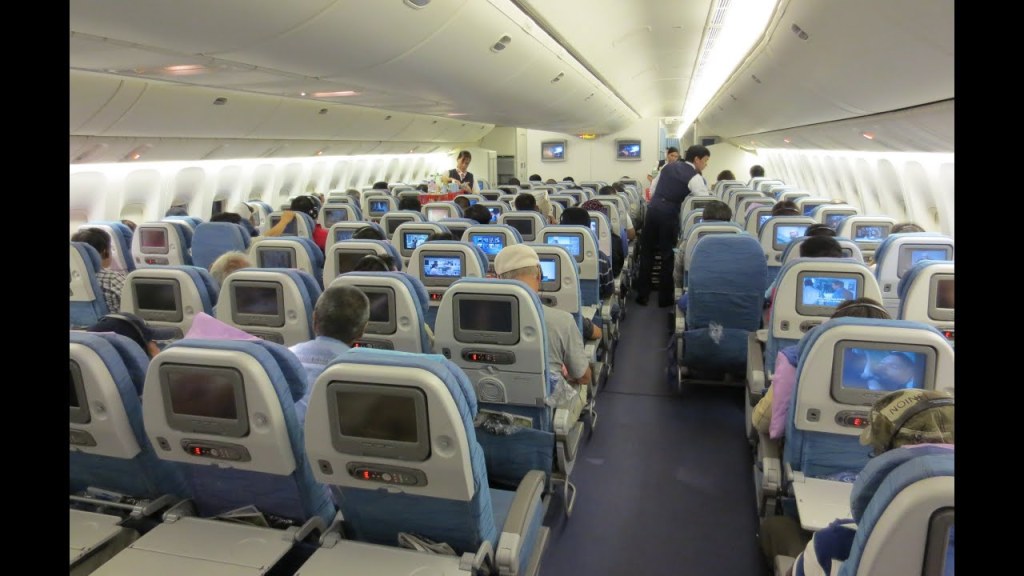
File photo uploaded by Poul Go.
She also disclosed that PAL has another chartered flight, Sunday July 7, with 355 passengers on board and of which over 20 are expectant moms.



















 The Daily Bread