Filipino nurses in UK brace for new coronavirus strain as country goes on third lockdown

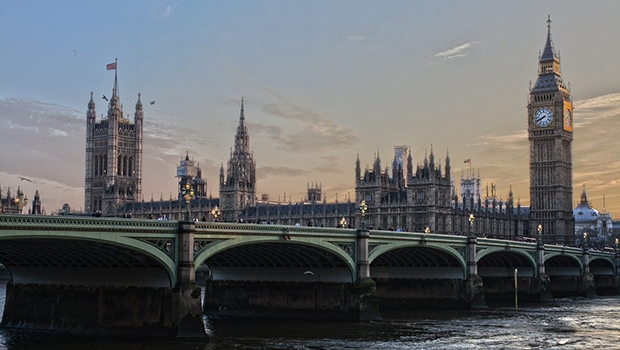
DUBAI – Health workers across the United Kingdom, among them over 18,500 Filipinos, are bracing for yet again another strain of the coronavirus threatening the country with a faster reproduction rate as British Prime Minister Boris Johnson, early this week, announced a nationwide lockdown which took effect today, Wednesday, Jan. 6.

British Prime Minister Boris Johnson (CNN photo)

This, as mass inoculation speeds up in an apparent race against time to flatten the curve as numbers reach unprecedented levels since March last year.

The UK has been on a regional alert system implemented in four tiers, or categories, of restrictions in the past weeks, but apparently had to abandon this as more regions were put on the highest levels or tier four, following London and southeast England, due to the severity of local infections.

The lockdown, in effect, placed the entire country on tier four and is seen to last till March.

 ‘Scared but I have learned to adapt’

“I am scared. But I have learned to adapt,” said 33-year-old Rose Ann Viterbo-Soriano, who works at Chelsea and Westminster National Health Service (NHS) Foundation Trust and assigned at West Middlesex University Hospital in Isleworth, west London.
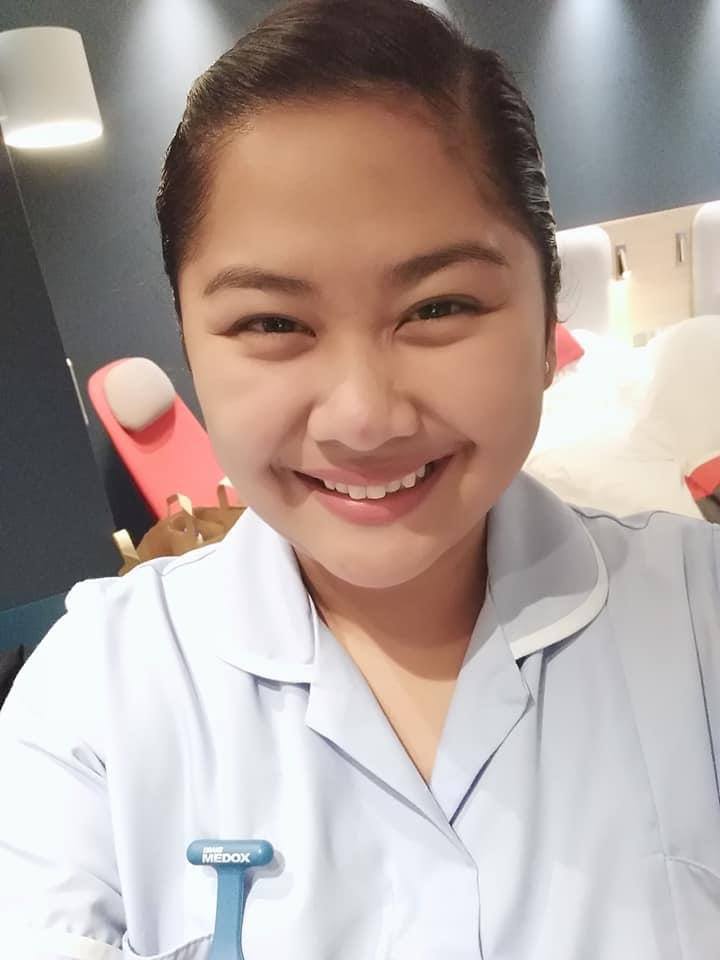
Rose Ann Viterbo-Soriano

The medical facility has a 400-bed capacity and was “already full, with majority (being) Covid patients,” she said.

“I was really scared when it all started since I was still pretty new to this country and dealing with all the adjustments,” Soriano, who arrived in the UK on Aug. 29 last year, said.

She said prayers and the strength coming from her loved ones has so far kept her “sane during these trying times,” with her family even asking her to just quit and go back home.

 “I have thought about stopping but I have held on to this profession for a long time and I love doing this job despite all the risks. Now that (the pandemic) has been going on for a year, it seems rather normal already to be dealing with patients who have Covid. And sad to say, you will really get used to deaths when you’re dealing with Covid,” said Soriano, who works 10.5 hours a day.

Soriano was a volunteer nurse for a year at the Jose P. Rizal Memorial Medical Center in Laguna in 2009.  Her most recent hospital employment was with Global Medical Center of Cabuyao, where she stayed for two years before becoming an overseas nurse.

Soriano said they already were on tier four even before the lockdown was announced. Categorization depends on the area’s rate of Covid infections and threats.

Tier four rules include a stay-at-home order as well as closure of  all non-essential shops, including indoor entertainment venues. Gyms and indoor swimming pools, indoor sports courts and dance studios must also be closed.

Movement of people is also restricted such that residents can not meet others indoors unless they live with them or are part of their “support bubble.”  

Overwhelmed

“Nagulat kami sa biglang taas ng infection dito sa amin,” for his part, said 47-year-old Marvin Moreno of San Pedro City, Laguna and a clinical nurse at Milton Keynes Urgent Care Service (MKUCS) in Buckinghamshire, England.
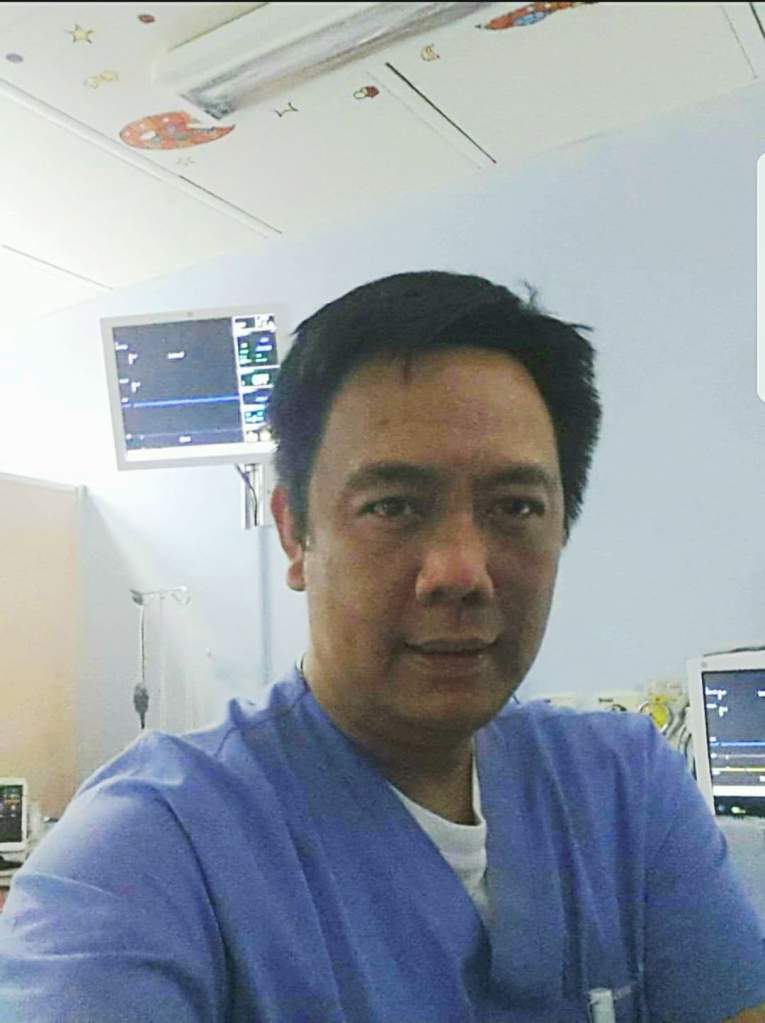
Marvin Moreno

On Dec. 29, Moreno said, the town of Milton Keynes recorded 364 new Covid-19 cases in a day. The hospital has around 550 beds, according to him.

“Sabagay kasi, maraming nakatira dito, pero sa London nagsisipag-trabaho. Ito kasi ang pinakamagandang lugar na tirahan na malapit sa London,” he added, referring to Milton Keynes, a big town which is about 80km northwest of London.

Moreno said restriction level at Milton Keynes was elevated from tier three to tier four on Dec. 20 “dahil sa dami ng mga bagong cases namin ng Covid.”

He said their hospital, the biggest in Buckinghamshire, was already overwhelmed with Covid patients a few days to Christmas. “Maximum capacity ang Milton Keynes Hospital,” Moreno said.

‘Worrisome’

“Nakaka-worry talaga,” meantime said 46-year-old Jeremiah Javier of Imus, Cavite who moved to the UK on Nov. 30, 2018 following 13 years’ work in Abu Dhabi, including two years as private nurse for a royal family.
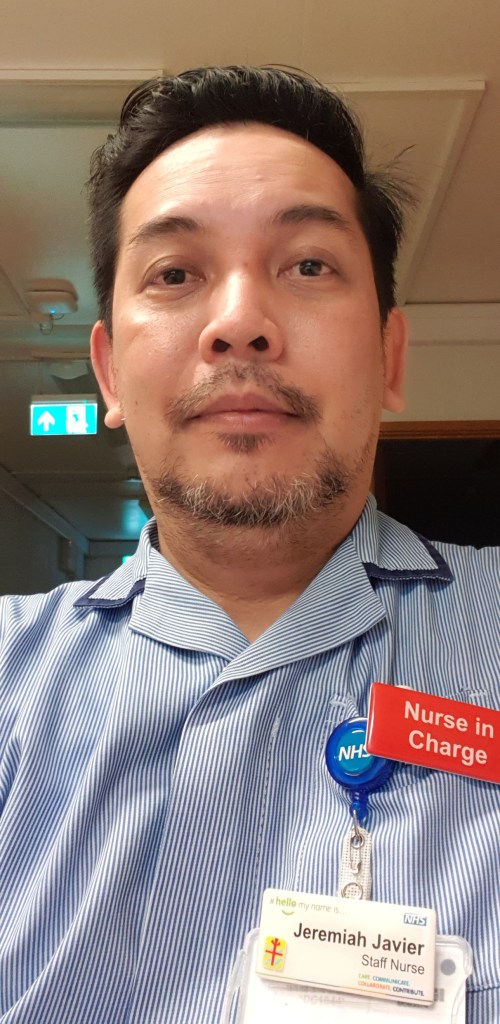
Jeremiah Javier

A staff nurse at the Ortho/Surgery Ward of Milton Keynes University Hospital in Milton Keynes, Javier, who started out as an Emergency Room nurse at The Medical City in Pasig, Metro Manila, said the situation regarding the restrictions is “acceptable.”

“You need to stay home as much as possible, you can go out and buy your essentials. Malls are closed, but a few fast food chains are open for takeaways,” he said.

The recent holiday season, Javier said, “was observed (differently) from the usual celebrations we’ve grown to (back home).”
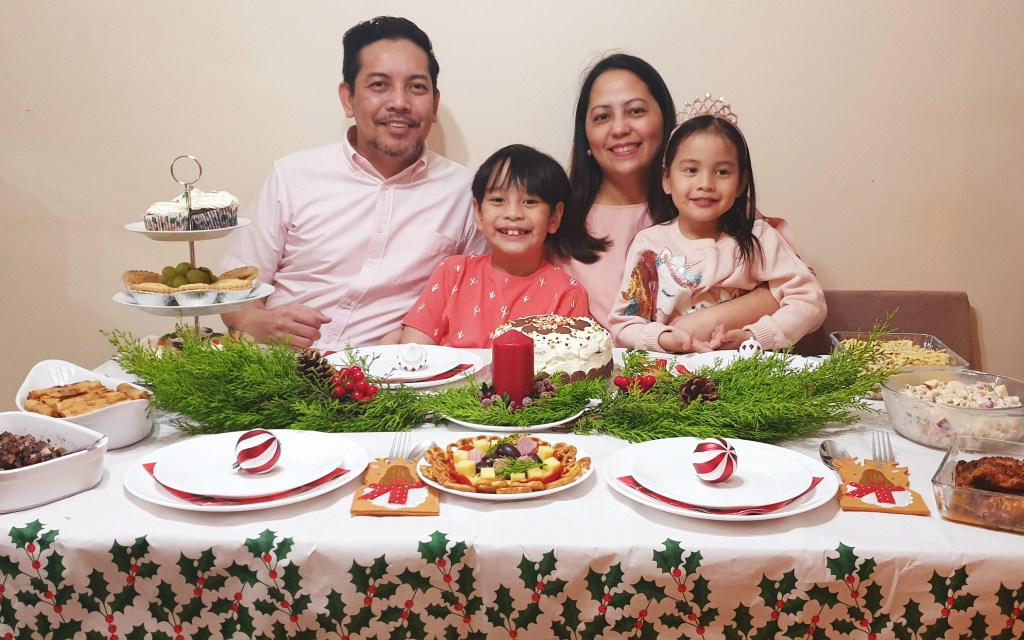
Javier and his family in the UK.

“We weren’t allowed to join other friends as what was stated in the tier rules. My family honored the occasion by reading the kids a nativity story: The reason and importance of why we’re celebrating it, as well as reflecting the year that was,” said Javier, whose lives with his wife and two kids.

Patient visitation time at their hospital was stopped, said Javier, adding that Tablets were provided in the ward for relatives and family members to have a video chat and face time with patients.
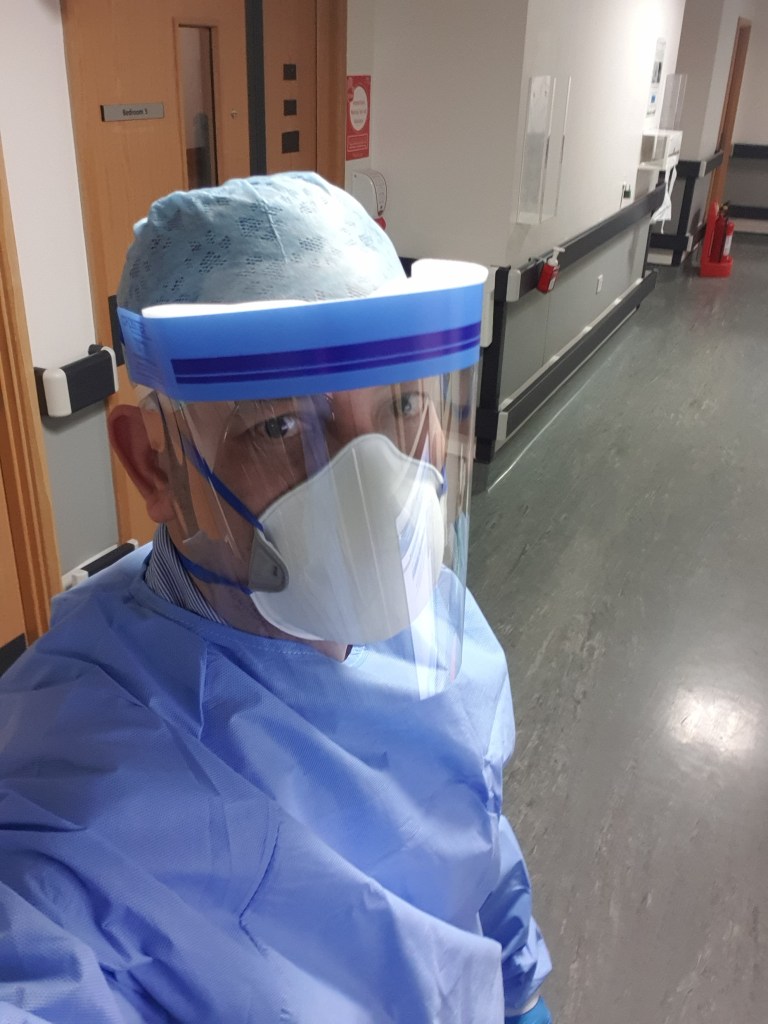
Javier on duty break.

“If on an end-of-life care, management has to arrange for one family member to visit the patient daily for limited hours,” Javier said.

‘Ganyan talaga’

Meantime, also weathering the Covid threat is Teresa G. Lareza, who had likewise been an Emergency Room nurse, but at a Dubai hospital for 12 years, and moved to the UK in August of 2019. 

Lareza got her close brush with the coronavirus on March 28, 2020 with symptoms manifesting after being exposed to a Covid patient. She survived the horrible experience.
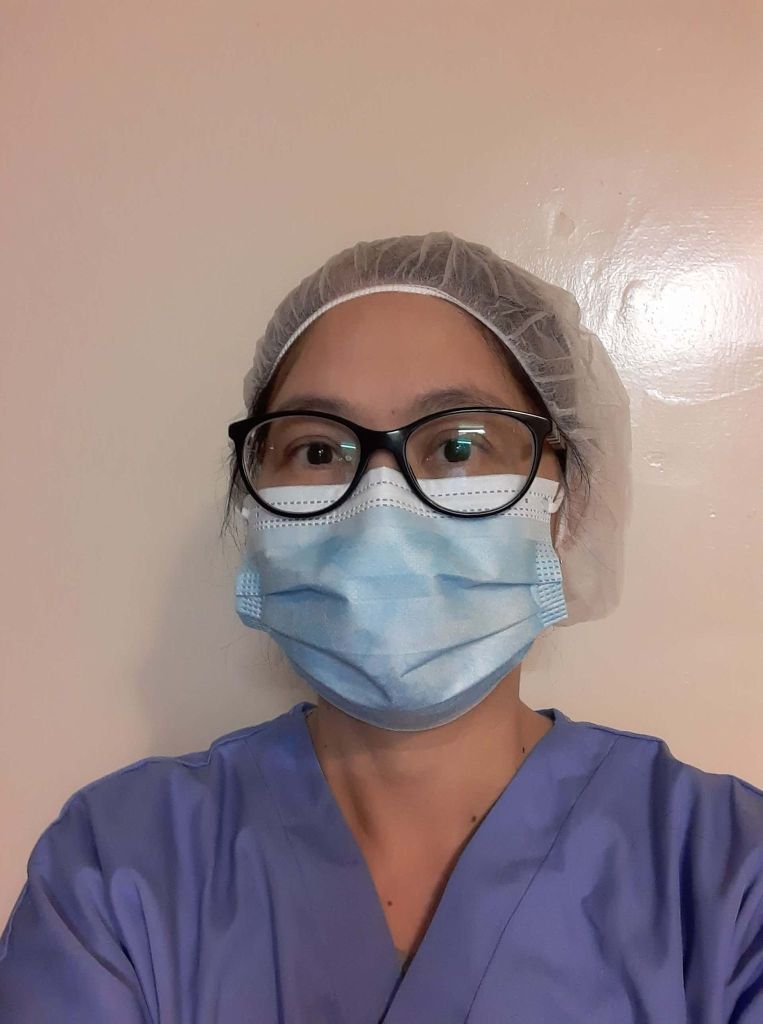
Teresa G. Lareza on duty break.

“More than 1,000 bed capacity kami. Busy and puno po lagi (ng pasyente),” said Lareza, who hails from Jaen, Nueva Ecija and works at Cambridge University Hospital NHS Trust in eastern England.

Their area was elevated from tier two to tier four on Dec. 27, 2020.

“We are so much hopeful na makabalik na tayo sa pre-Covid days. Prayers pa more. We hope that this (anti-Covid) vaccine (that is now being rolled out) will make all the difference para matapos na. Pagod na pagod na tayong lahat na makita ang paghihirap ng mga tao,” said Lareza.

Asked how wary she was, Lareza said: “Ganun talaga. Dasal lang at lakas ng katawan ang kailangan.”
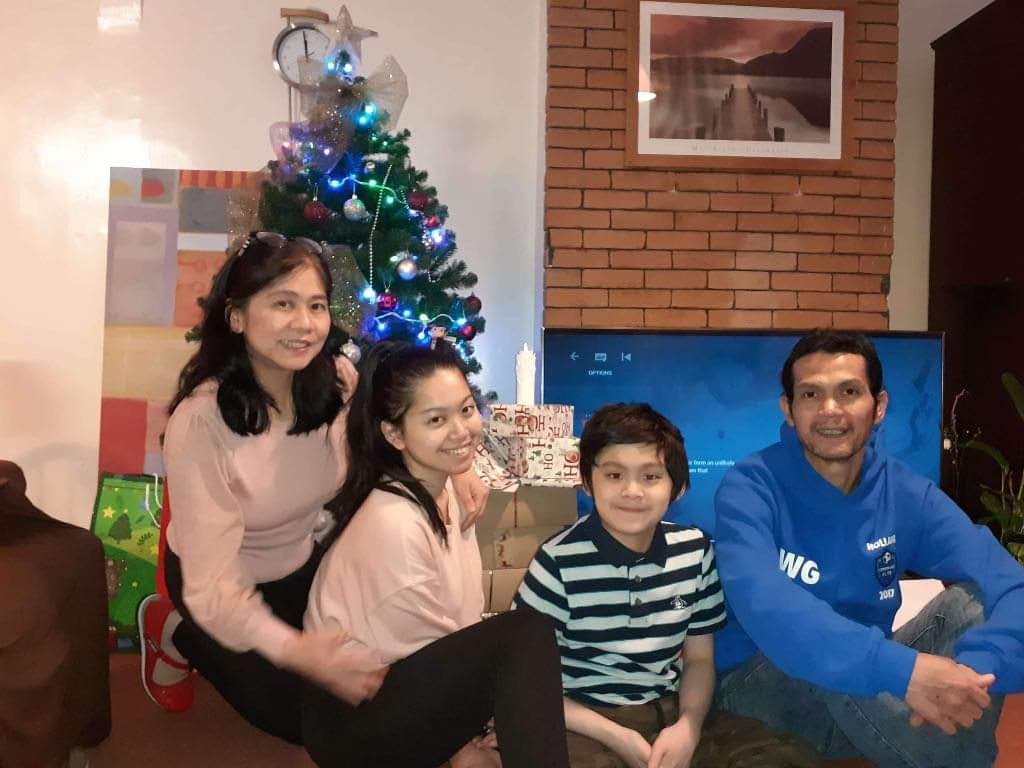
Lareza and family.

Work shifts in their hospitals are 7:30 am to 8:30 pm for “long day,” 8:15 pm to 7:45 am for night shifts; 7:30 am to 3:30 pm for “early shift,” and 6 pm -2 am for “twilight shift.”

Lareza, whose husband and two children live with her, said there was no pattern with the shifts. “Pa-iba iba,” she said.

 Different perspective

John Philip Villanueva of Biñan, Laguna, who has been in the UK since 2016 and is currently working in Eastbourne District General Hospital (EDGH) in East Sussex, England said he felt bad about Covid at the start but has found comfort in seeing things from a different perspective.
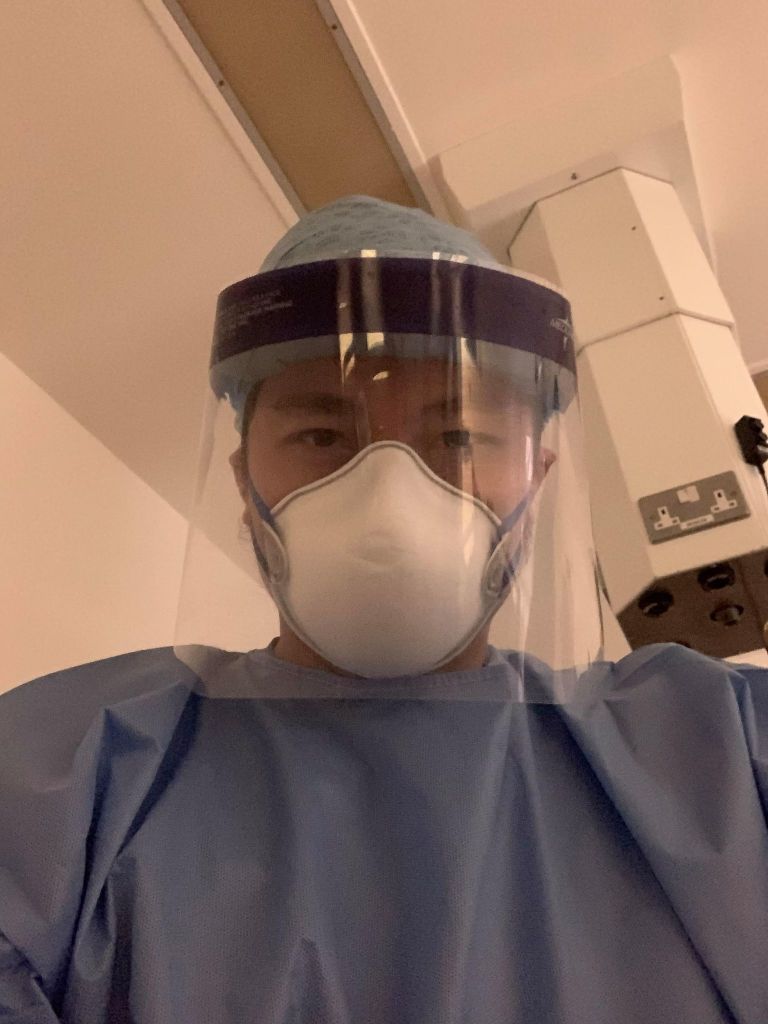
John Philip Villanueva on duty break.

“I have gotten used to it. I’m now looking at the brighter side of things, like for instance, as an overseas Filipino worker (OFW), not being able to go anywhere (because of the restrictions) means being able to save a bit more than before. I also use the time to learn and acquire new skills,” Villanueva said.
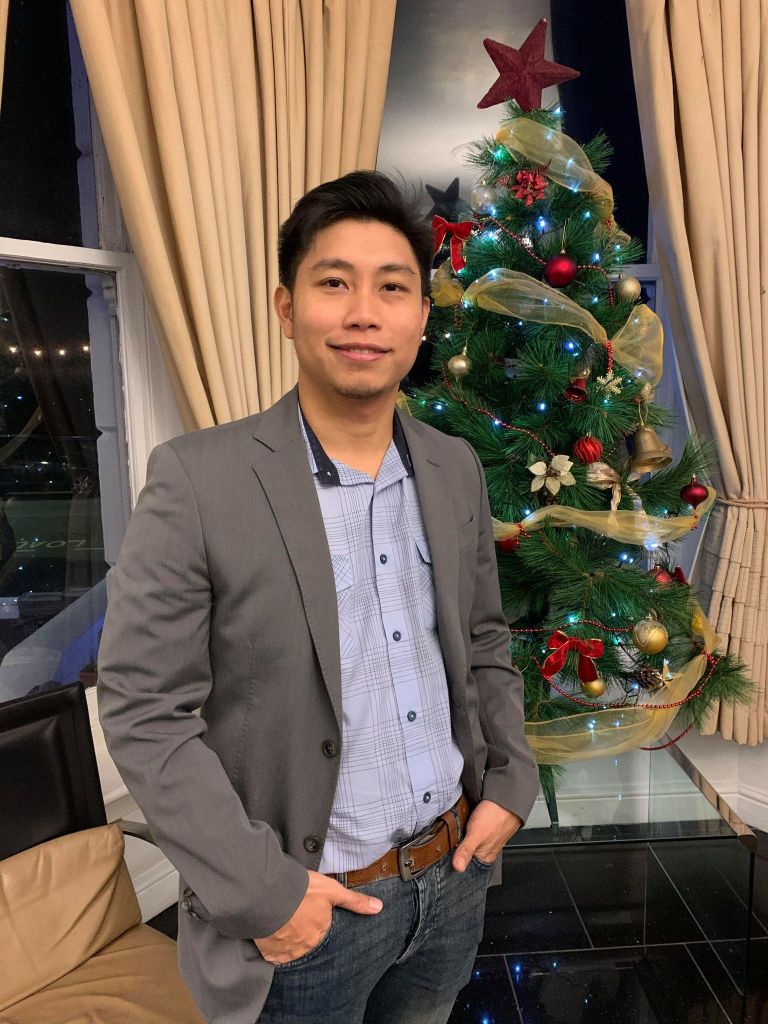
John Philip Villanueva

He said their total hospital bed capacity is 820. Covid situation as of Dec. 30 was 133 in-patients, Villanueva said.

The numbers

According to Johns Hopkins University’s Center for Systems Science and Engineering (JHU-CSSE), there were 58,784 new Covid cases in the UK as of Jan. 4, 2021. On Christmas Eve there were 39,036; there were 1,033 on Aug. 21; by Nov. 12, there already were 33,470 new cases; there were only 40 on March 2, still according to JHU-CSSE.

The Associated Press has reported that there were 26,626 COVID-19 patients in hospitals across England on Jan. 4. The international news agency said authorities reported 407 Covid-related deaths on the same day, which brought the total to 75,431.

There were 20,426 Covid patients on Dec. 28 and 18,974 at the first wave peak on April 12, 2020, according to British Broadcasting Corp. (BBC).

British Prime Minister Boris Johnson ( BBC)

Johnson, in announcing the lockdown, said the government has to do so because the new variant of the virus was spreading in a “frustrating and alarming” way. The new lockdown, the third so far, was expected to be in place till March. Scientists said the new coronavirus variant has a higher reproduction rate.

There were approximately 18,500 Filipinos in the UK’s government-run NHS.

The country has, early last month, started its Covid-19 vaccination drive, further speeding it up with the approval of the vaccine developed by Oxford University and drugmaker AstraZeneca to which some 100 million doses have been secured in a bid to have 13 million people vaccinated by mid-February.
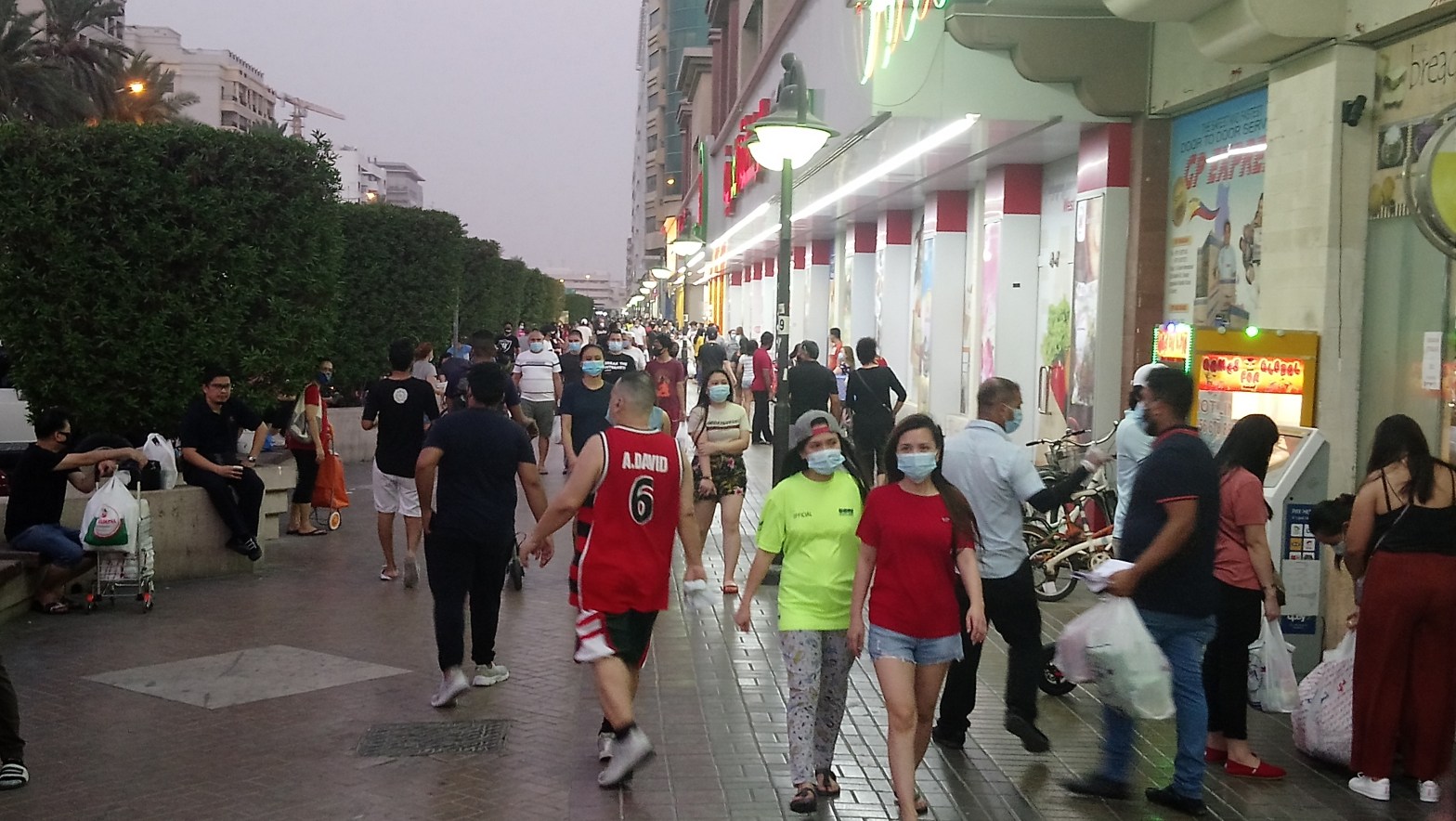
Few Dubai OFWs avail of New Year’s Eve repatriation

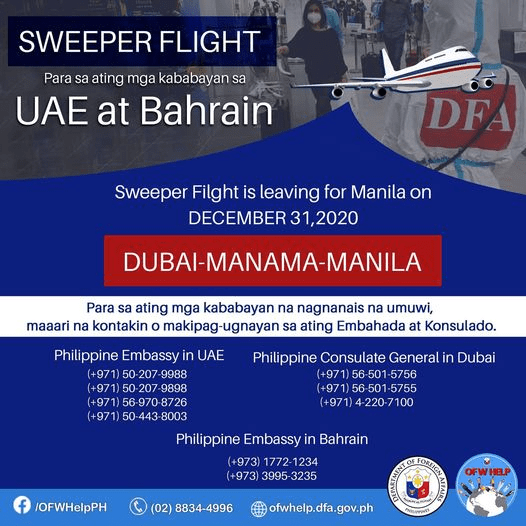
DUBAI: The Department of Foreign Affairs (DFA) has announced a New Year’s Eve repatriation in the Gulf but only a few overseas Filipino workers (OFWs) in Dubai are availing of the flight apparently due to stringent procedures in leaving the Philippines again as well as the Covid vaccine roll out that the UAE has started before Christmas.

Consul General Paul Raymund Cortes

 “Very, very few OFWs have registered,” Consul General Paul Raymund Cortes  told GMA News Online. “We are looking at about a hundred or even less,” he added.

Repatriation requests peaked in July at around 8,000.

The sweeper flight – PR 8659 DXB BAH – is scheduled to leave Dubai at 11:45am on Dec. 31 then head to Manama in Bahrain to get OFWs there before flying to Manila, where it is expected to arrive at 4am of Jan. 1, 2021.

Priority are OFWs on expired visit visas as well as those whose residency visas have been cancelled and don’t have enough fund for plane tickets, Cortes said.

Eased restrictions

Economic activities in Dubai have, over the past several months, started to normalize as restrictions have been eased – events are again allowed as restaurants and hotels resume operations.

Cortes said this can be a factor for the low turnout as OFWs who had lost their jobs during the quarantine months in March and April have started to be re-employed.

“And it is very difficult to leave the Philippines again,” Cortes added, citing various requirements among which a certification of being Covid-free.

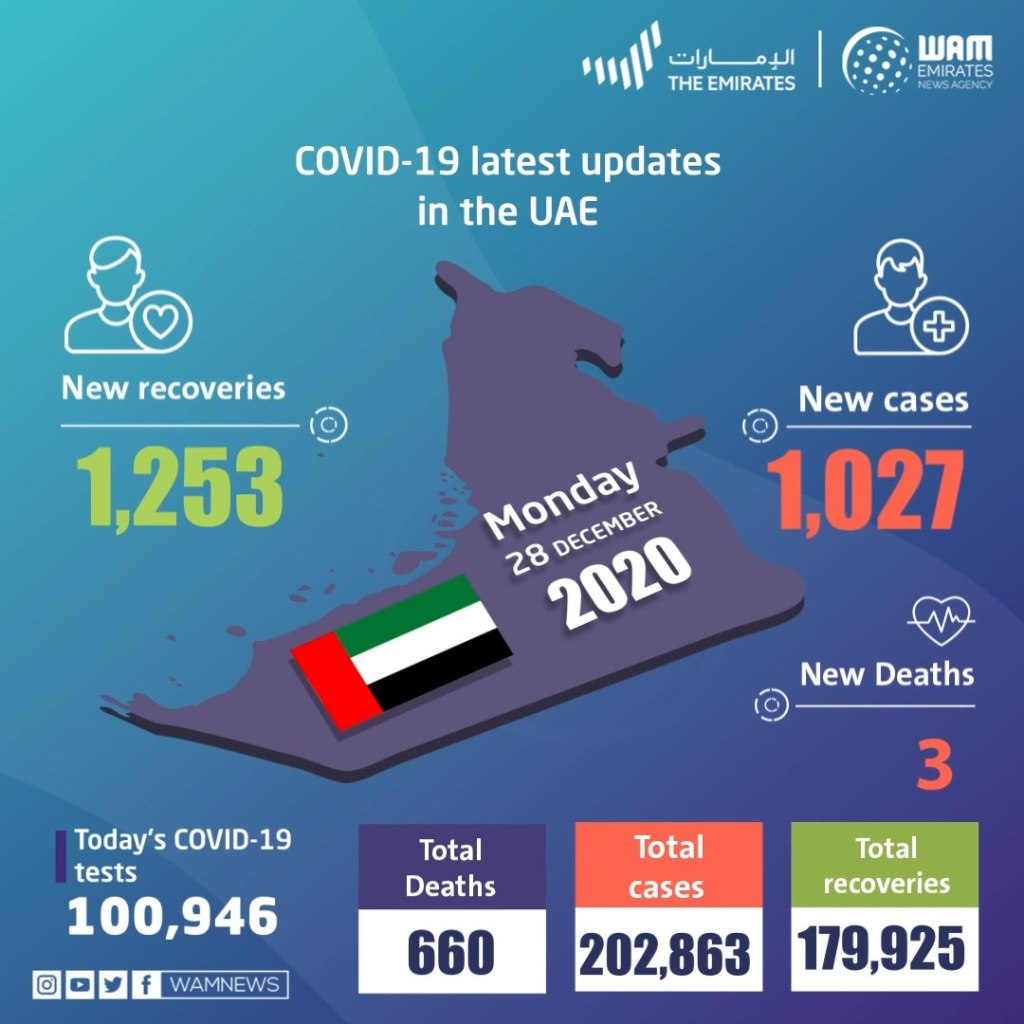
The UAE Ministry of Health and Prevention (MoHAP), has announced that it conducted 100,946 additional COVID-19 tests over the past 24 hours, using state-of-the-art medical testing equipment, of which 1,027 new coronavirus were reported. This brought the figures at 202,863 total recorded cases since January of which 179,925 have fully recovered and 660 have died.

Vaccine roll-out

With this in the backdrop, Covid vaccine roll out has begun across the country with Dubai giving free Pfizer-BioNTech jabs to everyone so long as they are officially residents of the city. The mass inoculation started on Dec. 23.

“This shows that the UAE government is willing to provide vaccine services to all nationals regardless of citizenship as a gesture of its warm welcome to everyone,” Cortes said.

He refused to comment whether the free Covid vaccine may have also been a factor in the low turnout among OFWs who wish to return home.

The Philippine Consulate General’s Office has repatriated over 3,500 Filipinos, including children of OFWs, since the first flight took off in mid-June carrying some 370 OFWs on board Cebu Pacific flight 5J 19. Other subsequent flights were made through the Philippine Airlines.

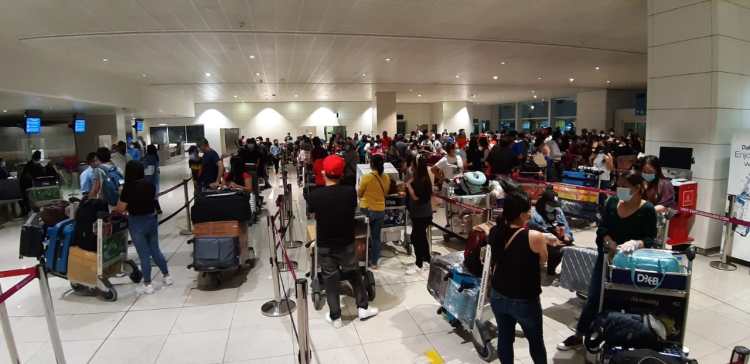
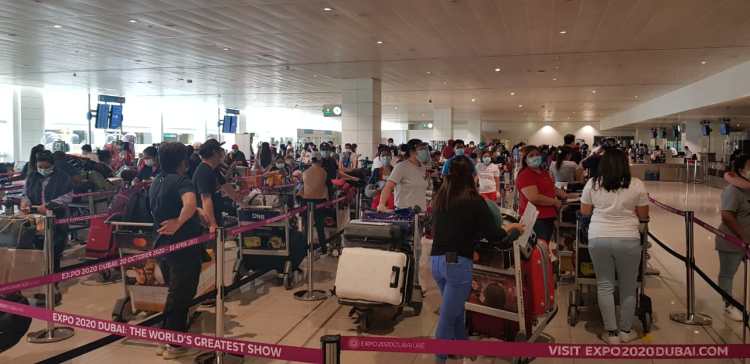
OFWs lining up at Dubai International Airport’s check-in counters for repatriation back in August. (PCG photo)

According to Cortes, the number of repatriation applicants among OFWs peaked in July at approximately 8,000.

Cortes heads the Philippine missions in Dubai and the neighboring Northern Emirates of Sharjah, Ajman, Um Al Quwain, Ras Al Khaimah and Fujairah.

OFW educators open Southville college campus in UAE

DUBAI: A group of four Filipino academicians have officially launched an institution for higher education in the United Arab Emirates (UAE), a move addressing issues about children of overseas Filipino workers (OFWs) in the country, who had to part ways with their parents and be in the Philippines when it was finally time for college.

The opening of Southville International School and Colleges in Ras Al Khaimah (Southville-RAK), an emirate north of Dubai, is also seen to be a welcome break for college undergrad OFWs planning to complete the required units and obtain diplomas.

Enrollment and reservation have begun. The campus is scheduled to open in the fall of next year, or around September.

‘Opportunity to shine’

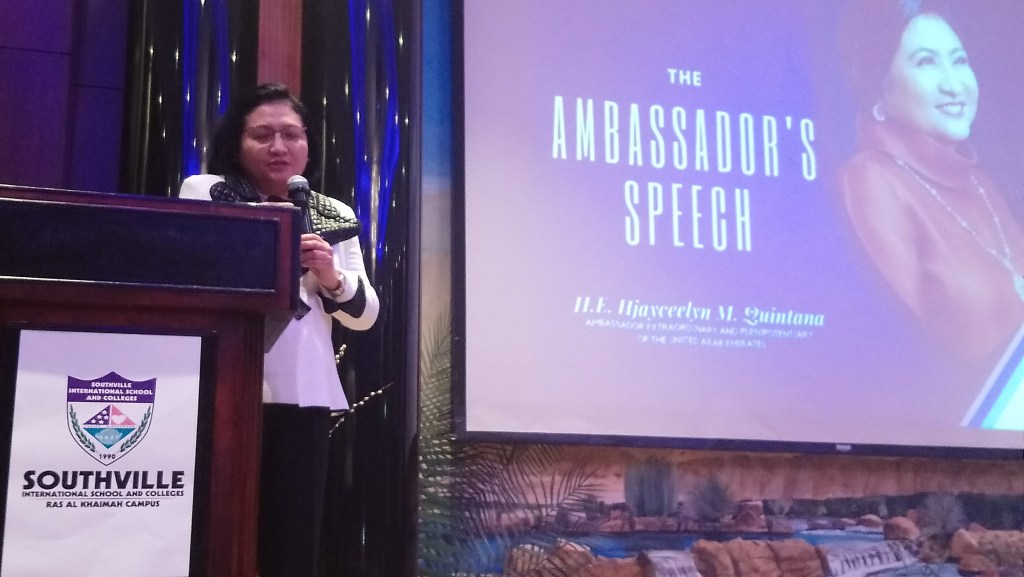
Ambassador Hjayceelyn Aurora Quintana, head of the Philippine missions in the UAE, who graced the event held Dec. 20 at Dusit Thani Hotel on Sheikh Zayed Road, commended the effort, saying it provides opportunities for more Filipinos to shine.

Ambassador Hjayceelyn Aurora Quintana, head of the Philippine missions in the UAE, addressing the event. (Photo by Jojo Dass)

“I am very happy,” the ambassador said. “This is the time for us to shine again and wave our flag,” she added.

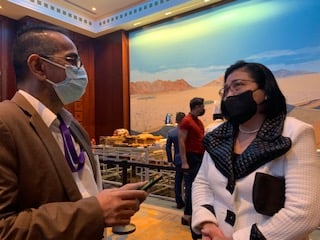
Ambassador Hjayceelyn Aurora Quintana talks to Daily Bread’s Jojo Dass.

Consul General Paul Raymund Cortes and wife, Dr. Yasmin Balajadia Cortes, also graced the event.

12,000 children of OFWs

There is a growing number of children of OFWs staying with their parents in UAE. Most of these kids go home to the Philippines after finishing K-12 to pursue college, where tuition is relatively less expensive.

Prior to the pandemic, there were approximately 12,000 children of OFWs spread across the eight Filipino schools in the UAE which are located in Dubai, Abu Dhabi and Sharjah, officials said. There are also an undetermined number of Filipino children enrolled in international schools in the UAE.

Also prior to the Covid pandemic, there were some 750,000 OFWs in the UAE, according to official estimates. Consul General Paul Raymund Cortes said they have been able to send home over 3,500 OFWs from June to December through the mass repatriation program of the Department of Foreign Affairs (DFA).

The Philippine Consulate General was officiating around 1,200 OFW marriages a year – or 25 each week – before mass gatherings were banned due to the coronavirus.

Tuition comparisons

Meantime, yearly college tuition in the UAE range from AED35,000 to AED70,000 dirhams, according to Dr. Rex Venard Bacarra, one of Southville-RAK’s founder, who also is its academic head and director for administrative services.

Average annual tuition in the Philippines is at approximately P150,000 or some AED11,500.

Tuition at Southville-RAK is at AED550 dirhams per unit or AED25,000 per academic year, said Bacarra.

According to Francis Errol Medina, one of the four academicians, there were around 700 K-12 Filipino graduates across the UAE a few years back. “Ninety-five percent went home for college. These graduates were those who enrolled in Filipino schools. Not included in this number were those who studied in other schools (also attended by other nationalities),” said Medina, who holds an MBA from the University of Strathclyde-Glasgow UK’s campus in the UAE, at a presentation during the official launch.

Undergrads

Undergrad OFWs may also enroll at Southville-RAK to continue college following a syllabus assessment of units taken in their previous schools to determine pending loads.

Opening a Philippine college campus in the UAE took four years, according to Dr. Rommel Pilapil Sergio, also one of those behind the Southville-RAK project.

“We have been declined multiple times (by other institutions and colleges in the Philippines). But we never ceased,” said Sergio, who likewise holds two doctorates, one of which is in management that he received from Liverpool University in the UK.

Another academician, who worked for the Southville-RAK project is Dr. Benigno Lebig, who holds a doctorate in Strategy and International Business also from King’s College London.

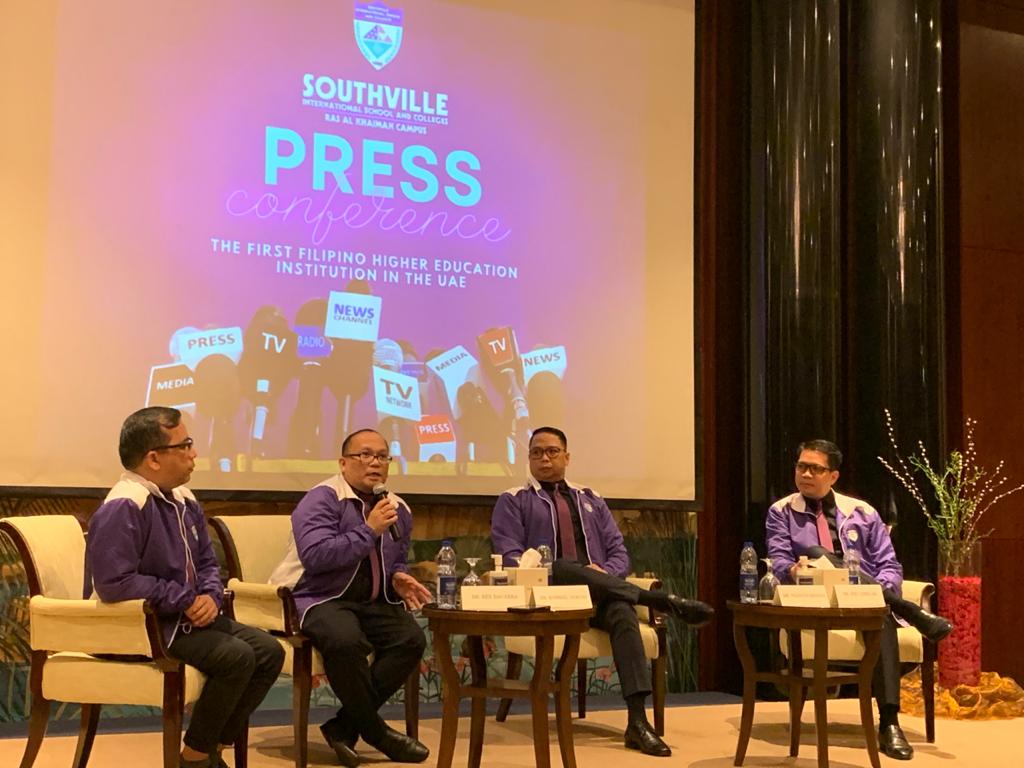
The four OFW academicians taking questions during a press conference. From left: Dr. Rex Venard Bacarra, Dr. Rommel Pilapil Sergio, Francis Errol Medina and Dr. Benigno Lebig. (Photo by Jojo Dass)

All four academicians have been bestowed the Dakilang Bayani Award. Sergio was also recipient of the 2016 Pamana ng Pilipino (Philippine Heritage) Presidential Award; he was associate professor and chair of the Human Resource Management Programme at the Canadian University Dubai and is currently with the Abu Dhabi School of Management. He was from De La Salle University (DLSU) where he has a doctorate in Psychology.

Bacarra, who holds two doctorate degrees, one of which is in Management Research from King’s College London in the United Kingdom, was also from DLSU, where he obtained his Doctorate in Philosophy. Prior to his current post, Bacarra was professor of Philosophy and The Humanities at The American College of Dubai.

Courses and accreditations

Meantime among courses offered are Bachelor of Science in Psychology, Accountancy, Marketing Management, Financial Management, BSBA in Entrepreneurship, and in Human Resources; and a Master’s in Business Administration.

Classes may be held online, face-to-face or blended.

As RAK is some two hours away from Dubai by car or bus, the school can arrange transportation, even a hostel, with a third party provider.

Southville International School and Colleges (SISC) is a private, non-sectarian school based in Metro Manila. It is ISO 9001-2015 certified and accredited by the  Accrediting Commission for Schools, Western Association of Schools and Colleges (ACS WASC) is a world-renowned accrediting association and one of the six regional accrediting agencies in the United States.

The school also welcomes other nationalities.

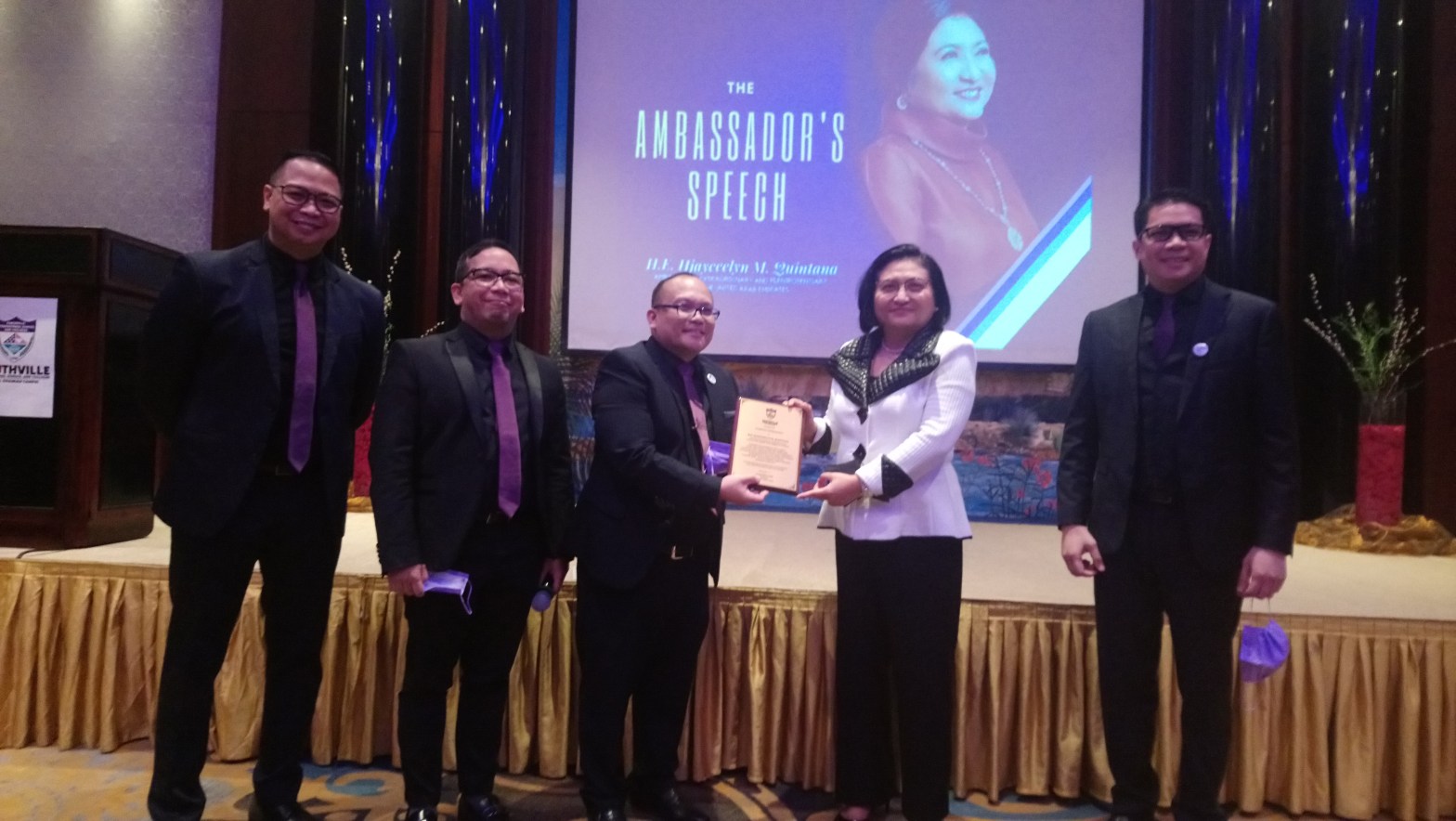
Main photo caption: Ambassador Hjayceelyn Aurora Quintana, head of the Philippine missions in the UAE, receives a plaque of appreciation from Dr. Rommel Pilapil Sergio. With them from left are Francis Errol Medina, Dr. Rex Venard Bacarra and Dr. Benigno Lebig. (Photo by Jojo Dass)

South Cotabato: How front liners repulsed a Covid onslaught in time for Christmas

As Metro Manila was battling Covid in March, medical front liners in South Cotabato, a province some 1,000 kilometers away, were already having all hands on deck to tackle the pandemic head on.

With help from the provincial government, they converted an infirmary into a Covid hospital and pushed hard to have their own swab test set up, instead of having to send samples to Davao City, which is some three hours away by land, and wait for 12 days to get results by which time the patient would have long died. Having the test done in South Cotabato, on the other hand, drastically reduced waiting time for the results to eight hours.

Koronodal, capital of South Cotabato and home to approximately 200,000 residents, reported its first Covid-19 case in March. By August, the situation started to worsen with an upward trajectory in the number of cases. Koronadal City, itself, appeared tethering on the verge with 196 cases of which 96 were active on September 30.

Eight months later on Dec. 27, total confirmed Covid cases in the entire province stood at 1,127 of which 1,029 have recovered; 64 were active ones, down from 75 several days earlier; and 26 have died, according to the South Cotabato Integrated Provincial Health Office’s Provincial Epidemiology and Surveillance Unit (SCIPHO-PESU).

Local officials concur that the numbers could have been far worse had the province’s medical experts not acted ahead of time and restrictive measures not put in place.

PNA photo by Roel Osano.

These holiday period, residents are taking on the festive hat, albeit with a bit of caveat as the threat of a coronavirus onslaught appears to have been repulsed following concerted efforts by the medical front liners, the provincial government and the private sector to flatten the curve.

‘First challenge’

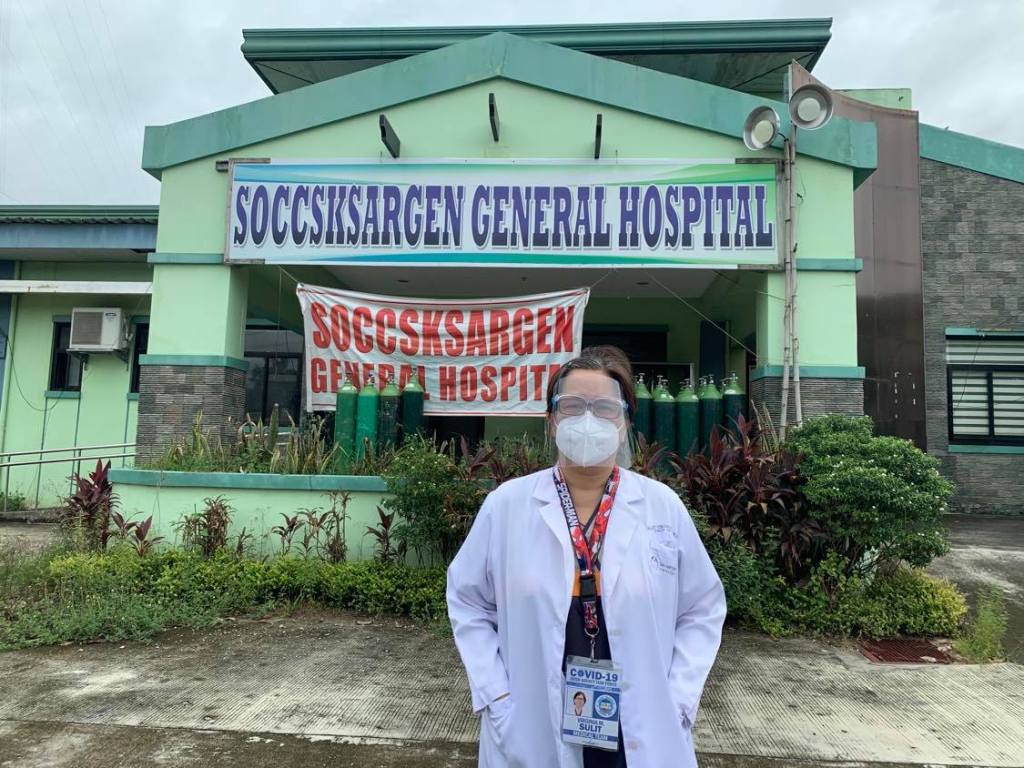
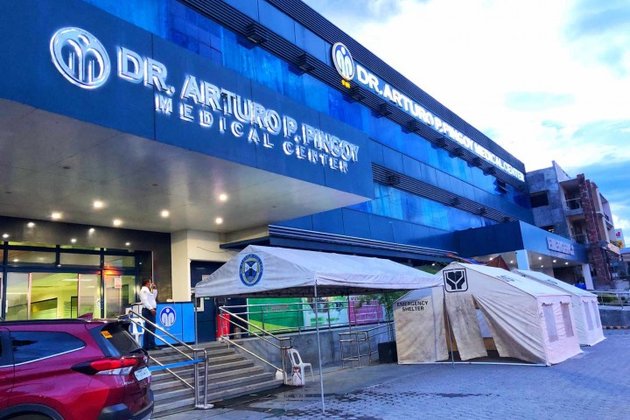
“First challenge was converting an infirmary into a hospital capable of taking in ICU cases,” said Dr. Virginia Montañano-Sulit, adult pulmonologist and Chief of Clinics at Dr. Arturo P. Pingoy Medical Center (DAPPMC) in Koronadal City, where the first confirmed Covid case was reported.

Dr. Virginia Montañano-Sulit

Dr. Sulit is also designated head of the South Cotabato Covid Medical Management Committee (SCCMMC), which has 21 consultant-members grouped into what is known as the South Cotabato Covid Volunteers (SOCOVID).

The team is composed of DAPPMC Medical Director, Dr. Nanette Pingoy-Franco, a rehabilitation medicine specialist; a surgeon; two pulmonologists, including Dr. Sulit, herself; two cardiologists; four anesthesiologists; a neurologist; a nephrologist; two family medicine practitioners; three internal medicine practitioners; two obstetricians; an endocrinologist; and an ear, nose and throat (ENT) specialist. All were on call 24-7.

‘Major make-over’

“It was a major make-over in terms of supplies, equipment, training of staff on critical care… most of what the World Health Organization’s (WHO) advised for Covid facilities. So, we had to set up the monitors and ventilators; prepare the supplies; train the different hospital staff on how to disinfect rooms and equipment, how to do the triaging of patients coming in, how to don and doff the PPEs, and so on,” said Dr. Sulit, a biology graduate from University of the Philippines – Diliman, who obtained her degree in medicine at University of the East – Ramon Magsaysay Memorial Medical Center.

“It used to be just an infirmary, but because of the urgency of the Covid situation,  the provincial government, the SOCOVID volunteers and the Dr. Arturo P. Pingoy Medical Center set it up at around the third week of March to accommodate moderate to critical cases. We began accepting patients in April,” Dr. Sulit said.

The converted infirmary, where moderate to critical Covid patients throughout South Cotabato would be sent for treatment, only has 18 ward beds and three ICU beds, according to her.

The Department of Health (DOH) Region XII took jurisdiction of the infirmary, which used to be the Upper Valley General Hospital, and renamed it as Socsargen General Hospital (SGH) in January this year.

Dr. Sulit said there were new buildings around the original infirmary because the long-term plan was to convert the whole compound into a hospital for all the five provinces comprising Region XII – South CotabatoCotabatoSultan KudaratSarangani and General Santos or SOCCSKARGEN.

Daunting

Meanwhile, an even more daunting task, Dr. Sulit said, was setting up Polymerase chain reaction (PCR) testing in Koronadal for faster release of the results instead of having to send samples to Davao City where it would take 12 days to confirm whether the person who was swabbed was positive or not.

“Back in March, Metro Manila was getting hit so bad with so many cases and so many healthcare workers dying. We were scared over here. At that time, we did not have access to testing. We had to send our swabs to Davao City and we would get the results after 12 days pa. By then, plenty of critically-ill patients have already died,” Dr. Sulit said.

She said there were also many incidents involving Covid suspects, who have died and were already buried or cremated within 12 hours of death as per DOH protocol, only to later on be declared Covid-negatives after test results have become available.

“The effect,” Dr. Sulit said, “was that so many sick people and the vulnerable ones avoided coming in for check-up and confinement due to fear that in case they die, there’d be no wake.”

Because the 12-day delay could not be helped, South Cotabato Gov. Reynaldo Tamayo, Jr. worked hand-in-hand with Dr. Rogelio “Toto” Aturdido Jr., head of the Integrated Provincial Health Office (IPHO); Dr. Pingoy-Franco, along with Dr. Conrado Braña, chief of South Cotabato Provincial Hospital (SCPH), to ensure that PCR testing be done in Koronadal City.

This, noting that by doing so, it would only take eight hours for the results to be made available, according to Dr. Pingoy-Franco.

Red tape

Having the PCR tests done in Koronadal was not really like moving mountains because DAPPMC, the only ISO-certified hospital in South Cotabato, already has the facility even before the Covid pandemic happened while SGH has the Genexpert machine.

Dr. Arturo P. Pingoy Medical Center

Dr. Sulit however lamented that red tape stood into the way of allowing DAPPMC to conduct the PCR tests using this technology even as preparations were gathering steam in the early months of the pandemic. “Surprisingly, despite this medical crisis, some people could not be flexible to fast-track what needed to be done to allow us to diagnose our patients much earlier,” she said.

She said the Genexpert machine and the cartridges were finally approved around May by DOH following persistent prodding by the South Cotabato local government and the medical front liners.

Genexpert is a type of PCR test that is faster than the traditional PCR or the RT-PCR (reverse transcriptase PCR), Dr. Sulit explained.

“Our province already had Genexpert machines for tuberculosis diagnosis even before Covid. Since available na ang machine sa SGH plus biosafety level 2 (BSL-2) capable ang TB laboratory ng DAPPMC, we fought to have the testing here,” Dr. Sulit said.

“It helped a lot that our governor was very supportive of us front liners. He and the the IPHO worked out the budget for our supplies. The business sector here also contributed a lot, including our fellow doctors who could not volunteer in the Covid hospital. So, it was a lot of sectors coming together to help us in the Covid center, including donors of food to hospital workers in the private hospitals,” she said.

The Covid laboratory, which was at DAPPMC, became operational in June.

PPE Diapers

Meanwhile, fighting Covid did not only mean struggling with red tape; it also meant having to bear the discomfort of having to wear diapers while wrapped in a PPE.

“You can’t change your PPE every time you need to pee, sayang yung PPE,” explained Dr. Sulit, adding that nurses at SGH have to wear theirs for six hours straight while those in the private hospitals need to for 12 hours of duty shift. “So, all the more the need to wear diapers often,” she said.

Dr. Sulit said they also have washable coveralls to save on hazmat suits. “We reserved the hazmat suits for the anesthesiologists when they intubate patients, for the surgeons and for the nurses assisting them,” she said.

“It was tough last March till May. Because of the lockdown, walang mabilhan ng hazmat suits kasi no flights. So initially, konting hazmat suits, mostly cloth washable coveralls,” she added.

‘Heavy months’

By August and September, Koronadal’s residents started feeling the coronavirus’ presence in their midst as numbers went on an upward trajectory from 16 total Covid cases on August 19 to 196 on Sept. 30 of which 96 were active, according to the city government.

Mindanews.com

At the converted infirmary, Dr. Sulit said beds started to be in full capacity.

“The SGH staff was divided into three teams of nurses, med technicians, X-ray technicians, pharmacists, respiratory therapists, utility workers, dietary and laundry staff,” she said.

“Nurses took six-hour shifts. Each team has a doctor resident on duty. And then there’s us, the SOCOVID  volunteer consultants with our designated on-call days. Each team stays in the Covid center for seven days then goes into quarantine for 14 days,” Dr. Sulit.

She said all SOCOVID volunteers could be called upon to assist when extra hands were needed. “We have been available 24/7 by phone, by messenger and when asked to be there. If the first call was not available, the second and subsequent on-call were asked to respond,” she said.

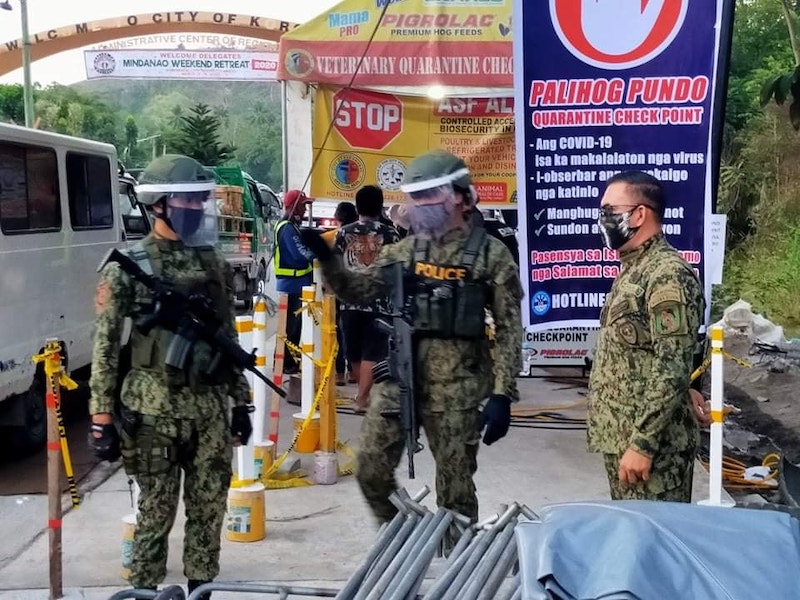
To address the situation, Koronodal Mayor Eliordo U. Ogena placed Koronadal under General Community Quarantine (GCQ) from Sept. 26 to 30; and under Modified General Community Quarantine (MGCQ) from Oct. 1 to 31 except for areas placed under Enhanced Community Quarantine (ECQ) or lockdown.  

The city, for the past previous months have been under MGCQ despite recommendations by the South Cotabato Medical Society (SCMS) for a full lockdown.

Dr. Aturdido Jr., for his part, told a press conference held Sept. 23 that South Cotabato was bearing the brunt of the pandemic. “We can no longer determine the origin of some infections that were detected in our communities,” he was quoted as saying during the media briefing.

According to IPHO, there were some 22 Covid-19 infections among medical and health workers in the city the week before, with 11 coming from the City Health Office (CHO), 10 from the South Cotabato Provincial Hospital (SCPH), and one from a private hospital.

Aturdido also said study showed that coronavirus’ infection rate in Koronadal city was very high at 13.07 percent per 10,000 of the population from August to the second week of September – meaning 13 people in every 10,000 of the population could contract the disease during this period.

Things finally got better by late October, an indication of which was an announcement by City Health Officer, Dr. Edito Vego made on the city government’s Facebook page, that they have stopped using a hotel as a Covid-19 isolation facility because the number of cases has continued to decrease.

Looking back, Dr. Sulit said the arrival of locally stranded individuals (LSI) as well as returning overseas Filipino workers (ROFWs) factored in.

“When the locally stranded individuals and ROFW’s or returning OFWs started getting bused in and flown in, the numbers rose. Understandable yun, kasi imported ang Covid. Manila and Cebu have international flights getting in, then Covid dissipated to the provinces,” she said.


Festive

On Dec. 8, the city government officially opened the Paskuhan Village at  Prime Regional Center on  Carpenter Hill as part of a Christmas campaign dubbed “Paskoronadal 2020,” highlighting festive celebrations in the new normal.

Relative calm has descended and residents were keeping fingers crossed that the worst was over. Nonetheless protocols like social distancing and the wearing of masks, remain to be strictly enforced.

Koronadal City is the administrative seat of Region XII.  It is also famous for its waterfalls and the annual Hinugyaw Festival.

South Cotabato, also called as the “Land of the Dream Weavers” yearly celebrates the T’nalak Festival. T’nalak is the cloth woven by the lumads, which, in the province, are called B’laan and T’boli.

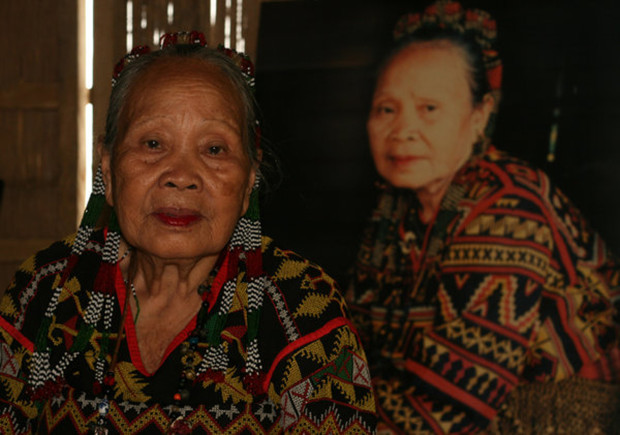
Lang Dulay (Mindanews.com)

Among prominent figures of the country was one such weaver – Lang Dulay, a recipient of the National Living Treasures Award, who was a well-known T’nalak weaver from Lake Sebu, South Cotabato. She passed away in 2015.

Former Dubai OFW launches Christmas food drive for the homeless

DUBAI: Santa Claus came to town in San Pedro, Laguna for Christmas.

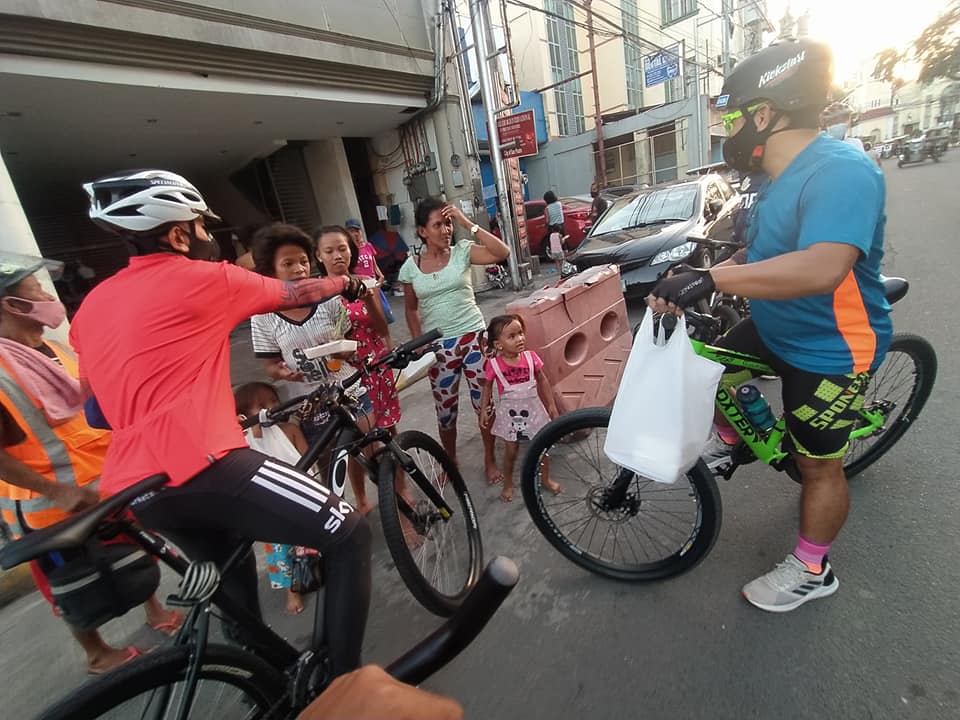
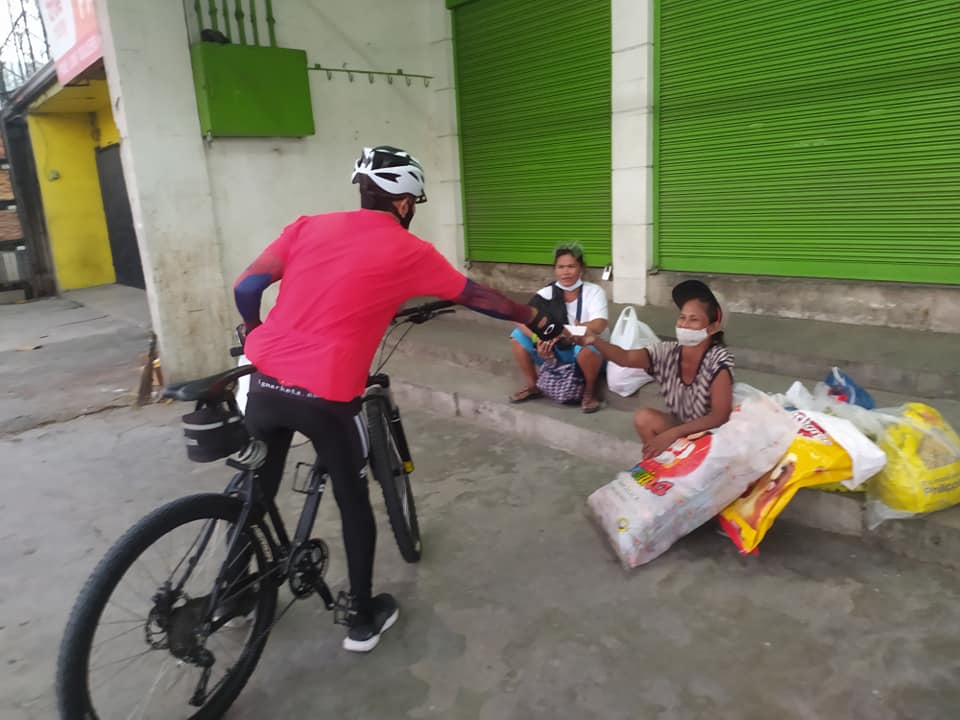
But not on his reindeers, rather on a mountain bike with friends, handing out food packs of lechon manok, pancit canton and lumpiang shanghai to the homeless for Noche Buena on Christmas Eve.

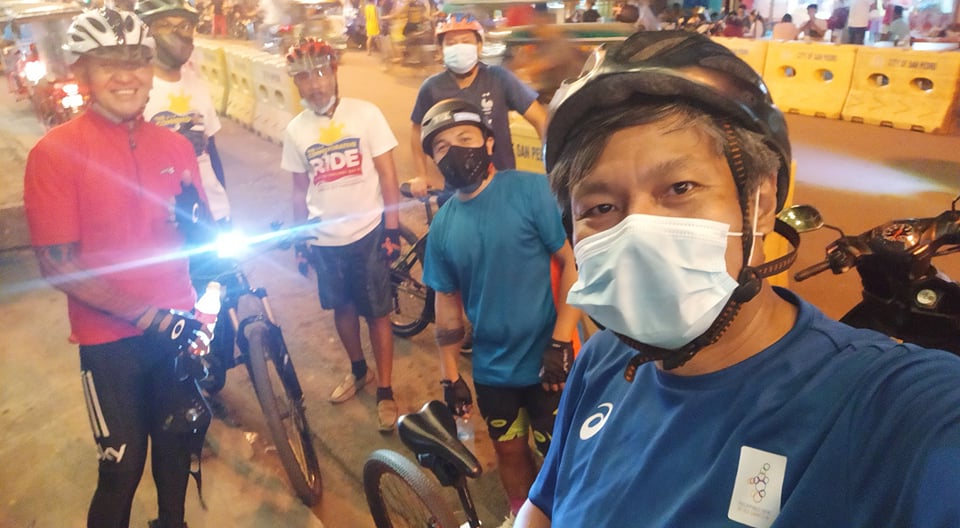
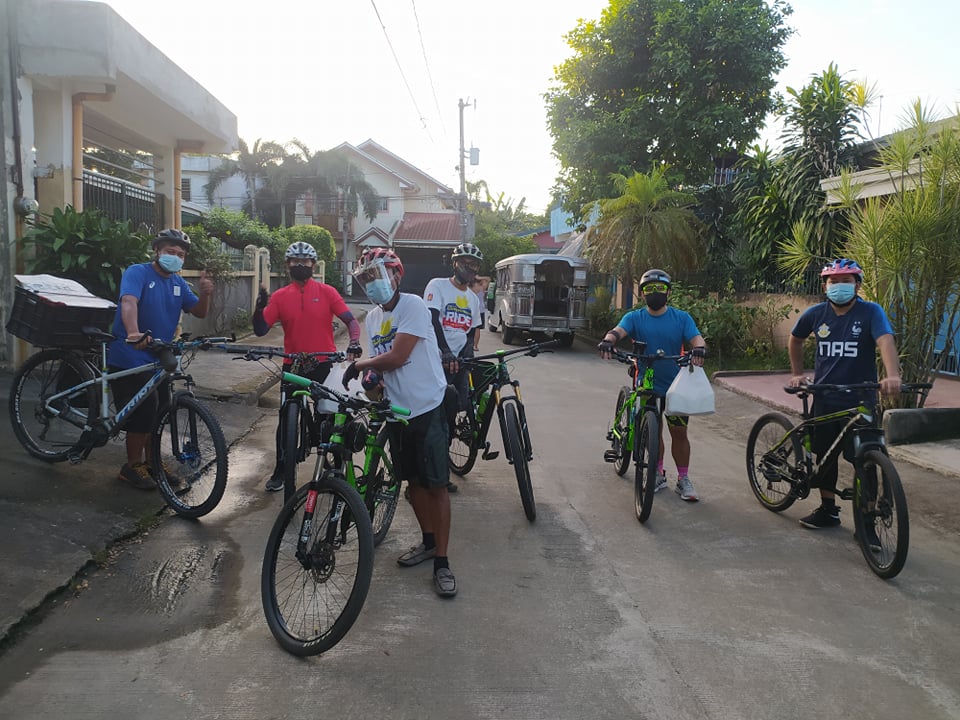
Mike Zuniga pose for posterity with friends during their Noche Buena food distribution in San Pedro, Laguna. (Contributed photo)

Fifty-one-year-old Mike Zuniga, an accountant-turned-fulltime-professional-photographer in Dubai, who launched the initiative dubbed, “Padyak Noche Buena,” said he came up with the fundraiser because less fortunate people also deserve to feel the Yuletide spirit.

“We are not rich and we have to scrape every bit of food we put on our table,” said Zuniga, who arrived in the United Arab Emirates (UAE) in 2006 and has gone back to the Philippines for their kids’ college.

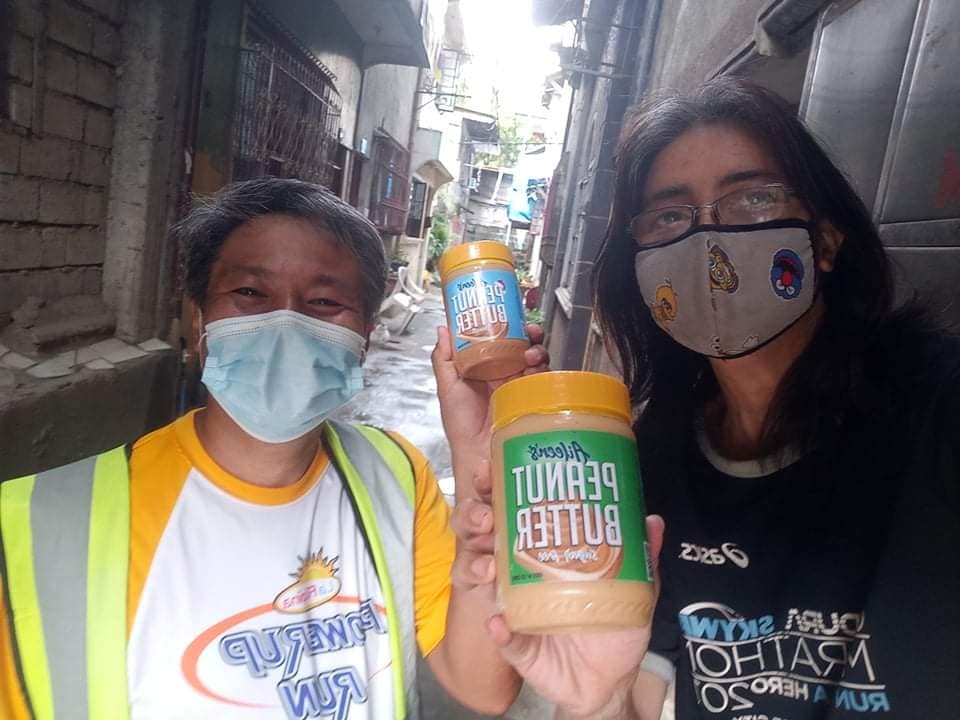
From their place in San Pedro, Laguna, Zuniga at times went as far as Lagro in Fairview; Caloocan; Pasig; Imus, Cavite; Meycauayan, Bulacan; even Antipolo, for the peanut butter deliveries made cycling on his mountain bike. (Contributed photo)

“But seeing these people with less than what we have, we started to give anyway. Gusto ko talaga tumulong. Pero dahil sapat lang ang pera namin, akala ko hindi ko kayang tumulong. Pero sa maliit na halaga, nasimulan ko at ngayon, sa halagang biente pesos pwede pala. Maliit na halaga para sa atin, pero malaki na siya sa mga walang wala,” he added.

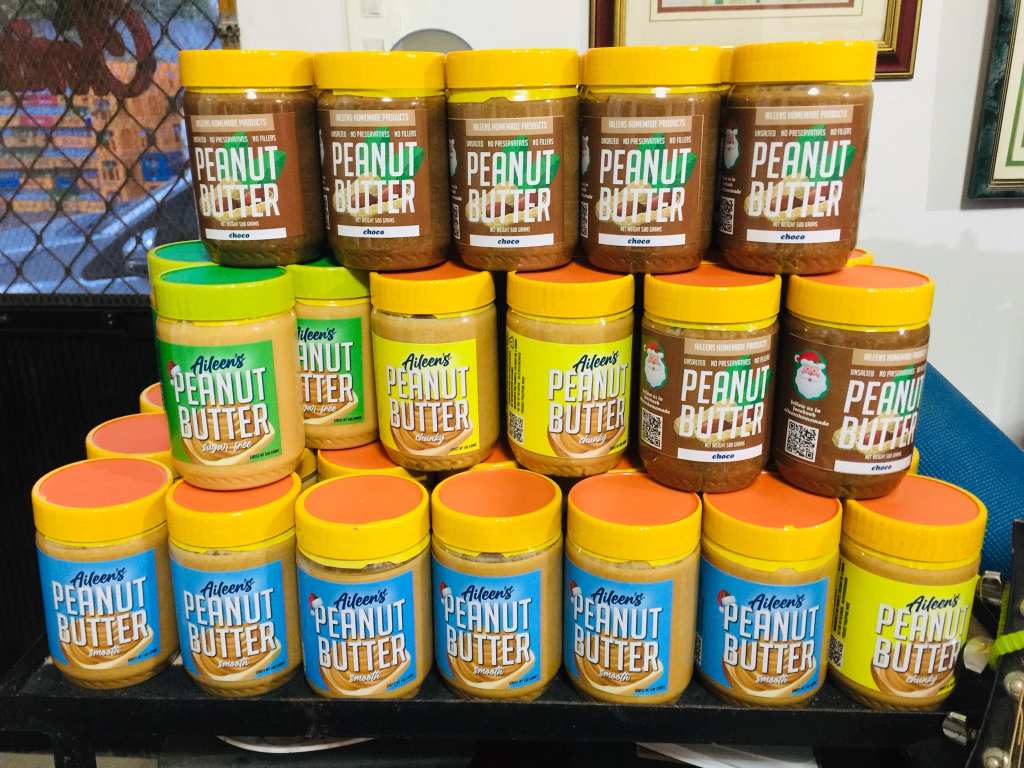
Zuniga, his wife, Aileen and kids prepared homemade peanut butter that came in a variety of flavors and sold them online, of which P20 pesos from each jar purchased was set aside for the Noche Buena food-for-the-homeless project. Donations also poured in.

Zuniga, a blogger, said they initially targeted 100 beneficiaries. “We went way beyond the 100-people mark. But we are still encouraging people to donate kasi we still have other projects lined up,” Zuniga said. Sales and deliveries were made from Dec. 1 to 23.

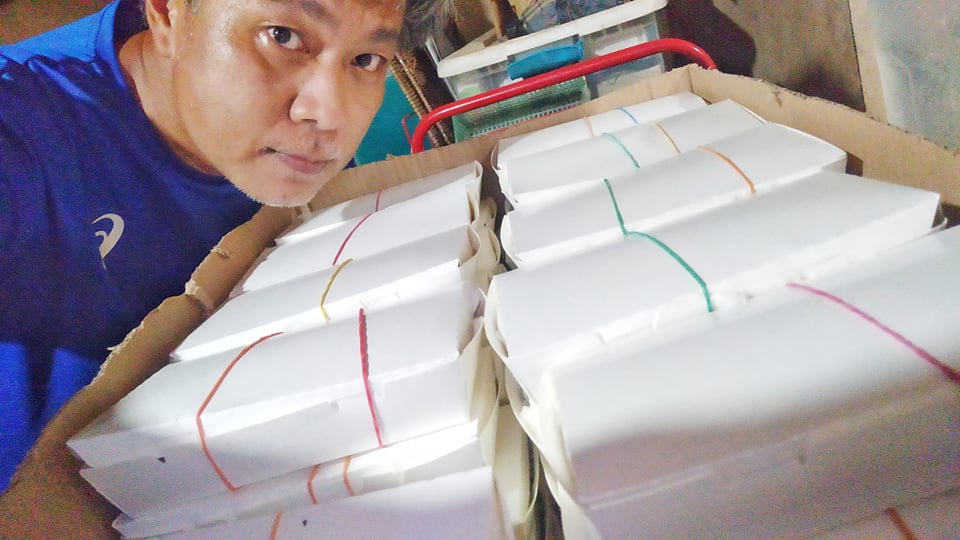
The food packs.

Deliveries

From their place in San Pedro, Laguna, Zuniga at times went as far as Lagro in Fairview; Caloocan; Pasig; Imus, Cavite; Meycauayan, Bulacan; even Antipolo, for the peanut butter deliveries made cycling on his mountain bike.

“Ang deliveries namin started within San Pedro, Laguna muna then being a blogger here, I started selling sa blogger friends ko, who were in Makati and Manila. Magulo sa simula basta may bumili, nagde-deliver ako by bicycle.

“Once a week, we do Cavite; twice a week for the Metro Manila deliveries; and from time to time, Calamba. Kapag may total 8 minimum jars ordered na, nagde-deliver na ako,” Zuniga said.

Mike Zuniga during one of his deliveries.

To boost sales, he said, he put some add-ons like bagnet and longganisa from Vigan, danggit and dried squid from Cebu and homemade longganisa and tocino, “para lang sila bumili ng isang peanut butter, matikman lang.

“Once matikman nila ang peanut butter, I was confident then that mag-order sila ulit,” said Zuniga.

Do-it-yourself peanut butter

Making the peanut butter was not easy, recalls Zuniga.

“Wala po akong alam kung paano gumawa ng peanut butter,” he said. “Nagsimula lang siya sa pandemic at naglockdown dito. Need ko lang ng palaman sa tinapay kasi ito ang murang paraan para maitawid ang gutom sa gabi kasi nga bawal lumabas.

“We love peanut butter and we realized mahal ang peanut butter sa grocery. So nag-search ako sa YouTube kung pano gumawa at nakita ko naman madali siyang gawin. pero un ang akala ko. hindi pala,” Zuniga added.

With help from friends, and following at least two months of trials and errors, they finally hit the spot – after which they decided to sell from a P500 start-up, then went the extra mile and launch the Noche Buena food drive.

The peanut butter comes in four varieties – “Smooth,” which is their bestseller; “Choco,” “Chunky,” and “Sugar-free,” which is best for kare-kare, Zuniga said.

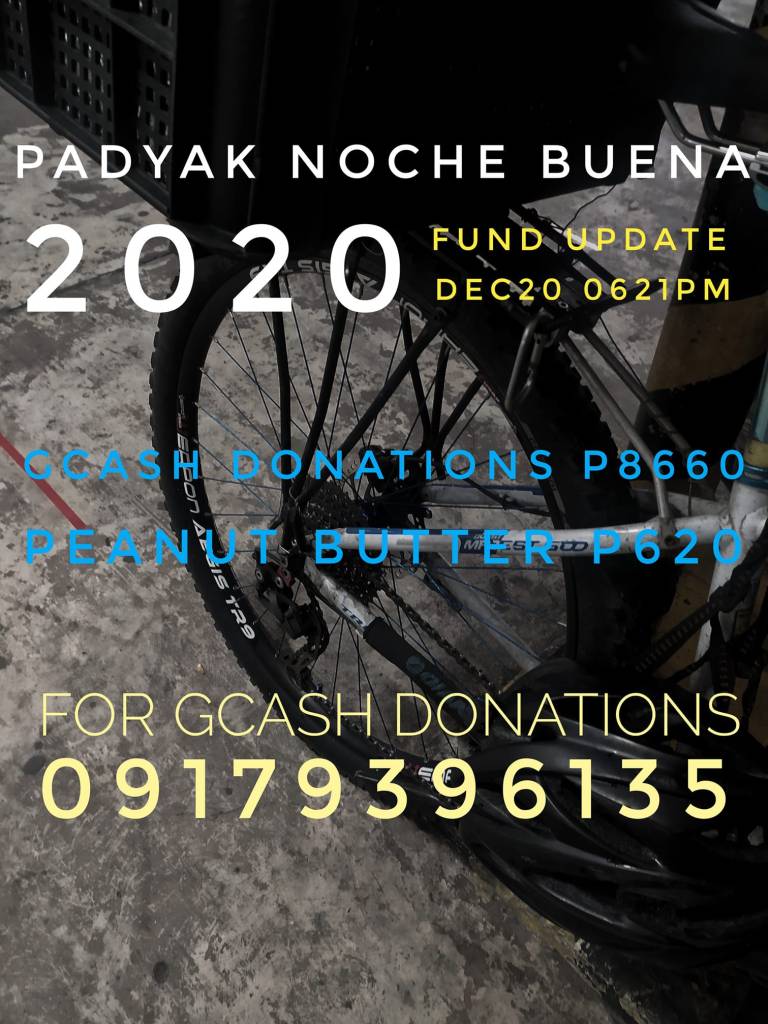
By December 20, the food drive had P8,660 in donations and P620 in sales. Price of the peanut butter starts at P140. Beneficiaries were the homeless in San Pedro, Laguna.

Source: Mike Zuniga’s Facebook

Zuniga said peanut butter production stopped on Dec. 23 and will resume on January 4.

Covid risk assessment officer catches the virus – at home

DUBAI: Here’s a Christmas lesson about not being complacent with the coronavirus these holidays.

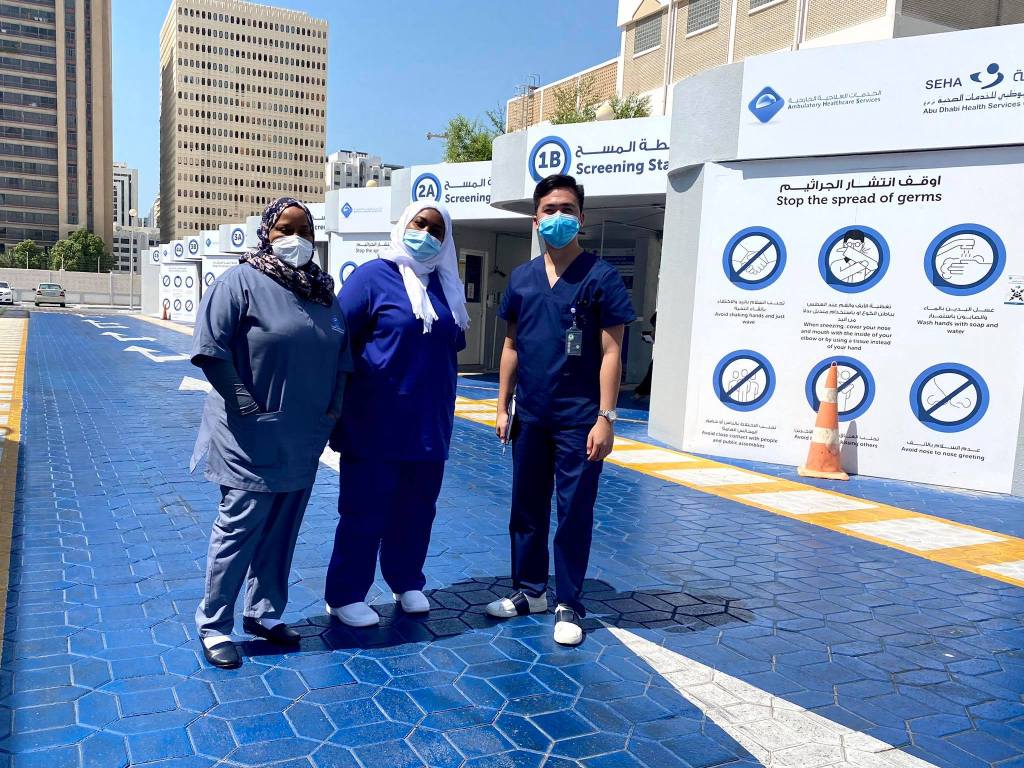
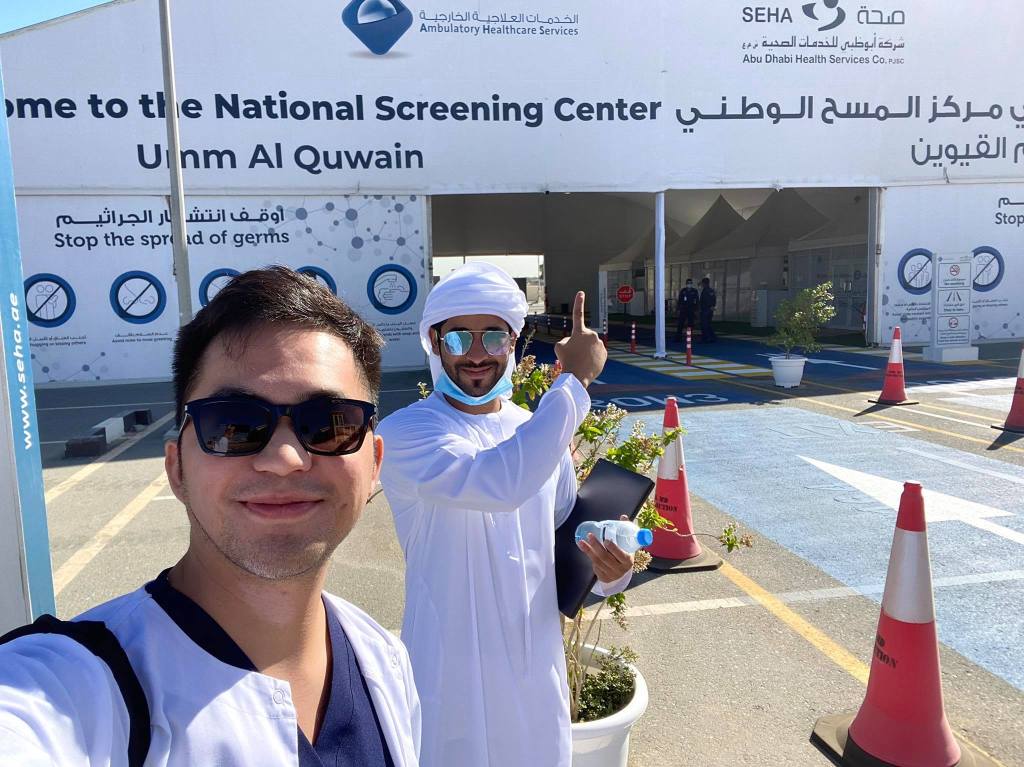
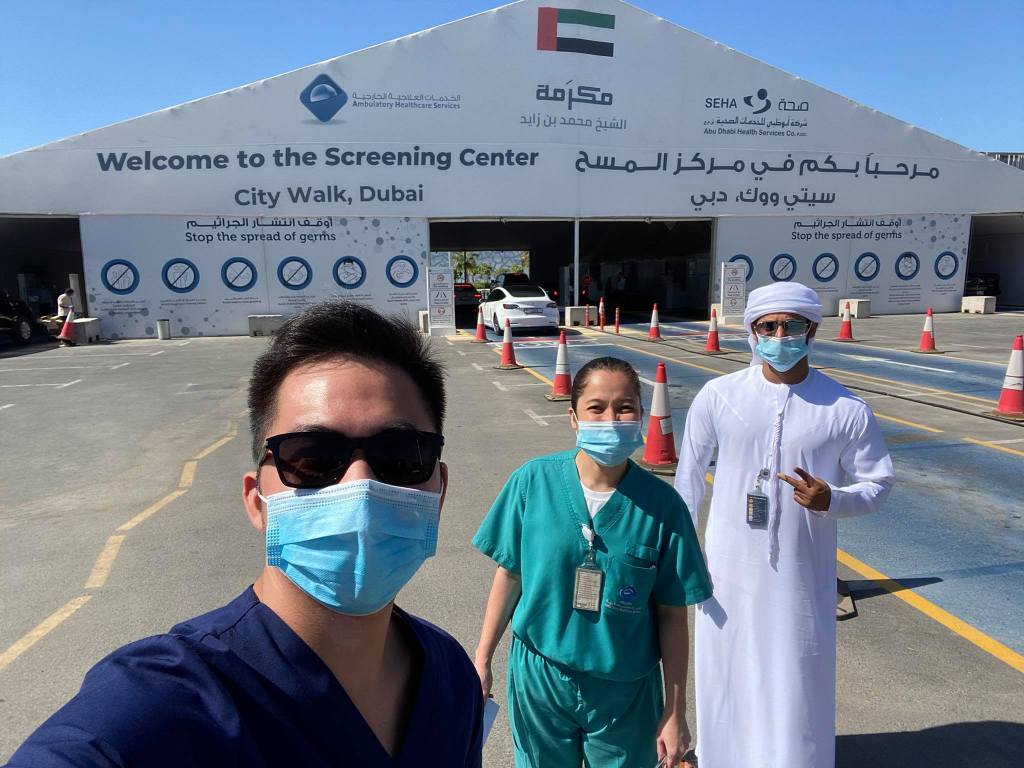
An overseas Filipino worker (OFW), tasked to inspect Abu Dhabi’s government-run Covid screening and vaccination facilities, himself ended up infected with the virus that he contracted not at work, but of all places, in his home.

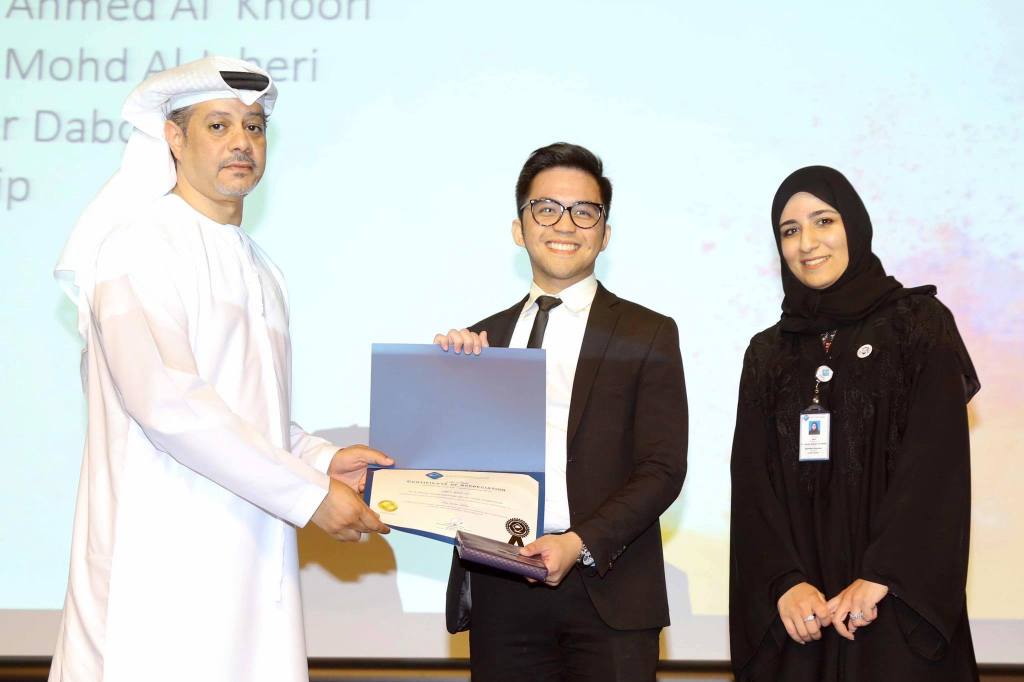
Dan Lester Dabon accepting an award

“Akala namin normal sakit lang yung nangyayari sa kanya,” said Dan Lester Dabon referring to a family member whom he looked after for three days while in sickbed. “I managed and provided care when he was so sick. We later learned that he was COVID-19 positive,” he added.

Dabon, who consequently spent three days of home isolation and another 15 in a Covid quarantine facility where he stayed till Dec. 15 after getting two consecutive negative PCR results, said what happened should remind everyone not to let their guard down on the coronavirus.

Dan Lester Dabon while in quarantine.

“Importante ang discipline at ang pagiging proactive,” said Dabon, a quality, risk and patient safety professional. He started his home quarantine on Nov. 27 even before learning that his sick relative was Covid-positive, apparently acting on suspicion which comes with his job being a risk assessor. He was admitted to the Covid quarantine facility on Dec. 1.

Dabon, who has also opened a healthcare consulting services agency which aims to to help bring healthcare standards in the Philippines to international standards, said he felt scared when he started feeling strange and later on tested positive.

“But I was confident because I did not expose any person at home, workplace or in the community,” he said.

“When I knew that the person was COVID-19 positive, I immediately contacted my colleagues and informed them that I was exposed. On the same day, I went with our occupational health officer to visit the nearest healthcare facility,” he narrated.

From there, Dabon said he was swabbed and a “quarantine watch” connected to a GPS was strapped to his wrist before being advised for a home quarantine.

“The next day, I was called by a contact tracing officer from the Department of Health (contact tracing) to visit the COVID-19 Prime Assessment Center (PAC) at Abu Dhabi National Exhibition Center (ADNEC). I did another swab and on the next day, I tested positive.

“On that same day, I returned to ADNEC for proper medical screening such as physician consultation, Rapid PCR Test, blood tests, X-Ray and electrocardiogram (ECG). Even though the results were not available, I insisted to the physician that I  be admitted to a hotel quarantine facility because I was having the symptoms such as high grade fever, sore throat, body malaise as well as pain and severe headache,” Dabon further shared.

He said he was provided with supportive treatment at the quarantine facility. “Meaning, I was treated based on symptoms. Moreover, supplements were also given such as Zinc, Vitamin C and other multi-vitamins,” he said.

Dabon said his sick relative has also finally tested negative for Covid-19. “Pero malala yun case nya, kasi nag anti-viral sya at ni-refer sa hospital,” he said.

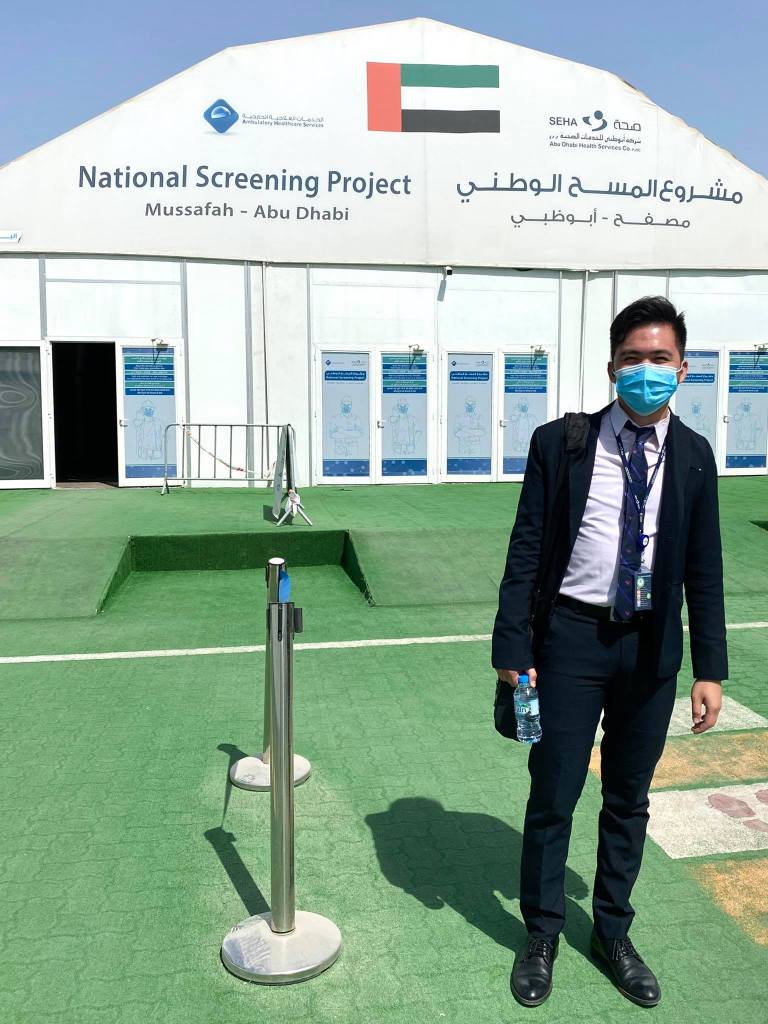
Working at the largest ambulatory or primary healthcare setting in the Middle East under the government of Abu Dhabi as risk officer, Dabon routinely inspects up to 250 school health services across in public schools across Abu Dhabi and neighboring Al Ain, four mobile clinics, 17 drive-thru screening centers; two Covid-19 Prime Assessment Centers (PACs); 11 disease prevention and screening centers (DPSCs) and 31 multi-specialty healthcare centers, among others.

“Yan lahat iniikot ko,” said Dabon. “Nag-iinspect ako ng mga risk and safety issues sa mga drive-thru and national screening projects dito sa UAE. Nagko- conduct ako ng proactive risk assessment para ma-ensure na each process is safe for the patient, staff and the general community. In short, ina-anticipate ko ang mga bagay before mangyari ang isang incident,” he added.

The following day after being discharged from the ADNEC Covid facility on Dec. 15, Dabon went back to work where he could face another risk of coronavirus exposure. “Direcho duty mag-inspect sa Abu Dhabi vaccination facilities,” he said.  

MERRY CHRISTMAS! Dubai Pinoys send home balikbayan boxes full of gifts

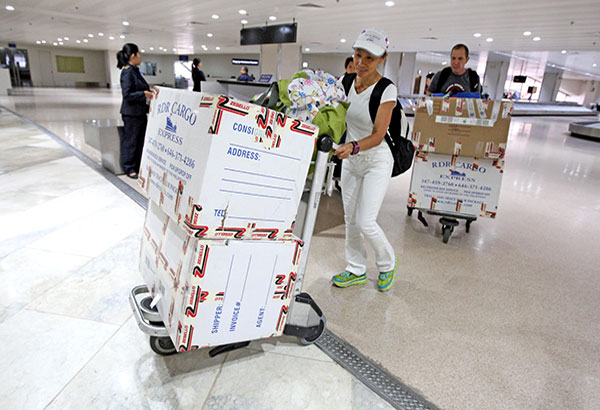
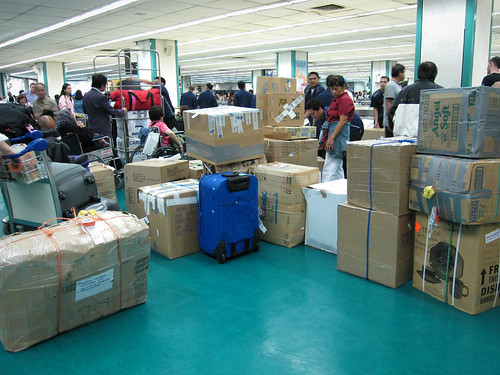
DUBAI, United Arab Emirates –  As the UAE’s economy springs back to life following months of coronavirus quarantine measures months ago, Filipinos have risen up to the occasion, sending balikbayan box-full of goodies and wish-list gifts for their loved ones’ Noche Buena back home.

Photo from Philippine Star

Indeed! Come hell or high water, Filipinos in the UAE are not giving up on this tradition.   

And so it goes that pandemic or not, Covid-19 or what not, the spirit of Christmas prevails among overseas Filipino workers (OFWs) who, despite the immensely challenging times, have been managing to send gifts to their loved ones back home through balibayan boxes.

The “Ber” months have traditionally been peak season for door-to-door forwarders as OFWs start shipping boxes, which they have religiously started filling up around March with favorites, Noche Buena groceries and requested items that they bought mostly from sale events and discount stores.

Some did got the knack of it by surviving through “ayuda” free meals from Good Samaritans during the quarantine days, so they could save for their balikbayan boxes.

It takes at least two months for a balikbayan box to make it to the Philippines in time for the Christmas holidays – all things considered like port congestion, shipping time and delivery points, cargo forwarders said, adding that with this, the volume of cargo starts to peak around September.

Upswing

Allan Michael Bautista, head of the 15-member League of Freight Forwarders (LFF) in the UAE, said members have been reporting a gradual upswing in transactions. Last year, he said up to 7,000 boxes were being shipped every week to the Philippines during the Christmas peak season.  

Allan Michael Bautista, head of the 15-member League of Freight Forwarders (LFF) in the UAE

“We’re happy to hear among members of the LFF that business continues to pick up during this period and we’re looking forward for this trend to continue in the months that will follow till Christmas,” Babauta said.

Murali “Mike” Ragavan, owner and managing director of Makati Express, a door-to-door cargo forwarder company operating in Dubai over the past 20 years, for his part said the trend in sending balikbayan boxes home for Christmas has been changing in the past three to four years.

“The mindset has changed,” he said, explaining that port congestion issues have caused many OFWs to instead send in January or July, which he described as the peak months.

The ‘Ber’ months “are still high,” he said, but not as high as eight to 10 years ago when the volume “shoots very high before Christmas.”

Pandemic’s impact

Bautista said “a few forwarders based in the UAE decided to temporarily stop their services during the first few months of the pandemic.”

Ragavan said this was mostly during the quarantine months of April and May this year.

“In June, it suddenly surged high because people started travelling back and it peaked in July,” he said.

Bautista said demand eventually picked up as policy was eased and commercial businesses re-opened. “Even in the midst of the pandemic and during lockdown, OFWs pushed for ways to send whatever their families needed back home,” he said.

With thousands of OFWs having headed home after losing jobs in the past months, Bautista said cargo forwarders managed to stay afloat. “Nakakatulong ang ating mga LFF members para maiuwi ng ating mga kababayan ang kanilang mga kagamitan sa Pilipinas,” he said.

‘New Normal’
 
Bautista said they were, in this period of the “New Normal,” expecting the trend of sending balikbayan boxes to continue “as many of our kababayans will not be able to come home for the holidays with their family.”

He however noted that cargo forwarders are “anticipating (a) much longer lead time… given restrictions that are still ongoing sa ilang siyudad at rehiyon sa ating bansa due to the pandemic.”

The LFF was formed in 2018 to address concerns about OFWs falling victim to fly-by-night operators.


PANDEMIC CHRISTMAS. Pinoys skip holiday homecoming

DUBAI, United Arab Emirates (UAE) – Overseas Filipino workers (OFWs) around the world are skipping plans to be home in the Philippines mainly because of Covid-19.

From the United Kingdom and Italy to Canada, Tunisia, UAE and even the tiny Pacific island of Saipan, which is just two hours away from Manila by plane, overseas Filipino workers (OFWs) are skipping their traditional Christmas homecoming due to restrictions and fear of contracting the virus.

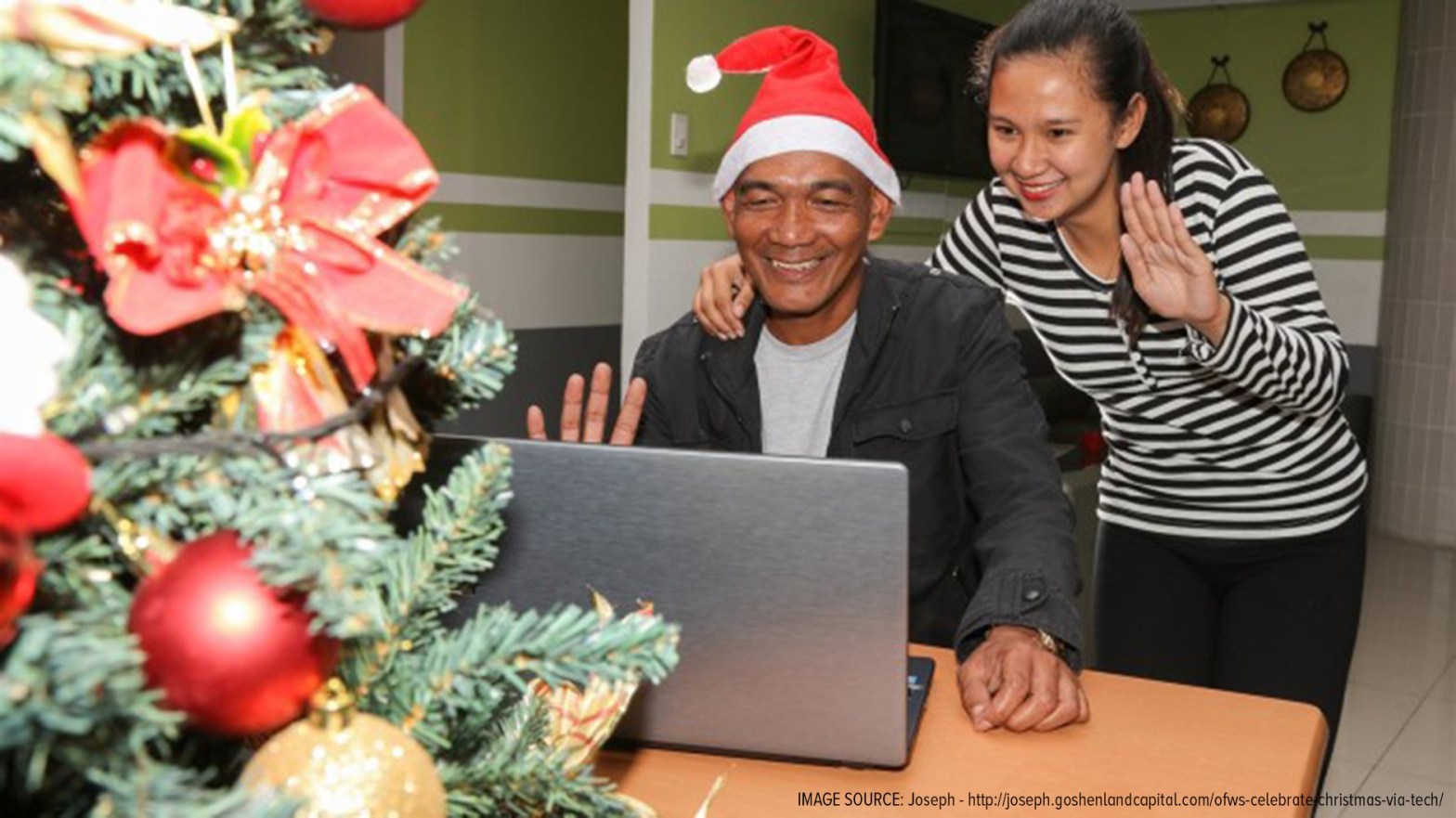
To make up for their absence, OFWs said they will instead be resorting to video chat apps and teleconferencing platforms as they celebrate the yuletide season under the new normal while the world anxiously waits for the vaccine that would eradicate the scourge.

Restrictions

“I can’t go home in the Philippines for Christmas due to the Covid-19 situation,” said 47-year-old Marvin Moreno of San Pedro City, Laguna and a clinical nurse at Milton Keynes Urgent Care Service (MKUCS) in Buckinghamshire, England.

Marvin Moreno

“The restrictions being imposed in the Philippines to all foreign travelers have caused me and my family to stay here and defer our Christmas holidays there,” added Moreno, a British passport holder, who arrived in England on April 4, 2004 and was last home for Christmas in 2015. He has been a Philippine Registered Nurse since 1995 and has passed requirements to obtain eligibility to practice his reception in England..

There are approximately 18,500 Filipinos in the United Kingdom’s government-run National Health Service (NHS). The country has, early this month, started its Covid-19 vaccination drive.

Moreno said they have sent a balikbayan box and will be getting in touch with family through video calling. “It’s always a sad feeling not to be with our family during Christmas time in the Philippines, but we keep our video calling on while we celebrate the Noche Buena so we could both feel our presence despite being separated by the distance. It’s sad to celebrate Christmas far from home; much more so when all nations are in crisis due to this pandemic,” Moreno said.

The Philippines is eight hours ahead of England such that it will be 4pm in England when the clock strikes midnight for the traditional Noche Buena in the Philippines.

Clarissa Medina

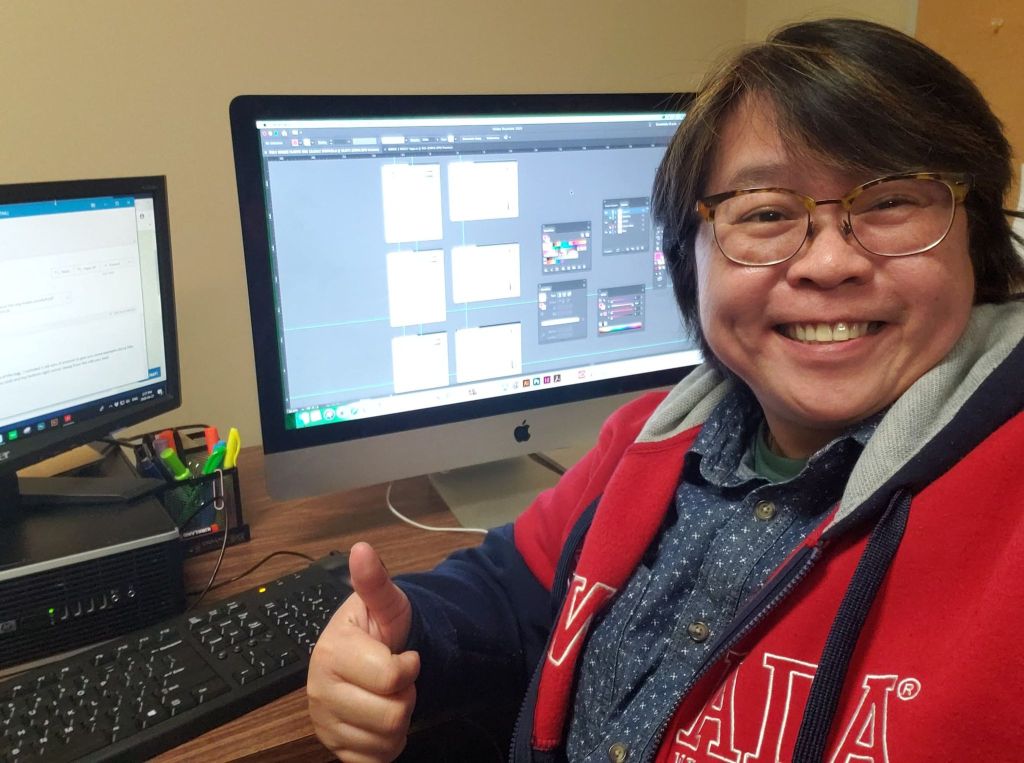
Meantime in Winnipeg, Manitoba, a province in Canada, graphic designer Clarissa Medina huddles herself for yet again another cold Christmas away from home.

“Malungkot pero nasanay na rin mula nang mag-OFW a long time ago,” said Medina, who has been working elsewhere abroad since the mid-90s.

“People just need to toughen up a bit to ignore the stones and thorns along the way,” said Medina, who was last home for Christmas three years ago and was planning to be home for the holidays this year.

She said she has been in constant communication with her loved ones through Facebook.

In Italy, house chef Roderick Ople likewise said he has gotten used to being away from home on Christmas, saying the last time he was with his family for the holidays was five years ago. “Nakaka-miss din kahit nasanay na,” he said.

Ople said he has sent a balikbayan box of goodies, remitted money and was in touch through Facebook as well.

Nanny

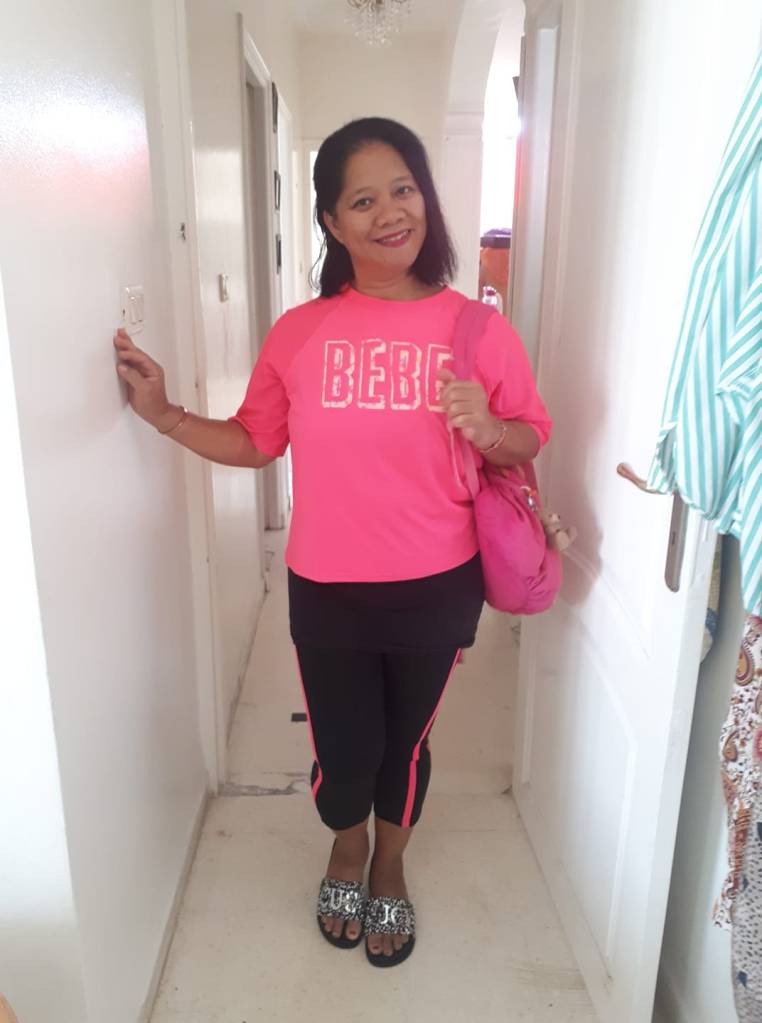
Maricris Gapi

Meantime, Maricris Gapi, single and a nanny, will not make it to the Philippines for Christmas.  

Instead, she’ll be in Manouba, Tunisia spending time with her wards – a twin – whom she has been looking after since they were five months old when she started working for the family in May of 2010.

“For some reason I got stuck here because of the pandemic,” Gapi said.  

The family used to stay in Dubai, but the parents had to send their twins, along with Gapi, to Tunisia in September last year.

“My madam was having a hard time in Dubai. So, the kids were sent here (in Manouba) for school,” Gapi said.

Gapi said she has developed affection for the children and bonding with their parents such that she now considers them her family as well and would not mind spending Christmas with them again as she has always done in the past 11 years.

“Na-in-love na rin po ako sa pamilya nila,” said Gapi, whose parents have passed on and who has siblings in the Philippines that she has sent some money for the holidays.

Gapi has been in Dubai for the past 26 years.

Balikbayan boxes

In Abu Dhabi meantime, Sheryl Abella Palacios-Manalo, medical practitioner who has not been with her family back home for Christmas for the seventh consecutive year, said she has been doing all she can to make up for it.

Sheryl Abella Palacios-Manalo

“Pilit kong ibibigay lahat ng gustong regalo ng aking dalawang anak,” Manalo said. “Nakapag-padala na din ako ng balikbayan boxes. Every day we are communicating thru Facebook messenger kasi meron kaming family chatgroup. Also, from time to time, Zoom meeting with my kids, mom and brother with his family,” said Manalo, who arrived in the UAE in 2007.

“Kulang ang diwa ng Pasko. If miracles do come true, I would really wish to spend Christmas with my family. I want to hug them all tightly to show how much I miss and love them,” she added.

Cancelled family reunion

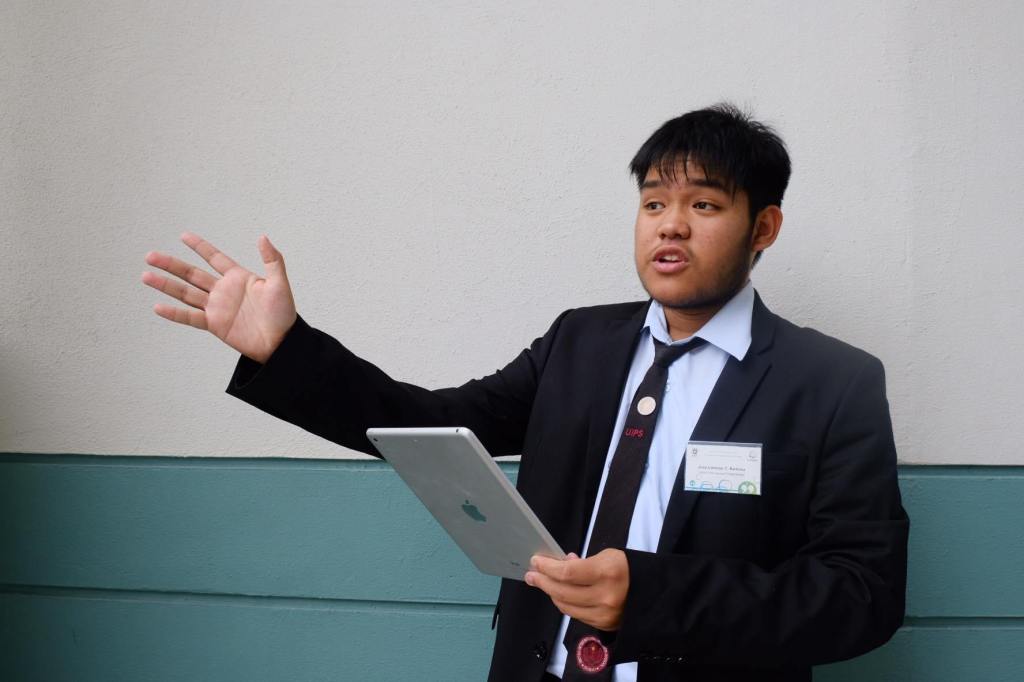
Nineteen-year-old Jose Lorenzo C. Barbasa, the only child of a Dubai-based OFW couple, meantime said, he and his parents were supposed to fly to the Philippines for a holiday reunion with the entire family in Bacolod City, Negros Occidental.

Jose Lorenzo C. Barbasa

“We originally had two plans: one for summer 2020 and another Christmas 2020. If summer 2020 was not to be, then we could have flown home for Christmas,” said Barbasa who is currently attending university studies in Dubai on remote, taking up a course in Business and Marketing Management.

“However,” he added, “we decided to stay home and let the Covid situation weather out until it is really safe enough to travel back home; we are also monitoring the Philippines’ handling of Covid.”

The last time the Barbasas were in the Philippines was in June of 2016 to celebrate a family grand reunion for his paternal grandparents’ golden wedding anniversary..

“Skipping Christmas in the Philippines is a little painful since we have never gone home for Christmas in almost a decade. Since our families are mostly in the Philippines and the US, we plan to meet all together via Zoom and have a family catch-up on Noche Buena,” Barbasa said.

Barbasa lives with his parents – a teacher-assistant at a British school and an assistant service manager for a dealership of Dubai buses – in Muhaisnah 4 in the outskirts of the city.

For her part, Mariecar Blanco Jara, a journalist who writes for a print and online media based in Sharjah, a city next to Dubai in the north, said she decided it was more reasonable to just stay in the UAE for the holidays.

Mariecar Blanco Jara

“The irregularity of international flights and surprise lockdowns make it more practical to stay where we are right now,” said Jara, adding that it has been three years since she was in the Philippines for Christmas.

“I call up my parents every Friday. I chat with my three children. I send Christmas cash gifts,” Jara said.

Peak season

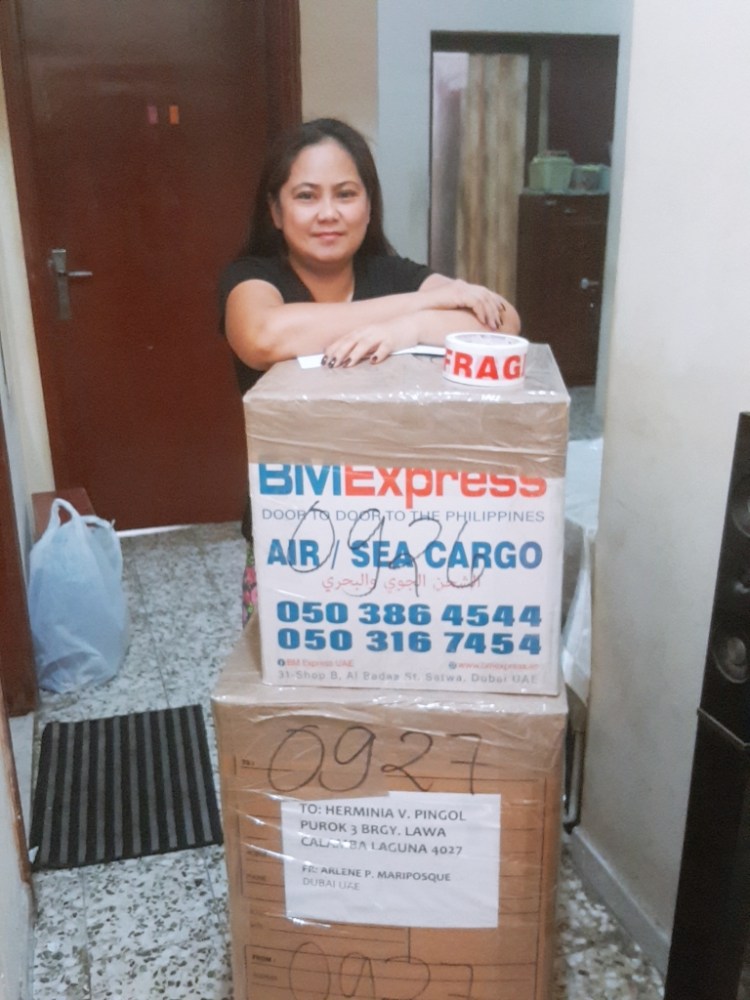
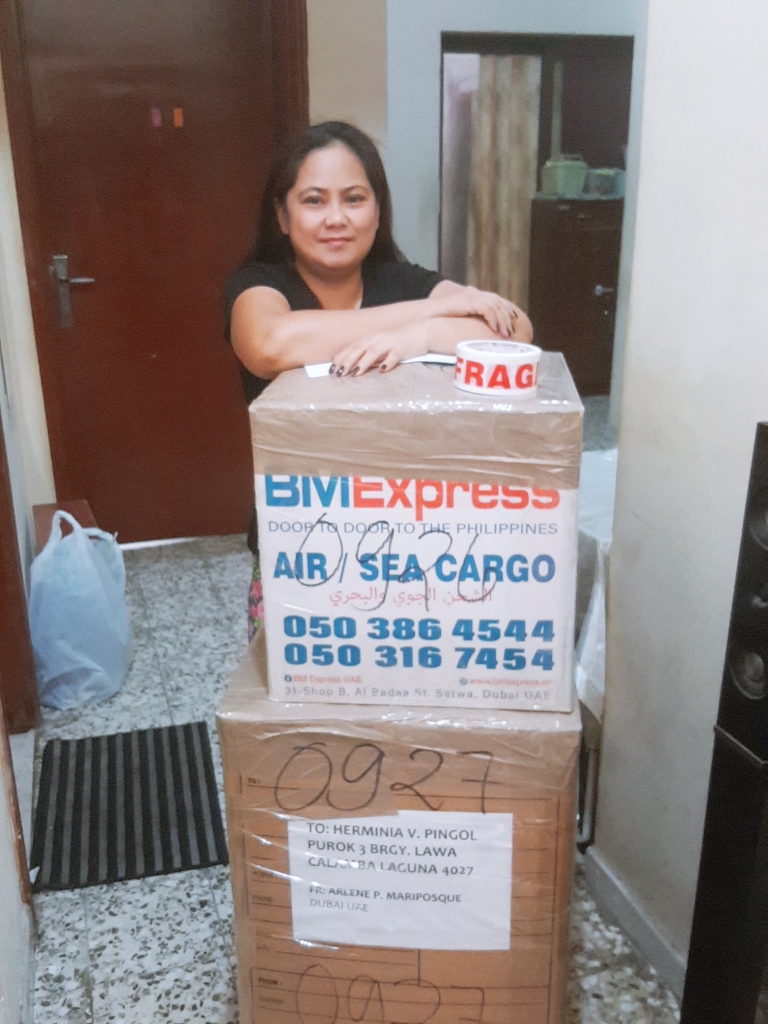
Like most OFWs here, Arlene P. Mariposque managed to send balikbayan boxes home for Christmas despite having been temporarily out of work during the Covid quarantine days back in March and April.

Mariposque works as photographer at a company providing desert safaris to tourists, the operations of which were halted by the flight suspensions.

Arlene P. Mariposque

“Nakapagpadala ako nitong October at last Aug para naman sa munting pamasko ko sa pamilya ko,” Mariposque said. “Nakakalungkot na seven years na akong di nakaka-uwi to celebrate Christmas,” she added.

Mariposque, who hails from Laguna, said she was planning to be in the Philippines for Christmas this year but had to forego it. “Due to the pandemic, ang daming requirements going back home at pabalik dito sa Dubai kaya hindi ko na lang itinuloy,” she said, referring to Covid tests and clearances from Philippine and UAE authorities.

Workload

Meantime, aside from Covid issues, Paula Vianca Lim, an accountant from Rodriguez, Rizal, for her part said she could not be with her 65-year-old mother in the Philippines.

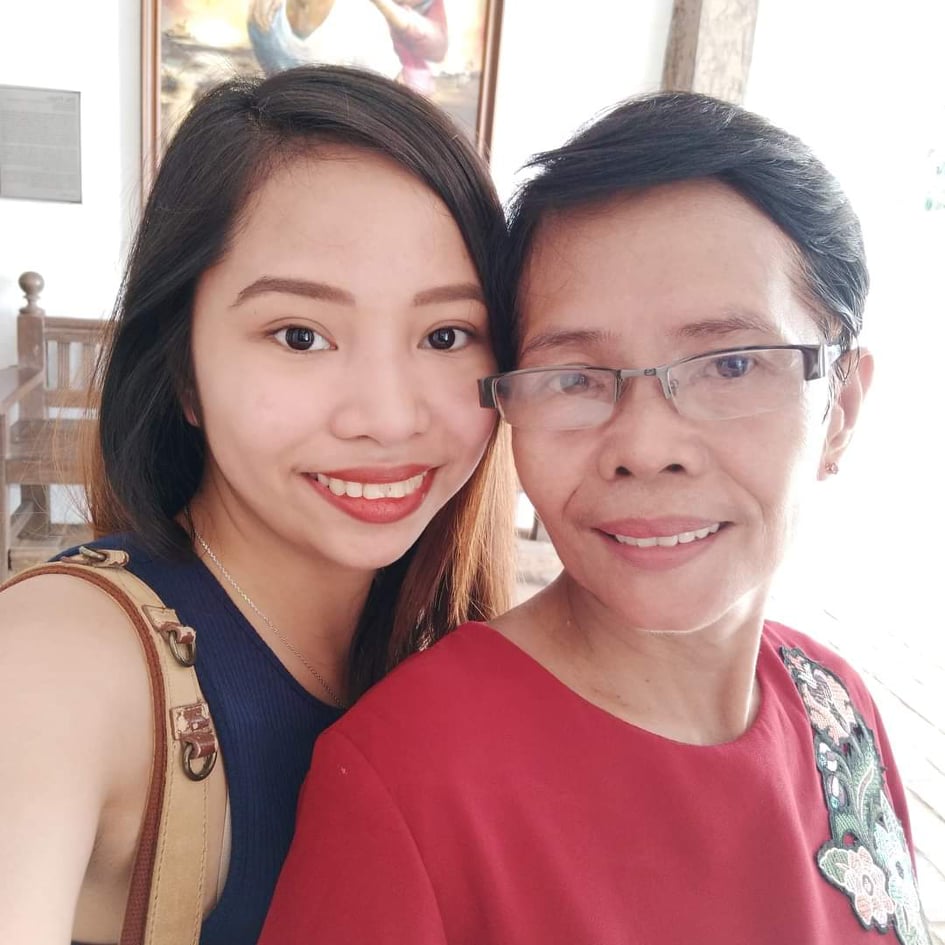
Paula Vianca Lim and her mom, Julie

“Hindi rin pwedeng umuwi dahil maraming trabaho regarding yearend reports,” she said. “Nakakalungkot na hindi makaka-uwi para mag-Pasko sa Pilipinas. Three years na akong hindi nakakasama nanay ko tapos mag-isa pa sya duon,” Lim added.

Saipan

Sports writer Roselyn B. Monroyo of Caruhatan, Valenzuela City has not been home for Christmas for the past 16 years since 2004 when she left for Saipan in the Commonwealth of the Northern Mariana Islands(CNMI), a US territory, to work.

Roselyn B. Monroyo

“Christmas has never been the same since I left home. Missing my parents big time. May dad passed away in 2009 and my mom just this year,” Monroyo said.

Aside from the Covid issue, Monroyo said there were other factors, too, that compelled her not to leave the island for the holidays.

“Una finances; second scheduling, and lately visa/travel document issues. Here on Saipan, contract renewal is every year and mine usually expires either by September or October, and often I receive my renewal by January, so it’s too risky to go on vacation in December without an approved contract/work permit because you may end up waiting for it in the Philippines for months,” she explained.

“I have always been sending something to them for Christmas, either money or in-kind gifts. Am also using social media to stay connected. But no matter how much money or how many gifts or how long you spend time with them online, doing all these will not be enough to make up for the lost time and memories,” Monroyo added.

Main picture courtesy of citiglobal.com.ph

Dubai OFW comedienne brings house down in solo gig

Part of the sold-out show’s proceeds to help distressed OFWs

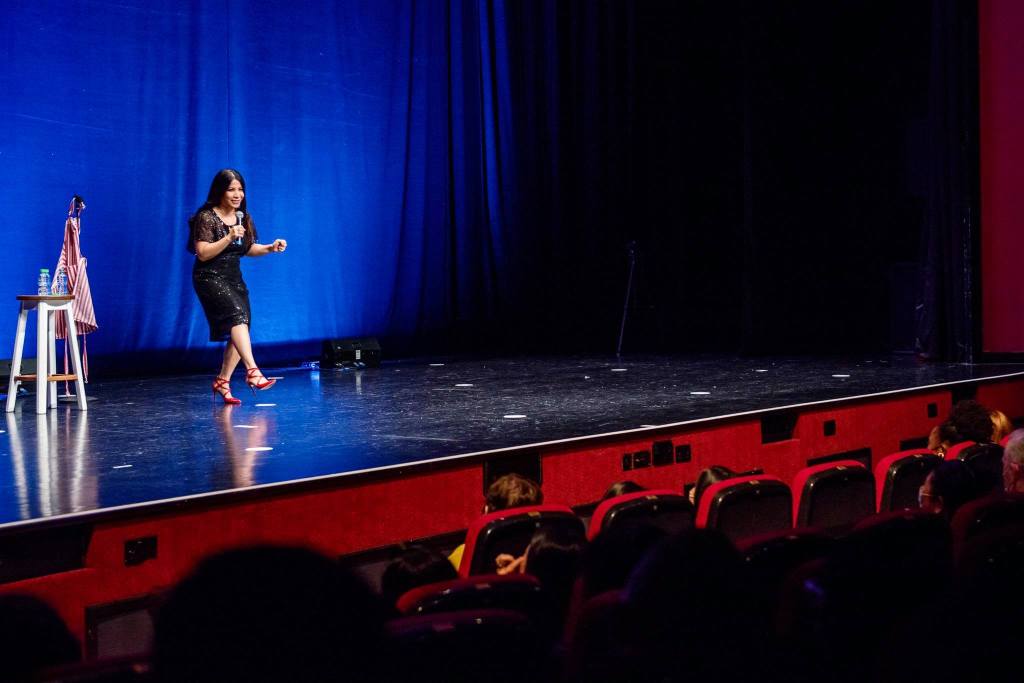
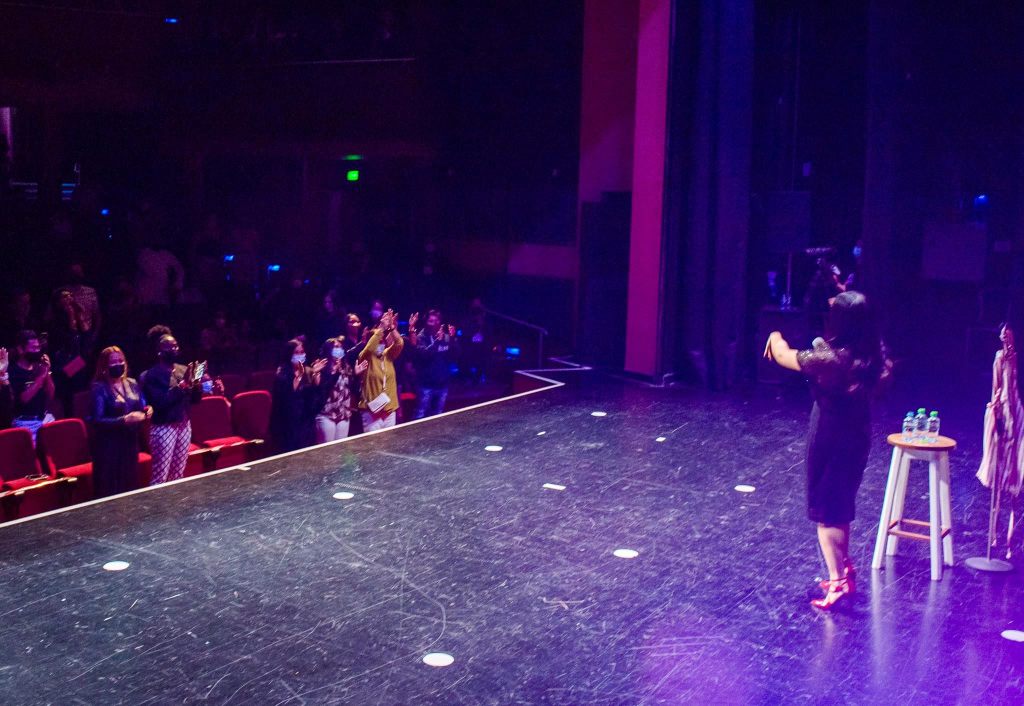
DUBAI: Hilarious Imah Dumagay, the overseas Filipino worker (OFW) from Mindanao who found love in stand-up comedy, recently brought the house down in an hour-long, major solo gig for a cause at the Mall of the Emirates’ The Theatre.

Hilarious Imah Dumagay getting a standing ovation.

The crowd could not get enough and wanted some more, which is why a second, and bigger show, is being put together in what promises to yet again be an evening of laughter, with part of the proceeds to also be shared to OFWs recovering from the economic impact of the coronavirus pandemic in the city.

“I was, at first, really nervous,” Dumagay told Rappler.

“Then, soon as I heard everyone excitedly cheering for me before I came on stage, I was overwhelmed ng love and support.

“Nawala yung kaba! Sabi ko sa sarili ko, ‘You (audience) all deserve my best tonight! To hell with the nerves! Haha! I felt so loved, at sa excitement ko, di ko na feel yung one hour,” Dumagay added.

The show, held on Friday, November 27, had a mixed audience of 300 expats. The Theatre, a high-end venue that has hosted performances in the likes of “The Nutcracker,”  has a 500-seat capacity. But management had to reduce this to 300 as part of social distancing protocol due to Covid.

“Around 60% po were Filipinos; 20% South Asians; the rest po ay mix ng Arabs and Caucasians,” Dumagay said.

The comedienne said she was “very, very happy” with the show’s turnout.

“Lalo na considering that I could be paving the way for more Filipinos who are interested sa stand-up. I maybe the first to do this, but I’m certainly sure I am not the funniest Filipino na andito sa UAE. So, I look forward to many more shows — like having a comedy special with Filipino stand-ups headlining it. That’s the dream,” said Dumagay, whose day job is being executive secretary to a Dubai CFO.

How prepared was she?  “Yung one-hour set was mostly written and rehearsed, lalo na yung order nung jokes para po smooth ang flow at may sense ang jokes. But yung crowd-work po, when talking to the audience, yun po, usually spontaneous,” Dumagay said.

She said part of the show’s proceeds will be donated to fellow OFWs who have lost their jobs and starting over due to the pandemic.

“Part of the proceeds will go to a selected OFW family here in Dubai to help them recover,” Dumagay said.

Dumagay said organizers are putting together another show tentatively set for February next year.

“Gusto nila February. Same show kasi ang dami pang di nakapanuod. Pero wait ko pa kung saang venue daw,” she said.
Meet Dubai’s ‘Pinoy Aquaman’ – 2.5 hour non-stop, 10-km daily swim in 30 days

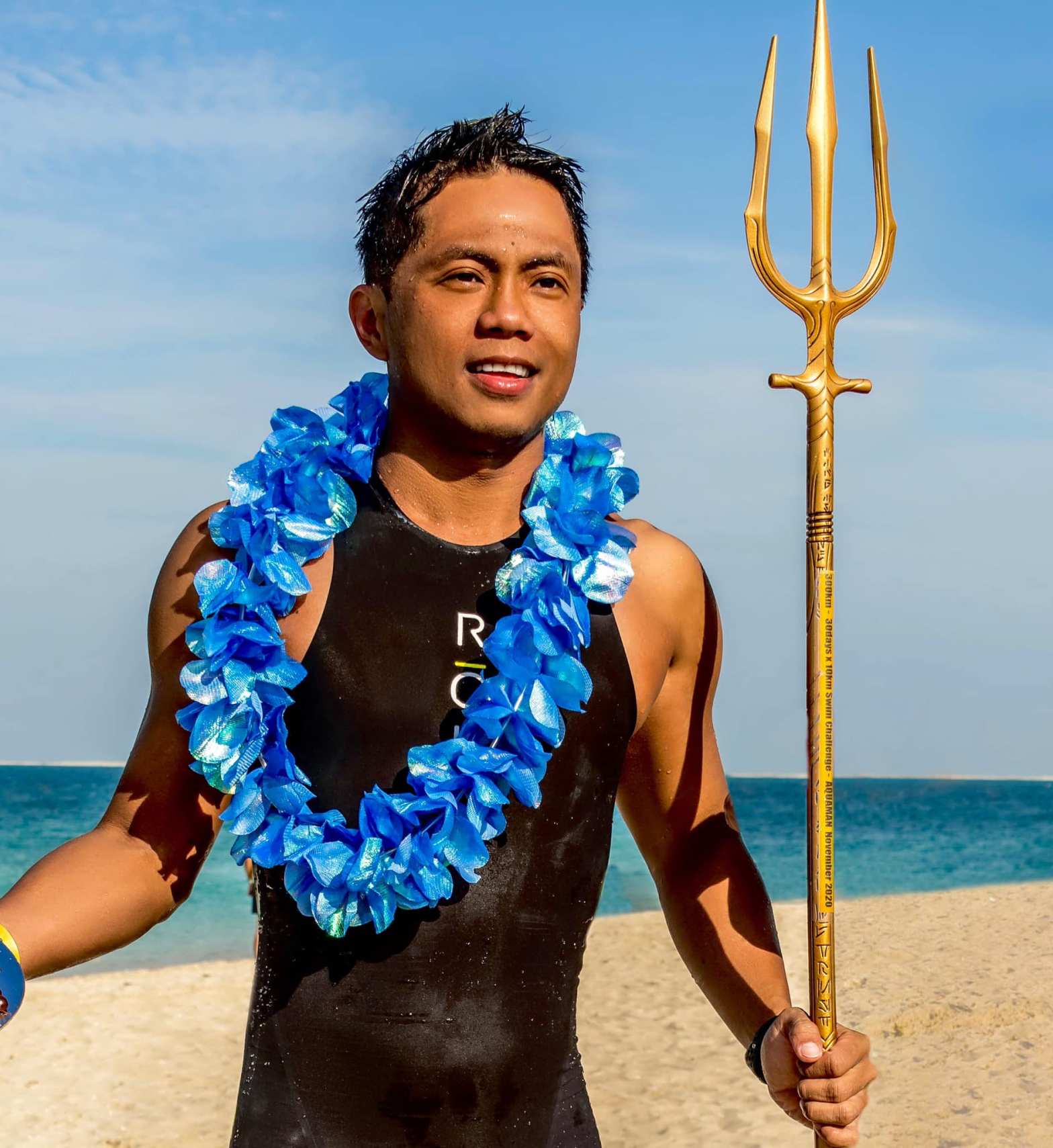
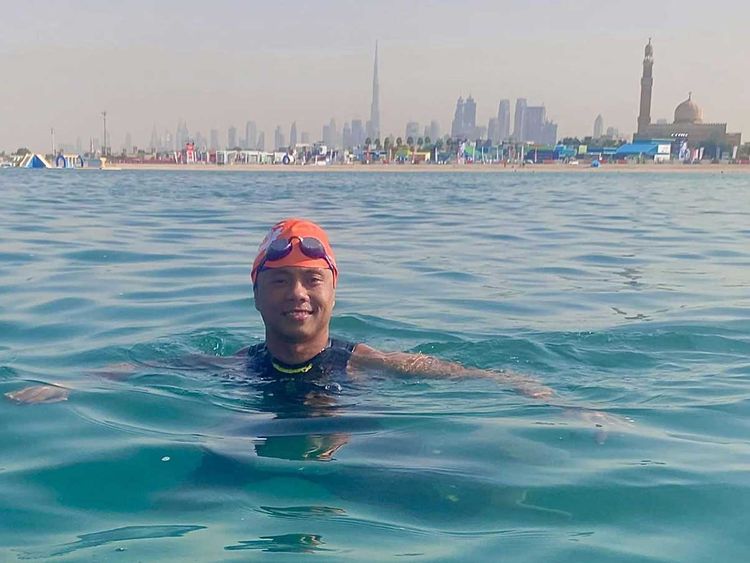
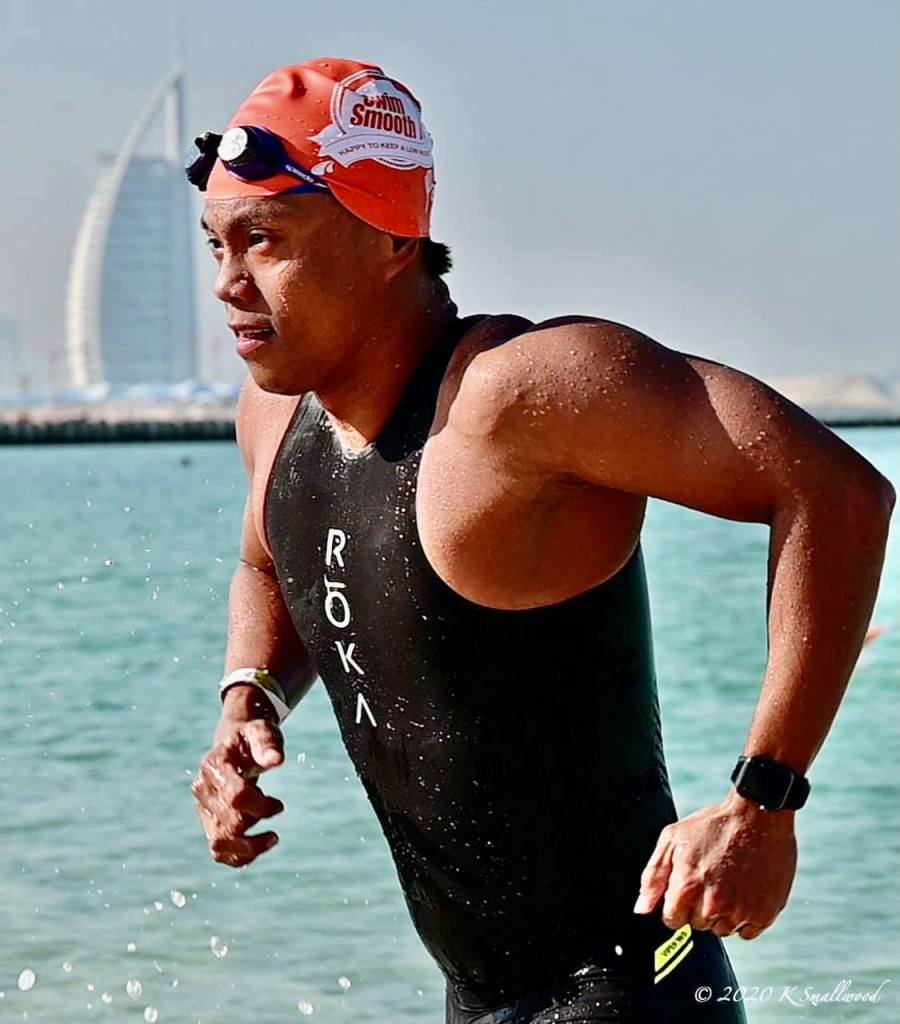
DUBAI: A Filipino swimming instructor here has caught the city in awe, taking to the open sea on a daily 2.5-hour, non-stop, 10-kilometer swim during Dubai’s just-concluded, annual 30-day Dubai Fitness Challenge.

His Highness, Sheikh Hamdan Bin Mohammed Bin Rashid Al Maktoum, Crown Prince of Dubai and Chairman of Dubai Executive Council (WAM)

This feat has earned him commendations from His Highness, Sheikh Hamdan Bin Mohammed Bin Rashid Al Maktoum, Crown Prince of Dubai and Chairman of Dubai Executive Council for his prowess and the eponymous tag, “Pinoy Aquaman.”

In his Facebook message, the Crown Prince thanked everyone who took part in DFC, an initiative that, he said, “works to transform Dubai into one of the world’s most active and dynamic cities.”

“It motivated us all to set tougher personal goals and actually achieve them. Well done to the two stars of the Challenge,” Sheikh Hamdan said, referring to 34-year-old Paolo Mangilinan and Ghani Souleyman, a Togolese national, who ran an ultramarathon (45km) per day for 30 days.

Paolo Mangilinan

“It’s tough,” he told GMA News Online. “Every single day takes me almost 2 and half hours.”

“I just want a real challenge. Dapat scary ang challenge,” Mangilinan, who has been competing in the Philippines since he was eight years old, said when asked why he decided to do the daily, 30-km swim.

He was the only entry in the DFC event to have done it. Others did a 30-minute swim as the 30X30 Challenge – 30 minutes in 30 days) – called for.

A triathlete, Mangilinan said water is his first love, which was why he went for swimming than basketball or other sports. He has also competed in the annual 70.3 Ironman Championship in South Africa.

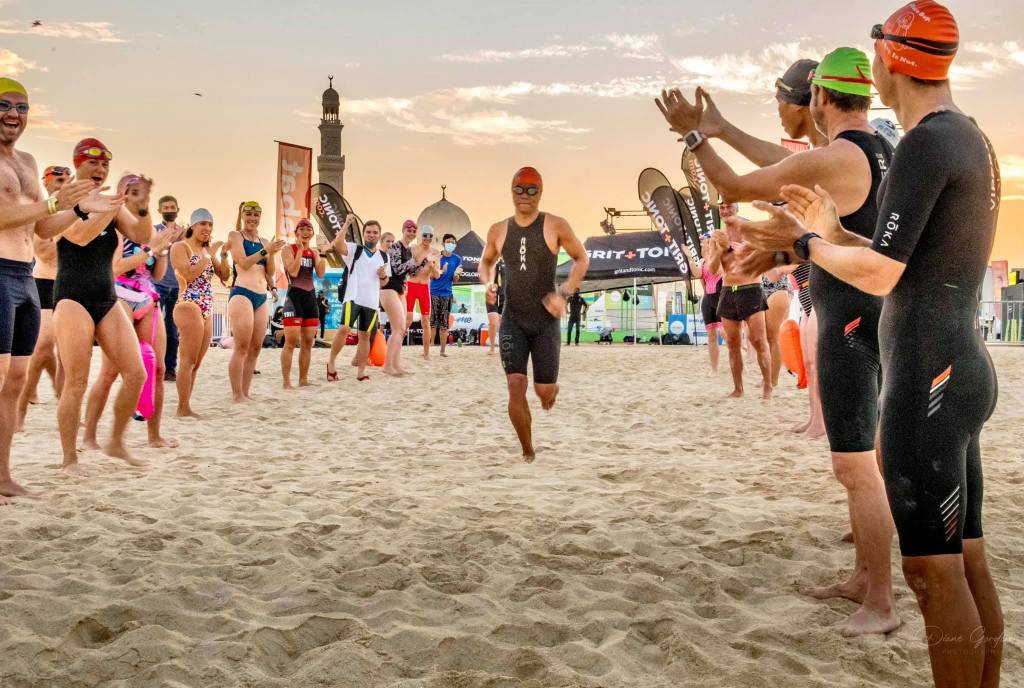
In his Facebook account, Mangilinan shared how he felt doing the last strokes on Day 30 as he neared the shore: “The crowd was just unbelievably amazing! Incredible feeling. A dream come true proving to myself that I can do it and anything is possible. This would not happen without your help guys.

“The amount of support I was getting every single day was just fantastic! My last few meters swim today was full of emotion. I shed tears… never thought I would be able to finish 30 days but I just kept believing – dream big, keep working hard; you will have lots of failure and downs but never stop believing.”

Mangilinan who has a Master’s Degree in Sports and been working in Dubai as swimming coach for the past 10 years, swam at Kite Beach, Black Palace Beach, The World Island’during DFC.

The Crown Prince launched the event in 2017. It encourages residents to commit to 30 minutes of sports activity for 30 days.

This year’s DFC featured three dedicated “Fitness Villages,” 10 community-centric Fitness Hubs, more than 200 virtual sessions and over 2,000 classes taking place across 150 locations throughout the month. The action-packed calendar also featured flagship programs, including the biggest citywide fun run with Dubai Run and a non-competitive, free-to-enter, bike ride community event along two distinct routes – with the longer route including the city’s main artery, passing a number of the city’s iconic buildings.

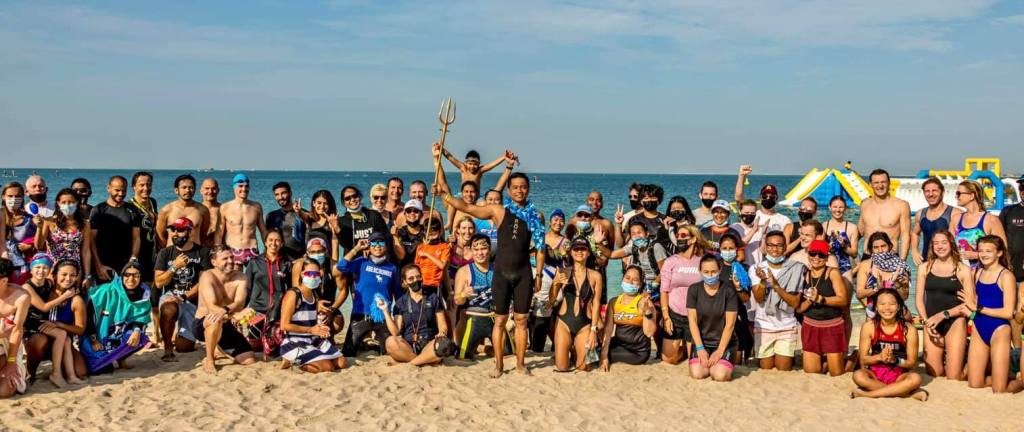
Main photo by Diane Gordon and grabbed from Paolo Mangilinan’s Facebook with consent along with other photos.

Design a site like this with WordPress.com
Get started